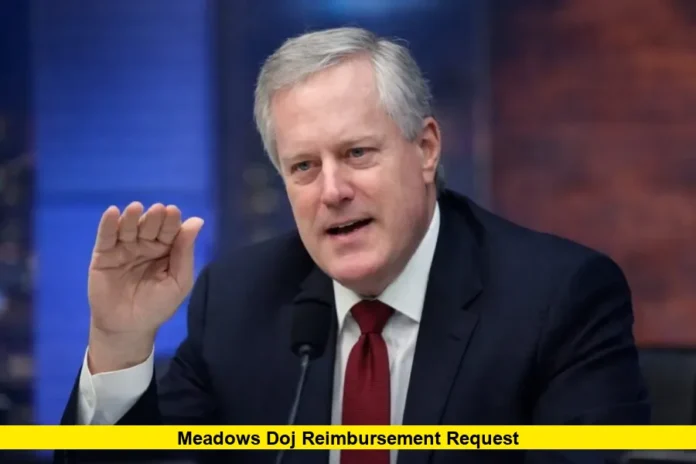

Former White House Chief of Staff Mark Meadows has formally asked the Justice Department to reimburse him for legal fees he racked up across multiple federal and state investigations tied to President Donald Trump — and the meadows doj reimbursement request has reignited one of Washington’s most uncomfortable debates: when does defending a senior official become a bill that ordinary Americans have to pay?
The request, submitted by Meadows’ attorney George Terwilliger III earlier in 2026, has not revealed a specific dollar amount. But the scale of the legal exposure Meadows accumulated over the past several years gives important context to just how large that figure could be.
Stay ahead of the most important political and legal stories shaping Washington — bookmark this page and check back regularly for updates.
How Meadows Ended Up With Millions in Legal Bills
Meadows was a key supporter of Trump’s efforts to overturn the 2020 election. He was never charged in connection with special counsel Jack Smith’s federal indictment against Trump over the 2020 election interference case, but he was criminally charged in parallel state cases in Georgia and Arizona. Trump later pardoned Meadows, and Georgia prosecutors dropped the charges. The Arizona case, however, remains unresolved.
Throughout all of that, the legal bills kept mounting. The breakdown of Meadows’ known legal costs includes over $569,000 paid to the Griffin Durham law firm, additional fees of roughly $19,000, and nearly $1.3 million billed by McGuireWoods, with $650,000 of that already paid. After Terwilliger left his firm and continued representing Meadows, he charged a flat fee of $20,000 a month in 2024 and $12,000 a month in 2025. Meadows also paid a flat fee of $200,000 to Paul Clement, a prominent former DOJ appellate lawyer who represented him when Meadows tried to move his Georgia state case into federal court. CBS News
Those numbers add up fast — and they form the financial backdrop of a reimbursement push that is now drawing both legal scrutiny and fierce political debate.
What Federal Law Actually Allows
The request is not without legal grounding. Federal regulations give the Justice Department authority in certain cases to provide counsel to current or former government officials, or to reimburse them for the costs of retaining private representation if they are involved in criminal, civil, or congressional proceedings in connection with actions they took in the course of their official duties. The department also has an internal administrative directive that lays out the rates at which it reimburses, which are generally much lower than market rate.
The two key tests are whether the conduct at issue reasonably appears to have occurred within the scope of the employee’s federal job, and whether paying for that defense would serve the public interest. Freedom For All Americans
Meadows’ legal team is expected to argue that his actions during the post-2020 election period fell within his official duties as White House Chief of Staff. There is also precedent for reimbursement in politically explosive investigations. In a 2020 opinion, the Justice Department’s Office of Legal Counsel concluded that current and former federal employees interviewed as witnesses in Special Counsel Robert Mueller’s Russia investigation could, on a case-by-case basis, be reimbursed for attorney’s fees when their testimony related to information obtained through government service.
That precedent matters. Critics will argue that Meadows was not merely a witness — he was a charged defendant in two state cases. Supporters will counter that his role as chief of staff directly drove his legal exposure and that the law should protect him accordingly.
The Bigger Pattern: DOJ Fielding a Wave of Claims
The Meadows request does not exist in a vacuum. The request comes at the same time the Justice Department is also fielding a variety of different requests for payouts from Trump himself, as well as claims from a number of pardoned January 6 rioters seeking damages for injuries they allege they suffered at the hands of Capitol Police. Trump and his two sons sued the IRS earlier this year seeking $10 billion in connection with the leak of his tax returns, and his lawyers have separately sought $230 million from the Justice Department in two administrative claims. CBS News
It was nearly a year ago when Trump’s DOJ reached a settlement with the family of Ashli Babbitt, the January 6 rioter who was fatally shot by a police officer during the attack on the U.S. Capitol. A few weeks ago, Trump’s DOJ also agreed to reward former White House national security adviser Michael Flynn with a $1.25 million check in response to a civil suit. MS NOW
Together, these developments paint a picture of a Justice Department that is actively processing a broad wave of financial claims tied to allies of the current administration — a pattern that is drawing scrutiny from legal observers, watchdog groups, and members of Congress alike.
Who Has Been Helping Pay Meadows’ Bills
One of the more overlooked angles of this story involves how Meadows funded his defense in the first place. Court filings did not detail how Meadows funded his defense, though prior reporting shows that at least some of his bills may have been paid by Personnel Policy Operations, a nonprofit created by Meadows’ employer, the Conservative Partnership Institute. In 2024, a progressive group called Accountable.U.S. asked the D.C. Attorney General’s office to investigate whether the arrangement to pay some of his bills violates IRS rules for non-profit organizations.
That investigation remains unresolved, adding yet another layer of complexity to a story that already touches on federal reimbursement law, nonprofit tax rules, and the boundaries of official conduct.
The Georgia Battle: $17 Million and Growing
While the federal reimbursement request moves through the Justice Department largely out of public view, the Georgia front is playing out in open court — and the numbers are staggering. Meadows is one of a number of defendants in the Georgia case seeking reimbursement for legal fees totaling more than $17 million, according to court filings. The outcome of those requests remains unclear, since the fee reimbursement law did not go into effect until May 2025, and the case was indicted in 2023. Lawyers for the county have argued the defendants’ requests violate the Georgia constitution because they are seeking payment retroactively. The Georgia Court of Appeals is currently weighing whether to accept the case.
The retroactivity question is central. Georgia passed a law allowing reimbursement for officials charged in connection with their duties, but the timing of when that law took effect versus when the indictment was handed down creates a legal conflict that state courts have yet to resolve.
The Transparency Problem
One aspect of this story that rarely gets the attention it deserves is the secrecy surrounding federal reimbursement decisions. The Justice Department’s determination on the matter is not likely to be made public. Unlike internal Justice Department tort settlements which can be obtained through public records requests, decisions on whether to provide counsel or reimburse attorney fees are treated as privileged — even though the cost is borne by taxpayers. CBS News
That means the American public may never know the full outcome of Meadows’ request, how much he receives, or the legal reasoning the department used to justify its decision. For a matter that directly involves public funds, that lack of transparency is raising serious questions about accountability.
What Meadows’ Lawyer Says
Meadows’ attorney Terwilliger said the reimbursement request is hardly unusual, adding that the protections exist to cover those who get entangled in legal disputes simply as a result of their government service. The argument, at its core, is that no senior official should be personally bankrupted for doing their job — even when that job involves decisions that later become the subject of criminal investigations.
Historically, most requests are not honored if the employee does not seek reimbursement from the outset, but the department has discretion to make exceptions. Meadows first made the request to the Biden administration under federal law that offers protections for former government employees, but that administration took no action on it. MS NOW Now, with Trump back in office and a more sympathetic department in place, the dynamics have shifted considerably.
What Comes Next
Whether the DOJ sees Meadows’ legal bills as a public obligation or a private burden will decide the case.The department has wide discretion here, and its decision — whenever and however it comes — will set a significant precedent for how future administrations handle the legal costs of senior officials caught in politically charged investigations.
In Georgia, the Court of Appeals will need to rule on the retroactivity issue before any state reimbursement can move forward. In Arizona, the criminal case against Meadows is still active, adding continued uncertainty to his overall legal situation.
The broader question hovering over all of this is whether the Justice Department under the current administration will treat this as a straightforward application of federal regulations — or as part of a larger political project to compensate allies who faced legal scrutiny during and after Trump’s first term.
The Role of Congressional Oversight
Beyond the courts and the Justice Department, Congress has its own role to play. Several lawmakers have already raised concerns about the pattern of DOJ settlements and reimbursements benefiting Trump allies. Oversight committees have the authority to request information, hold hearings, and demand accountability — though whether they exercise that authority vigorously depends entirely on the political will of the majority.
The Meadows situation, taken alongside the Flynn settlement, the Babbitt settlement, and the broader wave of Trump-related claims, gives Congress significant material to work with if it chooses to investigate how taxpayer money is being used to settle the legal accounts of those connected to the current and former president.
Why This Matters Beyond Meadows
The precedent being set here extends well beyond one former chief of staff. If the Justice Department establishes that senior officials who were investigated — and in some cases charged — in connection with efforts to challenge election results can receive taxpayer-funded reimbursement for their legal fees, it reshapes the legal and financial risk calculus for future officials. It may also affect how aggressively prosecutors pursue investigations of senior government employees in future administrations, knowing that the financial consequences of those investigations could ultimately fall on the public rather than the individuals involved.
For now, the legal machinery grinds forward. Courts in Georgia are deliberating. The DOJ is reviewing its federal request. And somewhere in the background, a figure that could easily run into the millions of dollars hangs over a question that cuts to the heart of democratic accountability: who bears the cost when power is abused, or when the line between official duty and personal ambition becomes impossible to draw?
If you have thoughts on whether taxpayers should foot the bill for the legal battles of former White House officials, drop them in the comments below — and keep watching this story as it develops in the courts and inside the Justice Department.