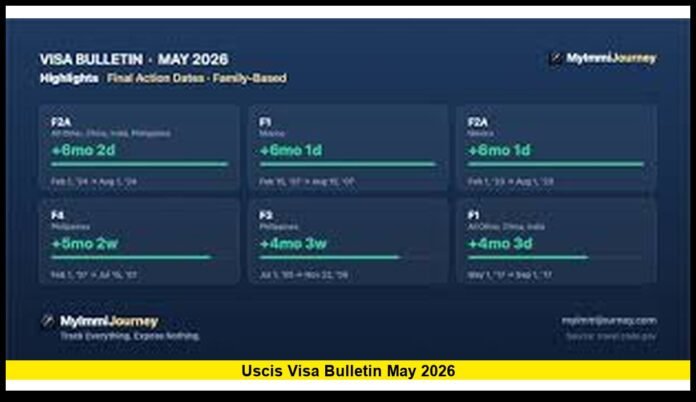

The USCIS visa bulletin May 2026 brings important updates on priority dates, green card availability, and processing timelines for family-based and employment-based applicants across the United States.
As of April 2026, the U.S. Department of State has released the May 2026 Visa Bulletin, and U.S. Citizenship and Immigration Services (USCIS) has confirmed which charts applicants must use for adjustment of status filings. These updates directly affect thousands of applicants waiting for green cards, especially those from high-demand countries.
What Is the Visa Bulletin and Why It Matters
The Visa Bulletin is a monthly publication that determines when immigrant visa applicants can move forward in the green card process.
It includes two critical charts:
- Final Action Dates (Chart A): When green cards can actually be issued
- Dates for Filing (Chart B): When applicants can submit documents early
USCIS decides each month which chart applicants inside the U.S. must follow.
For May 2026, USCIS has continued its pattern of using a mix of both charts depending on the visa category.
USCIS Filing Chart for May 2026
For adjustment of status applicants in May 2026:
- Family-sponsored categories: USCIS is using the Dates for Filing chart
- Employment-based categories: USCIS is using the Final Action Dates chart
This decision impacts how early applicants can submit Form I-485 and begin the final stage of the green card process.
Family-Based Visa Bulletin May 2026 Updates
Family-sponsored categories saw gradual forward movement in May 2026, especially in certain preference categories.
Key trends:
- F1 (Unmarried adult children of U.S. citizens): Slight advancement across most countries
- F2A (Spouses and children of permanent residents): Remains relatively stable with some forward movement
- F2B (Unmarried adult children of permanent residents): Slow progress continues
- F3 and F4 categories: Minor movement, still facing long backlogs
High-demand countries:
Applicants from India, Mexico, and the Philippines continue to experience longer wait times compared to the rest of the world.
Employment-Based Visa Bulletin May 2026 Updates
Employment-based categories remain a major focus due to high demand and visa retrogression trends.
Key movements:
- EB-1: Generally current for most countries, with some limitations for India and China
- EB-2: Continued backlog for India and China; slight forward movement for others
- EB-3: Moderate advancement in some regions; steady demand persists
- EB-4 (Special Immigrants): Limited movement; visa availability remains tight
- EB-5 (Investor Visas): Reserved categories remain current; unreserved categories show slower progress
Important note:
India and China continue to face the longest delays in employment-based categories due to high application volumes.
Understanding Retrogression in May 2026
Retrogression occurs when demand exceeds available visas, forcing priority dates to move backward.
In May 2026:
- Some employment-based categories show stagnation rather than retrogression
- Demand remains high, especially in EB-2 and EB-3 for India
- USCIS continues to monitor usage closely to avoid exceeding annual visa caps
This means applicants should act quickly when their priority date becomes current.
Priority Dates: What Applicants Should Watch
Your priority date is the most important factor in determining your place in line.
Here’s what to track:
- If your date is earlier than the listed date, your case is current
- If using the filing chart, you may submit documents earlier
- If using the final action chart, you may receive a green card
Tips for applicants:
- Check the bulletin every month
- Monitor category-specific movement
- Prepare documents in advance to avoid delays
Impact on Green Card Processing in 2026
The May 2026 Visa Bulletin reflects broader immigration trends in the U.S.:
- High demand continues to shape processing timelines
- Backlogs remain significant in family and employment categories
- USCIS is processing cases steadily but remains constrained by annual limits
Applicants filing in May 2026 may benefit from:
- Earlier filing opportunities (family-based)
- More predictable processing timelines (employment-based)
Who Benefits Most from May 2026 Updates
The following groups see the most benefit:
- Family-based applicants eligible under the Dates for Filing chart
- Employment-based applicants in EB-1 and EB-3 (rest of world)
- EB-5 applicants under reserved visa categories
Those facing longer waits include:
- EB-2 and EB-3 applicants from India
- Family-based applicants in F3 and F4 categories
What Applicants Should Do Next
If you are affected by the May 2026 Visa Bulletin:
- Confirm which chart USCIS is using
- Compare your priority date carefully
- File Form I-485 immediately if eligible
- Keep documents updated and ready
Delays often happen due to incomplete applications, so preparation matters.
Looking Ahead: Visa Bulletin Trends for 2026
Based on current movement:
- Gradual forward movement is expected in most categories
- High-demand countries will likely continue facing backlogs
- Employment-based categories may see limited advancement due to visa caps
While major jumps are unlikely, steady progress continues across most visa types.
Final Thoughts on USCIS Visa Bulletin May 2026
The May 2026 Visa Bulletin highlights steady but cautious progress in U.S. immigration processing. Applicants must stay informed and act quickly when opportunities arise.
Stay updated, track your priority date closely, and share your experience or questions in the comments to help others navigating the same process.