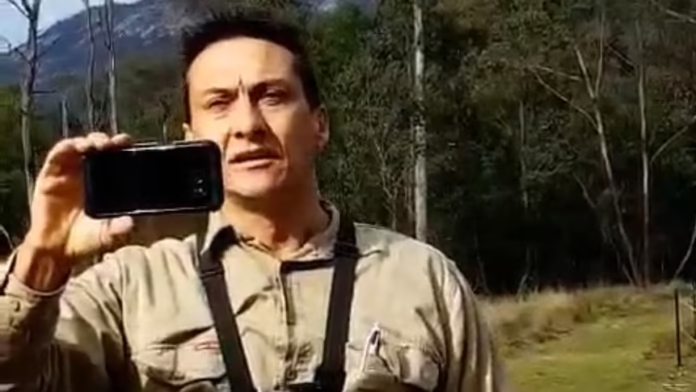

The name Dezi Freeman has been sending shockwaves across Australia and trending on social media feeds around the world — and the full story behind the name is one that most people are only just beginning to understand.
For seven long months, Freeman managed to evade one of the largest and most expensive manhunts in Australian history, hiding somewhere in rugged, mountainous bushland while hundreds of officers searched day and night. Now that the story has reached its dramatic conclusion, people everywhere are asking the same question — who exactly was this man, and how did it all come to this?
This story has continued to develop in ways nobody expected, and every new detail is more jaw-dropping than the last. Keep reading, because this one is far from ordinary.
What Started the Conversation
It began on a quiet August morning in 2025 at a rural property near the small Victorian town of Porepunkah, Australia. Police arrived to execute a warrant — a routine operation, by all appearances. What followed was anything but routine. Two police officers were shot and killed at the scene, a third was injured, and the man at the center of it all disappeared into the wilderness without a trace.
The names of the two fallen officers — one just days away from retirement after nearly three decades of service, the other a young officer on temporary assignment far from home — became symbols of grief for an entire nation. And the man who fled into the mountains became the subject of the biggest manhunt Australia had seen in living memory.
The Man Behind the Name
Who is Dezi Freeman? The answer is more complicated than most people expect. Born under a different name entirely, Freeman had, over many years, adopted a new identity tied to a worldview that rejected government authority, legal institutions, and law enforcement altogether.
He aligned himself with the sovereign citizen movement — a loosely connected belief system that holds that individuals can legally opt out of government jurisdiction. Followers often refuse to recognize courts, licenses, taxes, and police powers as legitimate. Freeman took those beliefs further than most, posting openly anti-government and anti-police content online in the years leading up to the incident.
By the time officers arrived at that Porepunkah property, Freeman had already made his position on law enforcement abundantly clear.
What Social Media Users Were Saying
The reaction online was immediate and deeply divided. For most Australians and international observers, the story was one of grief — two families shattered, a community traumatized, and a nation left asking how something like this could happen.
But in the darker corners of the internet, a very different conversation was unfolding. Fringe communities sympathetic to the sovereign citizen ideology framed Freeman as a figure of resistance. Some drew comparisons to Ned Kelly, Australia’s legendary outlaw. Memes spread. Conspiracy theories multiplied. A small but vocal online audience began treating the fugitive as a cause.
Mainstream users hit back hard, flooding comment sections with tributes to the fallen officers and calling out what they saw as dangerous glorification of a man accused of murder.
The Scale of the Hunt
Few people outside Australia initially grasped how enormous this search became. Hundreds of officers from multiple agencies were deployed into terrain that even experienced hikers would find punishing — steep mountain ridges, dense forest, caves, abandoned mineshafts, and conditions that swung from snowfall to scorching heat without warning.
The town of Porepunkah was placed into lockdown. Residents received emergency alerts telling them to stay indoors with windows and doors locked. A million-dollar reward — the largest ever offered in the state of Victoria — was announced for information leading to Freeman’s capture.
Weeks became months. The searches continued. No confirmed sighting came.
When Everyone Thought the Story Was Over
By early 2026, the official tone had shifted in a direction nobody expected. Investigators publicly stated they no longer believed Freeman was alive. Cadaver dogs were brought in. Specialized search teams combed the national park. Still, nothing was found.
Social media erupted all over again. Was it over? Had he somehow survived and escaped? The uncertainty itself became a viral phenomenon, with people debating the outcome daily across platforms.
Then came the answer nobody could fully predict.
How It Finally Ended
In late March 2026, nearly seven months after the initial shooting, Freeman was located at a rural property in northeast Victoria. In a confrontation with police at the scene, he was shot and killed. No officers were injured. The longest manhunt in recent Australian history was over.
The reaction ranged from relief to raw emotion. For the families of the two officers killed in August 2025, it represented a painful but necessary chapter of closure. For the Porepunkah community — which had lived under an extraordinary cloud of fear and tension for the better part of a year — it was the moment they had been waiting for.
What Happens Next
The manhunt is finished, but the questions it leaves behind are far from answered. Conversations about the sovereign citizen movement, rural radicalization, and the safety of law enforcement officers are now louder than ever in Australia. Investigations into the final confrontation will follow their course. And two families will continue to navigate a grief that no outcome can undo.
Freeman’s story is now part of Australian history — a case study in extremism, defiance, and the long arm of consequence.
Share your reaction in the comments and stay with us as this story continues to unfold.