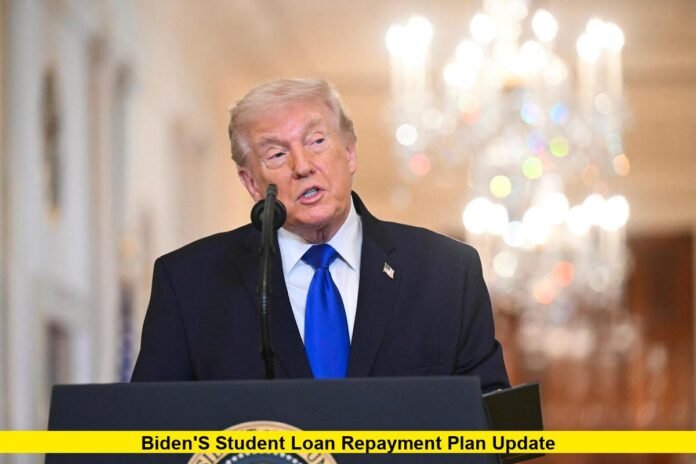

For two years, millions of Americans woke up each month without a student loan bill sitting in their inbox. No payment due. No collections call. No financial anxiety tied to a debt that, for many, had followed them since their early twenties. It felt — at least temporarily — like breathing room in an economy that rarely offers any.
That breathing room is officially over.
Biden’s student loan repayment plan — the Saving on a Valuable Education program, better known as SAVE — has been struck down by the federal courts, and the ripple effects are being felt by millions of borrowers nationwide. A ninety-day countdown has begun. Decisions must be made. And for many Americans, the consequences of getting this wrong could follow them for years.
This story is not just trending — it is erupting across social media, kitchen table conversations, and financial planning offices from coast to coast. Whether you owe ten thousand dollars or two hundred thousand, here is everything you need to understand about what just happened and what comes next.
What Sparked the Conversation
To understand why so many people are angry, anxious, and confused right now, you have to go back to where this all started.
When the Biden administration launched the SAVE plan, it was positioned as a revolution in student loan policy. Officials called it the most affordable income-driven repayment option ever created by the federal government. The pitch was simple and powerful — your monthly payment would be tied directly to what you earn, not what you owe. For borrowers with low incomes, that payment could be as little as zero dollars per month. For others, it would be a fraction of what traditional repayment plans required.
On top of that, the program promised accelerated pathways to loan forgiveness. Borrowers with smaller original loan balances could see their remaining debt wiped out in as little as ten years. Those with larger balances had a twenty or twenty-five year timeline, but even that was considered a meaningful improvement over the existing system.
Enrollment exploded. Millions of Americans signed up, restructured their financial lives around the new lower payments, and for the first time in years, felt like there was a realistic end in sight for their debt.
Then the lawsuits started.
A coalition of Republican-led states, arguing the Biden administration had dramatically overstepped its legal authority, took the SAVE plan to court. Their argument was direct — Congress never gave the executive branch the power to create a program this sweeping, this expensive, and this transformative without explicit legislative approval. Federal judges agreed. The plan was frozen. Borrowers were placed into administrative forbearance, meaning payments were paused while the legal battles continued to play out.
And so began the limbo.
The Moment Borrowers Noticed Something Different
At first, the forbearance felt like a gift. No payments due while the courts sorted things out. Many borrowers assumed the legal challenges would eventually fade, the program would survive in some form, and life would return to the version they had planned around.
Instead, things quietly got worse.
Interest began accumulating on SAVE loans even during the forbearance period. The months sitting in legal limbo were not counting toward loan forgiveness timelines. Borrowers who had been working toward Public Service Loan Forgiveness — teachers, nurses, social workers, government employees — watched helplessly as qualifying payment months stopped accumulating, even though they were doing everything right.
Then the emails arrived.
Department of Education notices began landing in inboxes across the country with a message that was impossible to misread — the SAVE plan was officially dead, a replacement court ruling had made the program’s end permanent, and borrowers now had ninety days to choose a new repayment path. Those who failed to act would be automatically moved to a standard repayment plan — one with fixed monthly payments that take no account of income whatsoever and that could, for many borrowers, represent a dramatic and sudden increase in what they owe each month.
For millions of people who had organized their entire financial lives around SAVE’s terms, this was not just a policy update. It was a financial emergency delivered by email.
Are you one of the millions of borrowers now scrambling to figure out your next move? Stay with us — what you learn in the next few minutes could save you from a costly mistake.
What the Government Is Now Saying
The current administration has not softened its messaging. Officials have described Biden’s student loan repayment plan in blunt terms — an illegal program built on a legal foundation that was never solid to begin with. The position from Washington is clear: sympathy for borrowers does not change what the courts have decided, and the era of SAVE is over.
What replaces it is still taking shape, and that uncertainty is a major part of why this story keeps trending.
The administration has announced a new program called the Repayment Assistance Plan, or RAP, which is being designed as a legal successor to income-driven repayment. But RAP is not expected to be fully operational until the summer of 2026, leaving a gap during which millions of borrowers must find a workable alternative or risk defaulting on their loans.
Existing repayment options — like Income-Based Repayment and Income-Contingent Repayment — are still available for now, but those programs are also under political and legal pressure. Congress has already signaled it wants to phase out some of these plans within the next few years, meaning borrowers who switch now may find themselves navigating yet another transition before long.
For borrowers pursuing Public Service Loan Forgiveness, there is a narrow and complicated option to buy back the months lost during SAVE forbearance — but it requires meeting strict eligibility requirements, submitting documentation on a tight timeline, and navigating a government bureaucracy that has never been known for its speed or simplicity.
The bottom line from Washington is this: figure out your plan, make your choice within ninety days, and do not expect the rules to stay the same.
The Real Financial Impact on Real People
Strip away the policy language and the legal jargon, and what you have is a human story playing out in real time across America.
Consider the borrower who graduated from a state university, took out fifty thousand dollars in federal loans, enrolled in SAVE because it was the only plan that made monthly payments manageable on an entry-level salary, and spent the last two years telling herself that things were finally under control. She is now being told that the plan she built her financial future around never should have existed and that she has ninety days to find a new one.
Or consider the middle school teacher in a low-income district who has been making qualifying payments toward Public Service Loan Forgiveness for seven years. He enrolled in SAVE because it was the recommended path. He spent twenty-three months in forbearance, watching the calendar move but his payment count stay frozen. He is now being told he can try to buy those months back — if he acts fast and if he qualifies and if the paperwork goes through correctly.
These are not edge cases. These are the stories showing up in comment sections, Reddit threads, Facebook groups, and financial counseling sessions everywhere.
The scale of the financial impact is difficult to overstate. A significant share of SAVE enrollees had been qualifying for zero-dollar monthly payments. For these borrowers, transitioning to any active repayment plan — even the most income-sensitive alternative still available — means new money leaving their household every single month. For families already stretched to the limit by inflation, housing costs, and childcare expenses, that new line item is not a minor adjustment. It is a genuine crisis.
And for borrowers who do nothing — who ignore the emails, who miss the ninety-day window, who assume someone will figure this out for them — the automatic assignment to standard repayment could be devastating. Standard repayment does not care how much you earn. It takes the total amount you owe and spreads it across ten years of fixed monthly payments. For someone carrying significant debt on a modest income, that number could be shockingly high.
Financial counselors and student loan advocates are urging borrowers to treat this ninety-day deadline like the financial emergency it is — research alternatives now, contact your loan servicer now, do not wait.
Why This Topic Is Trending and Will Keep Trending
Every few months, a new chapter of the student loan saga captures public attention. But this one feels different. It feels final in a way that previous updates did not. And that finality is what is driving the emotional intensity of the conversation online and off.
Biden’s student loan repayment plan was never just a policy for the people enrolled in it. It was a symbol. For an entire generation of Americans who graduated into the financial crisis, watched housing prices soar, saw wages stagnate, and carried debt loads their parents could barely comprehend, the SAVE plan represented something bigger than its monthly payment calculations. It represented a government acknowledging that the system had asked too much of too many people.
Watching it get dismantled — especially by courts and by a political opposition that framed the program as government overreach rather than relief — feels like a personal loss to many borrowers, even those who had begun to doubt whether SAVE would ever fully deliver.
Social media has become a pressure valve for that frustration. Stories of borrowers losing years of progress toward forgiveness are being shared thousands of times. Educators and healthcare workers who chose entire career paths partly because of Public Service Loan Forgiveness are expressing a sense of betrayal that is raw and unfiltered. First-generation college graduates who were told that education was the path to financial stability are asking, loudly and publicly, whether that promise was ever real.
The political dimensions of the story are also keeping it alive. This is not simply a legal outcome — it is a flashpoint in a larger national argument about the role of government, the cost of higher education, the enforceability of political promises, and the future of the federal student loan system itself.
Congress is also now actively debating what the long-term framework for student loan repayment should look like. With multiple income-driven plans being wound down and the new Repayment Assistance Plan still being built, there is a very real possibility that the rules will continue to change for years to come. Borrowers who feel like they cannot keep up with the shifting landscape are not wrong — the landscape really is shifting, faster than most people can track.
What is not shifting is the deadline. Ninety days. That part is real, it is fixed, and for millions of Americans, it is already counting down.
What do you think should happen next for the millions of borrowers caught in this student loan crisis? Share this story with someone who needs to know about the ninety-day deadline, leave your thoughts in the comments below, and follow along as this story continues to develop — because it is far from over.