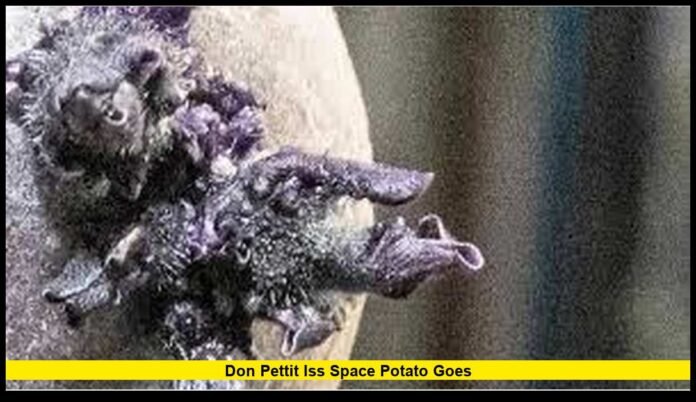

A single image from orbit has captured global attention and sparked widespread curiosity. The phrase don pettit iss space potato is now trending as people try to understand what they’re seeing and why it looks so unusual. What appears at first glance to be something strange or even extraterrestrial is, in reality, a simple plant experiment—yet its implications reach far beyond a viral moment.
The object at the center of the discussion is a potato grown aboard the International Space Station. Its unusual shape, floating roots, and unfamiliar appearance quickly fueled online reactions. But behind the buzz lies an important scientific effort focused on one of the biggest challenges in human spaceflight: how to grow food beyond Earth.
The image has sparked conversations not just among space enthusiasts but also among everyday viewers who suddenly found themselves intrigued by life in orbit.
If you’ve ever wondered how astronauts might survive on long missions—or what farming looks like in space—this story offers a fascinating look into the future.
The Moment That Captured Global Attention
When the image first appeared, it immediately stood out. Instead of the familiar round shape of a potato, the object looked irregular and almost organic in an unexpected way.
It floated freely in the microgravity environment, with thin strands extending outward in multiple directions. Many viewers described it as:
- An alien organism
- A mysterious biological form
- Something from a science fiction film
The visual alone was enough to spark widespread interest. Social media filled with reactions, jokes, and questions, turning a simple experiment into a major talking point.
Yet the explanation behind the image is grounded in science rather than mystery.
Understanding the Scientist Behind the Experiment
Don Pettit is a seasoned astronaut with a reputation for curiosity-driven experiments. Over the course of his missions, he has explored a wide range of scientific ideas, often using simple tools and creative thinking.
His work in orbit has included:
- Studying fluid behavior in weightless conditions
- Designing objects specifically for use in microgravity
- Conducting small-scale experiments during free time
- Sharing unique visuals from space with the public
The potato experiment fits into his broader approach—testing ideas that help expand understanding of how everyday processes behave in space.
What Exactly Is the Space Potato?
The potato grown aboard the ISS is part of a small, controlled plant experiment. It was cultivated using artificial lighting and a compact growing setup designed to function in microgravity.
Unlike plants grown on Earth, this potato did not follow typical growth patterns. Without gravity to guide it, the plant developed in a way that appears unusual to human eyes.
Key characteristics of the potato include:
- Irregular shape
- Root structures extending outward in multiple directions
- Lack of a clear “up” or “down” orientation
These features are not signs of anything abnormal in a biological sense. Instead, they reflect how plants adapt when one of their primary environmental cues—gravity—is removed.
Why It Looks So Different in Space
On Earth, plants rely on gravity to determine how they grow. Roots move downward, anchoring the plant and absorbing nutrients, while stems grow upward toward light.
This process, known as gravitropism, plays a major role in shaping plant structure.
In space, however, gravity is nearly absent. As a result:
- Roots no longer grow downward in a predictable way
- Growth becomes more influenced by light than gravity
- Plants develop shapes that may look unusual or unfamiliar
The potato’s appearance is a direct result of these conditions. Its root-like extensions spread in various directions because there is no gravitational force guiding them.
Why Growing Food in Space Matters
The importance of this experiment goes far beyond a single plant.
Future space missions—especially those involving travel to the Moon or Mars—will require new approaches to food production. Carrying all necessary supplies from Earth becomes increasingly difficult as mission duration increases.
Growing food in space offers several advantages:
- Reduces reliance on resupply missions
- Provides fresh and nutritious food for astronauts
- Supports long-term habitation in space environments
The potato experiment is one small step toward understanding how this can be achieved.
Why Scientists Study Potatoes in Space
Potatoes are often chosen for space agriculture experiments due to their practical benefits.
They:
- Offer a high calorie yield
- Can grow in relatively compact environments
- Are familiar and widely consumed
At the same time, they present challenges that researchers must address.
Compared to some other crops, potatoes require careful management of resources and space. Understanding how they behave in microgravity helps scientists determine whether they are suitable for long-term missions.
The Role of Microgravity in Plant Science
The International Space Station provides a unique environment for studying plant growth.
In microgravity:
- Plants must rely more on light direction than gravity
- Water distribution behaves differently
- Nutrient delivery systems require adjustment
These factors create a complex environment that researchers must understand before developing reliable space farming systems.
Experiments like this one help answer key questions:
- Can plants grow efficiently without gravity?
- What conditions produce the best results?
- How can systems be designed for future missions?
How Small Experiments Lead to Big Discoveries
One of the most interesting aspects of this story is how a relatively simple experiment can contribute to major advancements.
The potato was not part of a large-scale agricultural program. Instead, it represents a hands-on approach to science that allows astronauts to test ideas directly in space.
This type of experimentation:
- Encourages creativity and innovation
- Provides immediate insights
- Expands scientific knowledge in practical ways
Don Pettit’s work highlights the value of curiosity-driven research, even in highly technical environments.
Public Reaction and Its Impact on Science Awareness
The widespread reaction to the space potato demonstrates the power of visual storytelling in science.
What began as a surprising image quickly turned into a learning opportunity. People who might not typically follow space research became interested in:
- How plants grow in orbit
- The challenges of sustaining life in space
- The future of human exploration beyond Earth
This kind of engagement helps bridge the gap between scientific research and public understanding.
Connecting the Experiment to Future Missions
As space agencies plan longer missions, including potential journeys to Mars, the need for sustainable living systems becomes increasingly important.
Food production is a critical part of that equation.
The insights gained from experiments like the potato study will help:
- Develop advanced growing systems
- Optimize resource use
- Create self-sustaining habitats
These advancements will play a key role in enabling humans to live and work in space for extended periods.
Revisiting the Viral Trend
The surge in searches for don pettit iss space potato reflects a broader interest in how life adapts beyond Earth.
While the image may have sparked curiosity due to its unusual appearance, the underlying science provides valuable information about the future of space exploration.
This moment serves as a reminder that even the simplest experiments can capture attention and inspire deeper understanding.
What the Future Holds for Space Farming
Research into space agriculture continues to evolve.
Scientists are exploring:
- New types of crops suitable for microgravity
- Advanced growth systems that maximize efficiency
- Methods for recycling water and nutrients
- Ways to create stable, long-term food sources
These efforts aim to ensure that future astronauts can sustain themselves during long missions.
Why This Story Matters Beyond the Viral Moment
At its core, this story is about more than a potato.
It highlights:
- The adaptability of life in extreme environments
- The importance of innovation in space exploration
- The role of public interest in advancing science
The experiment represents a small but meaningful step toward solving one of the biggest challenges in human spaceflight.
The next time you see something unusual from space, it might be more than just a curiosity—it could be a glimpse into the future of how humans live beyond Earth.
Would you try food grown in space, or does the idea of a floating potato make you think twice? Share your thoughts and stay tuned for more insights into life beyond our planet.