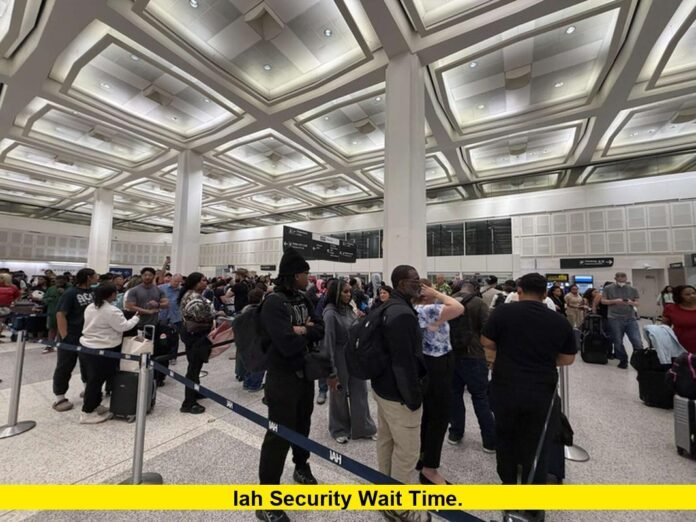

If you have a flight out of Houston in the coming days, the current IAH security wait time situation demands your attention before you leave the house. George Bush Intercontinental Airport is experiencing some of the most severe checkpoint delays in its history, driven by a federal government shutdown that has left TSA officers working without pay since February 14. Lines stretching up to four hours, closed checkpoints, and a drastically reduced screening workforce have turned a routine airport experience into a logistical nightmare for tens of thousands of travelers.
This is what is happening right now — and exactly what you need to know before you arrive.
📢 Flying through Houston soon? The security situation at IAH is changing by the hour. Keep reading before you pack your car.
The Scale of the Problem at IAH
The numbers coming out of George Bush Intercontinental Airport over the past several days are staggering. On Sunday, March 22, wait times inside Terminal E reached 220 minutes. By Monday morning, March 23, signage inside the terminal was showing estimated wait times of up to 240 minutes — a full four hours — just to clear the security checkpoint.
Lines did not stay inside the terminal. They stretched through baggage claim areas, spilled into hallways, and extended outside the building entirely. Airport staff, airline employees, and even law enforcement personnel were deployed to manage the crowds and keep people moving in the right direction.
The situation has not been a single bad morning. It has been a daily pattern of unpredictable and extreme delays that accelerated throughout the month of March. One woman reportedly broke down in tears after hearing her final boarding call for a flight to Philadelphia while still standing deep in the security line. A gate agent told her she was one of 40 passengers to miss that flight.
Why This Is Happening: The Shutdown’s Toll on TSA
The Department of Homeland Security shutdown, which began on February 14 after Congress failed to renew DHS funding, is the root cause of everything travelers at IAH are experiencing right now. TSA officers are classified as essential workers, which means they are legally required to continue showing up to their posts even without pay. Thousands of them have decided that is simply not sustainable.
Nationwide, more than 400 TSA officers have quit since the shutdown began. Thousands more have called out sick on a daily basis as their personal finances deteriorate. On March 21, the national TSA absenteeism rate hit 11.5 percent — the highest single-day callout rate recorded since the shutdown started.
Houston’s numbers have been even worse. At George Bush Intercontinental Airport, the callout rate among TSA officers reached over 40 percent on the most severely impacted days. At William P. Hobby Airport across town, the rate climbed even higher. When nearly half of your screening workforce does not show up for a shift at one of the busiest international airports in the country, the consequences are exactly what travelers have been experiencing.
Which Checkpoints Are Open — and Which Are Closed
As of the most recent update on March 23, the checkpoint situation at IAH looked like this: TSA screening checkpoints in Terminals C and D are closed. Standard TSA screening is available only in Terminals A and E. TSA PreCheck is limited and, at several points during the morning rush, was only available in Terminals A and C before closing entirely at 10:30 a.m.
CLEAR, the biometric identity verification service that normally allows members to skip the standard ID check line, was not operating at all on Monday, March 23.
By mid-morning on Monday, only two checkpoints remained fully active across the entire airport — one in Terminal A and one in Terminal E. The Terminal C checkpoint shut down at approximately 9:15 a.m. as staffing levels dropped below minimum operational thresholds.
Travelers flying United Airlines face an additional complication. Since United does not process checked baggage in Terminal A, passengers on United flights are being directed to check their bags at Terminal C first, then travel to Terminal E for security screening. Passengers departing from Terminal D are instructed to check baggage at Terminal D and then proceed to Terminal E to go through security. Several international airlines have also recently relocated from Terminal D to Terminal E, so double-checking your terminal assignment before you arrive is more critical than ever.
ICE Agents Arrive at IAH to Help Manage the Crisis
In a response that drew immediate national attention, the Trump administration deployed Immigration and Customs Enforcement agents to airports experiencing the worst staffing shortfalls. Houston was among the 14 airports where ICE agents were sent on Monday, March 23.
Approximately two dozen immigration officers — most of them armed and carrying badges identifying them as ICE Enforcement and Removal Operations personnel — were spotted at George Bush Intercontinental Airport, stationed near security lines alongside Houston police, emergency management staff, and airport employees.
ICE agents are not conducting TSA screenings. They are not running the X-ray machines or checking IDs at the checkpoint. Their role has been limited to crowd direction and line management at the most congested choke points inside the terminals. TSA officers continue to handle all actual security screening functions.
Houston Airports confirmed the deployment in an official statement, noting that decisions about ICE personnel and their assignments are made at the federal level and that any questions about specific roles should be directed to the U.S. Department of Homeland Security.
What the Airport Is Saying to Travelers Right Now
The messaging playing on a loop inside George Bush Intercontinental Airport leaves little room for confusion. The announcement warns passengers that TSA wait times are currently exceeding four hours and that travelers whose flights are departing soon may not clear security in time. It urges passengers to contact their airlines immediately to explore rebooking options.
That is not standard boilerplate. Airports do not broadcast four-hour security warnings unless the situation is genuinely critical. Houston Airports has been manually updating its official wait time estimates throughout the day based on observed passenger flow and the number of active screening lanes, acknowledging that the estimates can shift dramatically within a single hour.
Airport and airline employees have stepped up voluntarily to help organize the screening bin process at checkpoints, reducing friction at the conveyor belts and helping the limited number of TSA officers on duty work as efficiently as possible. National Deployment Officers — specialized TSA personnel who are dispatched to airports facing severe staffing emergencies — were already sent to Hobby Airport earlier this month, and similar support has been discussed for IAH.
What Normal Wait Times at IAH Look Like — For Context
To understand just how far outside the norm the current situation is, it helps to know what the IAH security experience looks like on a typical day. Under standard operating conditions, the average security wait at George Bush Intercontinental Airport ranges from 20 to 28 minutes. During peak travel periods — early mornings, late afternoons, and major holidays — that can stretch to around 90 minutes.
For TSA PreCheck holders, the typical wait under normal conditions is around nine minutes. CLEAR members can skip the ID verification line entirely and go straight to screening, cutting their overall checkpoint time even further.
Those benchmarks are essentially meaningless right now. A 90-minute wait would be considered a triumph on most mornings this week. The gap between what travelers normally experience at IAH and what they are facing today is not a matter of degree — it is a complete breakdown of the normal operating model.
How to Protect Your Travel Plans Right Now
Given the conditions at IAH, every traveler with an upcoming departure from Houston needs to adjust their planning significantly.
Arrive much earlier than you normally would. For domestic flights, getting to the airport two and a half to three hours before your departure time is the bare minimum right now. For international flights, three and a half to four hours is not excessive — it may not even be enough during peak morning hours. If your departure is between 6 a.m. and 10 a.m., consider adding even more time.
Check live wait times before you leave home. Houston Airports updates its checkpoint status in real time at fly2houston.com. The MyTSA mobile app also provides live estimates that refresh frequently. Check both before you get in the car, check again when you are on the way, and check once more when you arrive at the airport.
Know your terminal assignment in advance. With Terminals C and D operating at reduced or zero TSA capacity, showing up at the wrong drop-off point wastes time you simply cannot afford to lose right now.
Keep your carry-on organized before you reach the checkpoint. Every second you spend digging for your ID or reorganizing your bag at the conveyor belt slows the line for everyone behind you. Have your laptop out, your liquids in a separate pouch, and your boarding pass ready before you reach the front of the line.
Contact your airline proactively. If you have any doubt about whether you can make it through security in time, call your airline before you leave home. Most carriers are offering flexible rebooking options during the shutdown, and getting ahead of a potential missed flight is far easier than dealing with it after the fact at the gate.
The Bigger Picture: When Does This End?
The staffing crisis at IAH — and at airports across the country — has a single, clear cause. TSA officers are being asked to protect the traveling public without receiving a paycheck. Until Congress and the White House reach a deal to restore Department of Homeland Security funding, the daily guessing game of whether your security line will be 20 minutes or 4 hours is not going away.
The shutdown has now passed the five-week mark. There is no firm resolution timeline on the horizon. Each additional day without a funding agreement is another day in which TSA officers face an impossible financial choice — and another day in which travelers at IAH face the very real possibility of missing their flights through no fault of their own.
Houston is particularly vulnerable because of its size, its international passenger volume, and its role as one of the major connecting hubs in the United States. When the system breaks down here, the ripple effects reach travelers from dozens of cities and multiple continents all at once.
Until the shutdown ends, the best tool any Houston traveler has is information. Check before you go. Arrive early. Stay flexible. And stay in contact with your airline throughout the journey.
If you have been through IAH security recently and experienced these delays firsthand, share what you saw in the comments — your real-world experience could save another traveler from missing their flight.