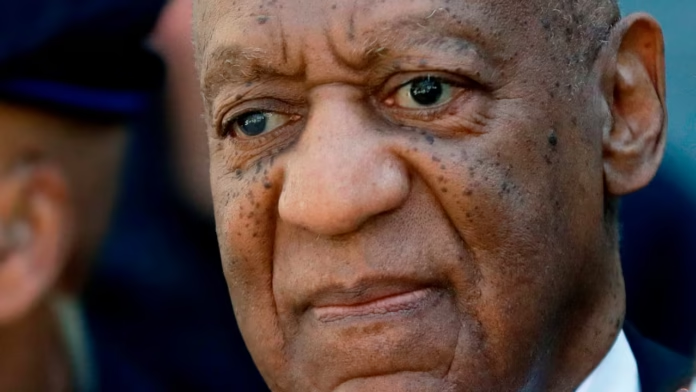

If you have been typing “is Bill Cosby dead” into a search bar recently, you are far from alone. The question has been trending across social media and search engines, fueled by viral hoaxes, aging rumors, and renewed public interest in a man whose life story remains one of the most dramatic falls from grace in American entertainment history. The answer is straightforward: Bill Cosby is not dead. He is 88 years old, living in Pennsylvania, and as of this week, facing a massive new legal blow that is generating headlines from coast to coast.
On Monday, March 23, 2026, a California civil jury delivered a stunning verdict against Cosby, ordering him to pay $19.25 million to a woman who says he drugged and sexually assaulted her more than five decades ago. It is a verdict that has reignited the national conversation about Cosby’s legacy, his legal battles, and the women who have spent years fighting for accountability.
👉 Share this article and follow along — additional punitive damages in this case are still being determined.
Who Is Bill Cosby and Why Does This Keep Coming Up?
Bill Cosby was born on July 12, 1937, in Philadelphia, Pennsylvania. For decades, he was one of the most celebrated entertainers in American history. He broke racial barriers in Hollywood in the 1960s when he became the first Black actor to star in a leading role on a prime-time dramatic television series. He won Grammy Awards, Emmy Awards, and built a cultural empire that reached its peak with The Cosby Show, which ran on NBC from 1984 to 1992.
That show made him a household name and one of the most trusted faces on television. He portrayed a warm, funny, successful family doctor and father. Millions of Americans grew up watching him. He was, to many, the definition of wholesome entertainment.
All of that began to unravel publicly in 2014, when decades of sexual assault allegations — many of which had circulated quietly for years — exploded into mainstream conversation. By the time the full scope of accusations became public, more than 60 women had come forward to say Cosby had sexually abused them. The entertainment industry walked away from him almost overnight.
The Criminal Trial and the Overturned Conviction
In 2018, a Pennsylvania court found Cosby guilty on three counts of aggravated indecent assault related to the 2004 drugging and sexual assault of Andrea Constand, a Temple University employee. He was sentenced to three to ten years in prison and became the first celebrity to be convicted in what many called the defining moment of the #MeToo era.
But the conviction did not last. In June 2021, the Pennsylvania Supreme Court threw out the verdict. The court ruled that a prior agreement between Cosby and a former district attorney — under which Cosby gave potentially self-incriminating civil deposition testimony in exchange for a promise that he would not face criminal charges — had been violated. Because that testimony was later used against him at trial, the court found the prosecution unconstitutional.
Cosby walked out of prison a free man. No new criminal charges have been filed against him since.
A $19.25 Million Verdict — What Happened in Court This Week
Freedom from criminal court has not meant freedom from legal consequences. The civil courts have continued to hold Cosby accountable, and this week produced the most significant civil verdict against him to date.
Donna Motsinger, now 84 years old, brought a lawsuit alleging that Cosby drugged and sexually assaulted her in 1972. At the time, she was working as a server at a restaurant in Sausalito, California. According to her account, Cosby came in regularly while recording a comedy album at a nearby theater. He befriended her and invited her to a show taping. During the outing, she says he gave her wine that made her feel unwell and offered her pills she believed were aspirin. She said she drifted in and out of consciousness and later woke up at home with most of her clothing removed.
The trial ran for nearly two weeks in Santa Monica. Cosby did not appear or testify. Several other women who have made similar allegations against him, including Andrea Constand, were permitted to testify as part of establishing a pattern of behavior. Jurors also heard a deposition in which Cosby himself acknowledged obtaining Quaaludes, a powerful sedative, with the intention of giving them to women he wanted to have sex with.
The jury deliberated for just over a day before siding with Motsinger. They awarded her $17.5 million for past mental suffering and $1.75 million for future suffering, for a total of $19.25 million in compensatory damages. They also made a legal finding that Cosby acted with malice, oppression, or fraud — the standard required to unlock punitive damages, which are yet to be determined and could increase the financial judgment further.
Cosby’s attorney announced plans to appeal the verdict. Cosby himself denied the allegations, as he has done consistently throughout the years.
Motsinger addressed reporters outside the courthouse after the verdict. She said it had taken 54 years to reach that moment and expressed hope that the outcome would provide some comfort to the other women who had come forward.
How Was a 1972 Lawsuit Even Possible?
Many people are asking how a lawsuit about an event from over 50 years ago could even make it to trial. The answer lies in a California law passed in recent years that temporarily suspended the statute of limitations for survivors of sexual assault to pursue civil claims. That window allowed accusers whose cases would otherwise have been too old to bring to court to file new lawsuits.
Motsinger filed her lawsuit in 2023, taking advantage of that legal window. The California law has enabled several other similar cases to move forward, and it reflects a broader shift in how the legal system treats decades-old sexual abuse claims in the civil context.
This Is Not the First Civil Verdict Against Him
Monday’s verdict is not the first time a civil jury has found Cosby financially liable. In 2022, a jury in the same Santa Monica courthouse awarded $500,000 to Judy Huth, a woman who alleged that Cosby sexually assaulted her at the Playboy Mansion in 1975, when she was 16 years old. Cosby initially appealed that verdict but later withdrew his appeal.
The two California civil verdicts represent a pattern of compounding legal exposure. Where the criminal justice system ultimately failed to deliver a lasting conviction, civil courts have repeatedly stepped in to hold Cosby accountable on a legal standard that requires a lower burden of proof.
Cosby has publicly acknowledged facing financial difficulties, a striking admission for someone who was once among the highest-paid entertainers in the country.
Why Do People Keep Asking If He Is Dead?
Death hoaxes involving Bill Cosby have circulated repeatedly in recent years. Earlier in 2026, a false report claiming Cosby had died spread widely across social media platforms, generating enormous engagement before being debunked. A Facebook page titled “R.I.P. Bill Cosby” reportedly gathered nearly a million interactions before his representatives stepped in to clarify that he was alive.
These hoaxes are not new. Cosby has been the target of false death reports multiple times over the past decade. Several factors fuel the cycle: he is 88 years old and rarely appears in public, the controversies surrounding him have made him a frequent subject of online discussion, and social media algorithms reward shocking or emotionally provocative content regardless of accuracy.
The reality, as always, is more complicated and more legally dramatic than any hoax. Cosby is alive. He is living privately. And the legal battles are not over.
What Happens Next
The immediate next step in the Motsinger case is the punitive damages phase. Because the jury already determined that Cosby acted with malice, the court can now add an additional financial penalty on top of the $19.25 million compensatory award. That figure could be announced in the coming days.
Cosby’s legal team has signaled an appeal is coming, which means the litigation over this verdict alone could drag on for months or years. Meanwhile, the California look-back law continues to allow previously time-barred cases to work their way through the courts, and the broader wave of civil litigation against Cosby shows no sign of stopping.
At 88, living quietly in Pennsylvania, Bill Cosby now carries the weight of a $19.25 million judgment with more potentially on the way, a separate $500,000 verdict he chose not to fight, and the ongoing fallout from one of the most dramatic public reckonings in modern entertainment history.
His entertainment career is effectively over. Networks have largely removed his work from their platforms. Public speaking opportunities are sparse. The image of America’s beloved TV dad has been replaced, in the public consciousness, by the courtroom record that decades of women helped build.
The Broader Legacy
Bill Cosby’s story has become something of a defining case study in the tension between public image and private conduct. He was genuinely pioneering in his work to advance the representation of Black Americans in mainstream entertainment. He invested in education and historically Black colleges. He shaped the childhoods of millions.
And yet the courts have now repeatedly sided with women who say the reality behind that image was something far darker. That tension is not easily resolved, and for many Americans, it does not need to be. Accountability and legacy can coexist without canceling each other out.
What is clear is that the legal story is not finished. The women who stepped forward are still winning in court. And Bill Cosby, alive at 88, is still very much at the center of it.
Drop your thoughts in the comments below — this case is still unfolding and the punitive damages decision could come any day now.