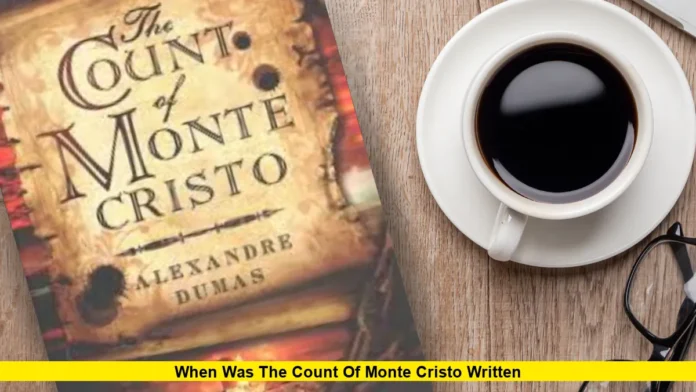

There is a question that has been typed into search engines millions of times, and it deserves a real answer. When was The Count of Monte Cristo written? The novel that gave the world Edmond Dantès — wrongfully imprisoned sailor, patient avenger, and master of disguise — began appearing in serialized form in 1844 and concluded its run in 1846, with the complete book published that same year. Alexandre Dumas put those words on the page nearly 180 years ago, and right now, in March 2026, the story is at the center of one of the biggest literary and television moments the U.S. has seen in years.
A stunning new eight-part miniseries based on the novel just launched its broadcast premiere on PBS Masterpiece this past Sunday, March 22, 2026 — and it has arrived to enormous anticipation. This is not a coincidence. It is the result of a story so sturdy, so morally charged, and so relentlessly entertaining that no era has been able to leave it alone.
👉 Keep reading to find out why this 180-year-old revenge saga feels more urgent than almost anything on television right now.
When Was The Count of Monte Cristo Written — And How Did It Come to Be?
Alexandre Dumas began publishing The Count of Monte Cristo as a serial in a French newspaper in August 1844. The story ran in installments until January 1846, gripping readers who waited eagerly for each new chapter. The complete novel appeared in book form that same year. Dumas wrote it with extraordinary speed, as he did most of his work, driven by both creative energy and the financial rewards that popular serial fiction offered at the time.
The novel took root in a true-crime story Dumas stumbled across in the police archives of Paris. A shoemaker named François Picaud was living in France in 1807 when a group of jealous friends falsely accused him of being a spy for England. He was arrested, imprisoned for years without a fair trial, and released only when the government changed. During his imprisonment, he befriended a wealthy Italian cleric who left him a fortune upon dying. Picaud returned to France as a rich man and systematically hunted down the people who had destroyed his life.
The bones of the plot were already there. Dumas took that grim real-world story and transformed it into something far grander — adding a Mediterranean island hiding buried treasure, elaborate disguises, a gothic island fortress prison, and a moral reckoning that stretched across hundreds of pages.
The Man Behind the Story
Alexandre Dumas was born on July 24, 1802, in a small village northeast of Paris. His father, Thomas-Alexandre Dumas, had been a general under Napoleon — in fact, the highest-ranking man of African descent in any European army at the time. His father died when Alexandre was just four years old, leaving the family in financial difficulty. That early experience of loss, injustice, and the cruelty of powerful institutions never left Dumas. It quietly shaped everything he wrote.
By the 1840s, Dumas had already become one of the most widely read authors in France. He had published The Three Musketeers in the same year he began The Count of Monte Cristo — 1844 — a staggering feat of creative output. He worked with a collaborator named Auguste Maquet, who helped outline plot structures, though Dumas himself wrote the manuscript in his own hand and gave it life with his distinctive voice.
He was a man of extravagant appetites. The money he earned from his writing flowed out just as fast as it came in. He built a mansion outside Paris called the Château de Monte-Cristo, founded his own theater in the city, and accumulated debts that eventually forced him to flee to Brussels. None of it diminished the work. If anything, his experience of wealth, social status, and the fragility of both gave his stories an authenticity that readers across every class recognized.
The Story That Refuses to Grow Old
At its heart, The Count of Monte Cristo is a story about what happens to a person when the systems meant to protect them turn against them instead. Edmond Dantès is a young sailor on the eve of his wedding when he is falsely accused of treason by three men acting out of jealousy and self-interest. A prosecutor who knows Dantès is innocent nevertheless sends him to the Château d’If — a real island fortress off the coast of Marseille — because releasing him would expose a politically dangerous secret.
Dantès spends years in isolation before he meets a fellow prisoner, the elderly Abbé Faria, who has been digging an escape tunnel in the wrong direction. Faria educates Dantès in history, languages, and science, and before dying, tells him the location of a massive treasure buried on a deserted Mediterranean island called Monte Cristo. Dantès escapes, acquires the treasure, and reinvents himself entirely. He returns to Paris as a wealthy, mysterious, and seemingly all-powerful nobleman — and he begins to dismantle the lives of every person who destroyed his.
The novel runs over a thousand pages in most editions and spans more than twenty years of story time. It covers corrupt financiers, corrupt judges, poisonings, duels, hidden identities, and the question that haunts the entire book: does any human being have the right to appoint themselves as the instrument of divine justice? Dumas never gives a clean answer. That ambiguity is part of what keeps readers debating it to this day.
The Novel’s Place in Literary History
The Count of Monte Cristo is one of the most widely translated and widely read novels ever produced. It has influenced writers across generations and genres — from 19th-century adventure novelists to modern superhero storytellers. The wrongfully imprisoned man who returns transformed, wealthy, and determined to set things right is one of the most recurring archetypes in all of popular culture. Dumas did not invent the concept of revenge, but he gave it its most elaborate and enduring fictional form.
The novel is set against the real political landscape of France between 1815 and 1839 — from the final days of Napoleon’s rule through the era of the Bourbon Restoration. Dumas used that historical backdrop not as mere decoration but as the engine of his plot. The corrupt officials, the shifting political loyalties, the social climbing and social ruin — all of it reflects the world Dumas actually lived in and observed. That grounding in real history gives the story a weight and credibility that purely invented worlds cannot replicate.
The island of Monte Cristo exists in real life, located off the coast of Italy. The Château d’If, the island prison where Dantès is held, still stands near Marseille and draws visitors who have read the novel and want to see where the story began.
The Brand-New PBS Series That Has America Hooked
Right now, in 2026, The Count of Monte Cristo is the most talked-about drama on American public television. A new eight-episode miniseries directed by two-time Palme d’Or and Academy Award-winning filmmaker Bille August premiered for streaming on March 1, 2026, and launched its weekly broadcast premiere on PBS Masterpiece this past Sunday, March 22.
Sam Claflin, widely known to American audiences from Daisy Jones and the Six and The Hunger Games franchise, stars as Edmond Dantès. Jeremy Irons, one of the most acclaimed actors of his generation, plays Abbé Faria, the imprisoned priest who becomes Dantès’s mentor. Ana Girardot plays Mercédès, the woman Dantès loves and loses. The cast also includes Blake Ritson as the scheming Danglars.
The series is available to stream on the PBS app and PBS Masterpiece on Prime Video, with new broadcast episodes airing on Sunday nights at 10/9c through May 10, 2026. PBS Passport subscribers were able to access all eight episodes starting March 1, well ahead of the broadcast schedule.
The production is a European co-venture involving Italian and French production companies, giving it a visual scale and attention to period detail that stands out even among prestige television dramas. Bille August’s background in sweeping European historical storytelling made him a natural fit for a story this large. The series spans eight full episodes, giving the creative team room to honor the novel’s complexity in a way that no two-hour film ever could.
Why This Story Hits Different in 2026
The enduring power of The Count of Monte Cristo comes from the fact that its central injustice — an innocent man destroyed by a corrupt system and the petty jealousy of people he trusted — is not a period piece. It is a permanent feature of human experience. Readers in 1844 recognized it. Readers in 2026 recognize it just as immediately.
The novel also asks serious questions about what justice actually looks like when institutions fail. Dantès does not simply punch his enemies or report them to the authorities. He infiltrates their lives, learns their secrets, and allows their own corruption to undo them. It is a fantasy of complete and total accountability in a world where accountability is rare — and that fantasy has never gone out of style.
The new PBS series leans into those themes with an eight-episode structure that gives the story room to breathe. Characters who were flattened in earlier adaptations get proper development. The moral complexity Dumas built into the novel — including the unsettling question of whether the count has gone too far — is preserved rather than edited out for the sake of a clean resolution.
A Legacy Nearly Two Centuries in the Making
From the first installment published in a Paris newspaper in August 1844 to a new American television event in March 2026, The Count of Monte Cristo has never truly been out of circulation. It has been adapted into films, stage productions, radio dramas, manga, comic books, and now a podcast. The story has been retold in nearly every medium and nearly every language on earth.
What Dumas created was not just a thriller. It was a meditation on patience, identity, and the true cost of living only for revenge. Edmond Dantès begins the story as an open-hearted young man full of hope. He ends it having achieved everything he set out to do — and having lost things he cannot get back in the process. That is not a simple story. It is a profound one, and 180 years have not diminished it by a single page.
If you’ve started watching the new PBS series or if The Count of Monte Cristo has been on your reading list for years, now is the perfect time to dive in — drop a comment below and tell us whether you’re Team Novel or Team Screen adaptation.