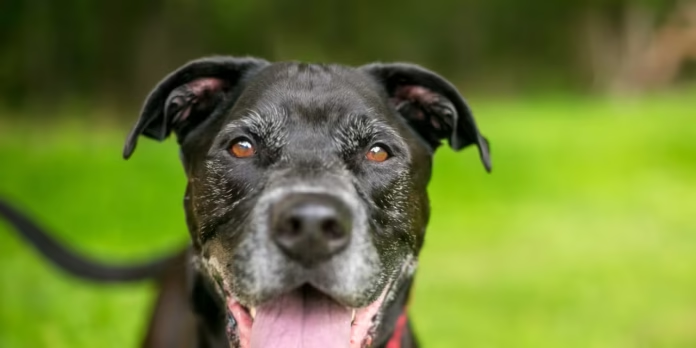

Every dog owner has felt it — the quiet dread that comes from watching your pet slow down, gray around the muzzle, and struggle with the stairs they used to fly up. That fear is now driving one of the most ambitious scientific initiatives in American history. The Dog Aging Project burst back into the national spotlight this weekend after a major primetime television broadcast dedicated a full segment to its work, bringing the conversation about canine longevity to millions of households across the country. With more than 50,000 dogs enrolled, a federally supported drug trial actively underway, and fresh private investment secured, this project is no longer a quiet academic effort — it is rapidly becoming one of the most watched scientific stories in America.
If you share your home with a dog, what researchers are learning right now may one day change everything about how long — and how well — your companion lives.
👉 Tell every dog owner you know — this research is happening right now, and it matters for both of you.
The Big Idea Behind the Project
Dogs get sick the same way people do. They develop dementia. Their hearts weaken. Their joints ache. Their cognitive abilities fade. And because a dog’s lifespan moves much faster than a human’s, scientists can watch the entire arc of aging-related disease play out in a fraction of the time it would take to study the same processes in people.
That insight sits at the heart of the Dog Aging Project. Co-founded in 2014 by biologist Matt Kaeberlein, the initiative set out to do something that had never been attempted at this scale: recruit tens of thousands of everyday family dogs and use them as a living, breathing research population to decode what drives aging — and what might slow it down.
Kaeberlein has described a moment of clarity that launched the entire effort. He realized that scientists already knew several ways to slow aging in laboratory animals, and that much of what makes those interventions work operates on biology that is shared across the animal kingdom — including in dogs, and including in people. If those methods worked in a lab mouse, there was every reason to believe some of them would work in a golden retriever. And if they worked in a golden retriever, the path toward applying those lessons to human medicine became far shorter.
How the Study Actually Works
What makes this project different from most scientific research is that none of these dogs live in a laboratory. They sleep at the foot of someone’s bed. They go to the dog park. They ride in the backseat to the vet. They breathe the same air as their owners, eat food from similar households, and experience the same environmental stressors their human families do.
That is precisely the point. Because dogs share our environments so completely, they are exposed to the same pollution, the same stresses, the same lifestyle factors that shape human health. Studying dogs means studying conditions that actually mirror real-world human life — something that laboratory rodents, raised in controlled and sterile conditions, can never fully replicate.
Enrolled dog owners complete detailed surveys about their pet’s health, diet, exercise habits, and behavior every year. A portion of dogs also provide biological samples — blood, urine, fur, and fecal samples — that give researchers a biochemical window into how each animal is aging at the cellular level. Select dogs receive MRI scans to track changes in brain structure over time. All of this data is gathered across hundreds of veterinary clinics and research hospitals throughout the United States.
The Drug at the Center of Everything: Rapamycin
Of all the treatments being studied, the one generating the most excitement — and the most rigorous testing — is a drug called rapamycin. It has been used in human medicine for decades, primarily as an immunosuppressant after organ transplants. But its potential role in aging research is something else entirely.
In mouse studies, rapamycin has extended life expectancy by as much as 60 percent and has been shown to slow cognitive decline. Those results have made it one of the most discussed compounds in longevity science, and they are what drove researchers to ask whether the same effects might appear in dogs.
The biological mechanism behind rapamycin involves a cellular pathway that regulates metabolism and growth. When that pathway is dialed down, cells shift into a kind of maintenance mode that resembles what happens during fasting — a state associated with slower biological aging. In essence, the drug tells the body to stop growing and start conserving, which appears to protect cells from the gradual breakdown that defines aging.
Early pilot work within the project has already produced encouraging signals. In a small study, dogs with signs of dementia who received rapamycin showed fewer brain cells associated with inflammation compared to those given a placebo. Inflammation in the brain is closely linked to the progression of dementia, so reducing it could be meaningful — though researchers are careful to note that this was a small study and larger results are still being gathered.
The TRIAD Trial: Testing Rapamycin at Scale
Those early findings led to a much larger effort. A clinical trial backed in part by the National Institutes of Health is now giving hundreds of dogs either rapamycin or a placebo to see whether the drug can extend healthy life in a real-world population. Dogs in the trial are at least seven years old, weigh between 44 and 120 pounds, and visit a clinical site every six months for checkups over a three-year period.
The trial is being conducted across more than 20 sites around the country, making it one of the most geographically distributed veterinary drug studies ever run in the United States. Researchers are tracking not just lifespan, but quality of life — how well dogs move, think, interact, and enjoy their days. The goal is not simply more years, but better years.
Results from this trial are expected to take several more years to fully materialize. But the scope and rigor of the study mean that when those results do arrive, they will carry significant scientific weight.
A Startup Betting on Dog Longevity
Alongside the nonprofit research effort, a venture-backed biotechnology company called Loyal is developing drugs specifically designed to extend healthy life in dogs. The company was founded in 2019 and has attracted serious attention from the scientific and investment communities.
Loyal’s founder envisions a daily chewable pill — beef-flavored for palatability — given to older dogs as a preventative measure, in the same way a physician might prescribe statins to a middle-aged human to ward off heart disease. One of the company’s drugs is currently in a clinical trial focused on dogs over the age of ten. The Food and Drug Administration has already reviewed the drug’s safety data and determined there is a reasonable expectation that it will prove effective. Final trial results are still pending, but the regulatory milestone is significant — it represents the first time the FDA has indicated this level of confidence in a drug specifically intended to target the aging process in any animal.
The company estimates its treatment could deliver approximately one additional year of healthy life. That may not sound like much in human terms, but for a dog breed with an average lifespan of ten or twelve years, it is substantial — and the actual benefit could turn out to be larger.
Social Life, Inequality, and What Else Shapes How Dogs Age
The Dog Aging Project is not only about drugs. Some of the most fascinating findings to emerge from the research have nothing to do with pharmaceuticals at all.
A study published earlier this year using data from more than 25,000 enrolled dogs found that social connection is one of the strongest predictors of canine health. Dogs who live with other dogs, who have regular positive interactions with people, and who exist in stable household environments tend to live healthier lives — independent of breed, weight, or age. The effect of social support on health outcomes was found to be roughly five times stronger than the effect of financial factors alone.
Researchers also found that the inequalities shaping human health ripple down into the lives of dogs. Animals living in lower-resource households face greater health challenges, mirroring patterns seen in human public health research. Even the finding that dogs in more affluent households tend to have more documented health problems turned out to have a straightforward explanation: wealthier owners take their dogs to the vet more often, meaning more conditions get caught and recorded.
Perhaps most surprising was the finding that dogs who spend more time around children tend to have slightly worse health outcomes — not because children are harmful, but because owners with young kids have less time to devote to their pets.
Private Investors Are Paying Attention
The scientific momentum behind this work has attracted major funding from outside traditional research channels. A group of prominent tech entrepreneurs and investors recently pledged $2.5 million to support the project’s expansion. Among the donors are the founder of Coinbase, a physician and longevity researcher, the author of a widely read book on performance and health, and several founders from the blockchain and venture capital worlds.
This kind of private support is increasingly critical. The project has faced uncertainty around its federal grant renewal, and researchers have been candid about the challenge of sustaining a long-term longitudinal study through the typical grant cycle. The private investment helps bridge that gap while the team pursues additional public funding.
The research team includes more than 70 scientists and veterinarians from over 20 academic institutions across the country, led by researchers at the University of Washington and Texas A&M University. All data collected is made available to researchers worldwide through an open-science platform, meaning that breakthroughs achieved by one team can be built upon by others everywhere.
What This Means for Your Dog — and for You
The parallels between dogs and people make this research unusually translatable. Dogs develop Alzheimer’s-like dementia. They suffer strokes. They get cancer at rates similar to humans. Their brains shrink with age. Their immune systems falter. Studying how and why those processes happen in dogs — and what slows them down — creates a roadmap that researchers believe will have direct applications in human medicine.
Because dogs age so much faster than people, scientists can observe patterns in a decade that would take half a century to see in human clinical trials. That speed is one of the most powerful tools available to aging researchers anywhere in the world.
For the millions of Americans who consider their dog a member of the family, the stakes are deeply personal. Every owner who has lost a dog to cancer, dementia, or organ failure knows the specific grief that comes with outliving a creature who gave unconditional love for far too short a time. The Dog Aging Project is working directly on that problem — and this week, for the first time, much of the country is learning that the work is already well underway.
What You Can Do Right Now
Dog owners across the United States can enroll their pets in the project at any time. The longitudinal study is open to dogs of all breeds, sizes, and ages, and participation primarily involves completing regular online health surveys. Select dogs may be invited to contribute biological samples or participate in clinical trials depending on their age and health profile.
The TRIAD rapamycin trial specifically is looking for dogs who are at least seven years old, weigh between 44 and 120 pounds, are spayed or neutered, and are in overall good health. Participants visit a nearby clinical site every six months for three years. Sites are active across the country, and the enrollment process begins online.
Participation costs nothing. And for every dog owner who joins, the research becomes a little more powerful — a little more likely to produce the kind of results that could add healthy, happy years to the lives of the animals we love most.
Have a dog who could be part of history? Drop a comment below and share your experience — or tell us what you’d want this research to discover first.