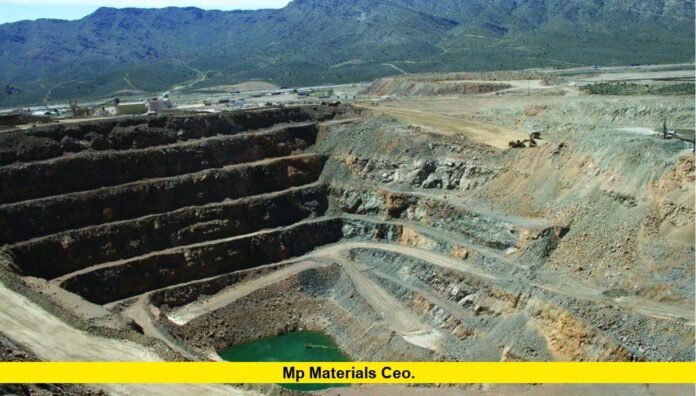

The mp materials ceo is at the center of a rapidly evolving U.S. industrial strategy, as the company pushes forward with major expansion plans, strong earnings momentum, and deeper government partnerships that are reshaping the rare-earth supply chain in 2026.
MP Materials, led by founder and CEO James Litinsky, has become one of the most strategically important companies in the United States due to its control of the only active rare-earth mine in the country. These materials are essential for electric vehicles, defense systems, robotics, and advanced electronics—making the company a critical player in national security and economic policy.
After years of reliance on foreign processing, especially from China, the company is now accelerating efforts to build a fully domestic supply chain.
Stay with us as we break down what this means for the economy, investors, and the future of U.S. manufacturing.
MP Materials CEO Leads a Major Industry Shift
Under James Litinsky’s leadership, MP Materials has transitioned from a mining-focused company into a vertically integrated rare-earth powerhouse.
The company now handles multiple stages of the supply chain—from mining at Mountain Pass in California to refining and magnet production in the U.S. This transformation has positioned MP Materials as a cornerstone of America’s effort to reduce dependence on foreign rare-earth sources.
Recent developments highlight how central this strategy has become. The company has stopped shipping raw materials to China and is instead focusing on domestic processing capabilities. This shift marks a turning point in how the U.S. approaches critical minerals.
Strong Financial Turnaround Signals Growth
MP Materials reported a return to profitability in late 2025, posting quarterly net income after a prior-year loss. This turnaround was driven by rising rare-earth prices and increased sales of magnetic materials.
A key factor behind the improved performance is a U.S. government-backed price support agreement, which guaranteed a minimum price for certain rare-earth elements. Market prices have since surged above that threshold, further strengthening the company’s revenue position.
The company also generated growing income from its magnetics segment, signaling that its downstream expansion strategy is starting to deliver results.
Readers following market trends should keep a close eye on how these financial gains translate into long-term stability.
Government Support Fuels Expansion Plans
The MP Materials CEO has been working closely with federal agencies to expand domestic production capacity. A major agreement with the U.S. Department of Defense includes long-term commitments to purchase magnets and support new manufacturing facilities.
One of the most ambitious projects underway is the “10X Facility” in Texas. This large-scale magnet manufacturing plant is expected to significantly boost U.S. production capacity and create thousands of jobs.
The facility represents a multi-billion-dollar investment and is designed to produce large volumes of high-performance magnets used in everything from EV motors to military equipment.
This collaboration between government and industry reflects a broader push to secure critical supply chains within the United States.
Rare-Earth Prices and Global Demand Surge
The global demand for rare-earth elements continues to rise, driven by clean energy technologies, electric vehicles, and defense applications.
Prices for key materials like neodymium and praseodymium have surged in recent months, reaching levels well above earlier government-backed thresholds. This trend has strengthened MP Materials’ financial outlook and reduced reliance on subsidies.
At the same time, global supply remains heavily concentrated, with China dominating refining capacity. This imbalance has increased urgency among U.S. policymakers to build domestic alternatives.
MP Materials is currently one of the few companies capable of scaling production quickly enough to meet that demand.
Strategic Partnerships Strengthen Market Position
The company has also secured partnerships with major technology and industrial players. These agreements are designed to ensure long-term demand for its products while supporting expansion into advanced manufacturing.
Collaborations include supply deals for rare-earth magnets used in consumer electronics and clean energy systems. These partnerships are expected to play a key role in stabilizing revenue streams and accelerating growth.
In addition, the company continues to invest in recycling initiatives to recover rare-earth materials from used products, further strengthening its supply chain.
What’s Next for MP Materials CEO and the Company
Looking ahead, the MP Materials CEO is focused on scaling production, completing new facilities, and expanding into heavy rare-earth processing.
The company is also working to bring additional capabilities online, including advanced separation technologies that will allow it to produce more specialized materials domestically.
As these projects come online, MP Materials is expected to play an even larger role in supplying critical components for U.S. industries.
Investors, policymakers, and industry leaders are all watching closely as the company continues to grow.
Why This Matters for the U.S. Economy
The rise of MP Materials reflects a broader shift in U.S. industrial policy. By investing in domestic production of critical minerals, the country aims to reduce supply chain vulnerabilities and strengthen national security.
This strategy also has economic implications, including job creation, technological innovation, and increased manufacturing capacity.
As global competition intensifies, companies like MP Materials are becoming central to the future of American industry.
What do you think about the growing role of rare-earth companies in the U.S.? Share your thoughts or stay tuned for more updates.