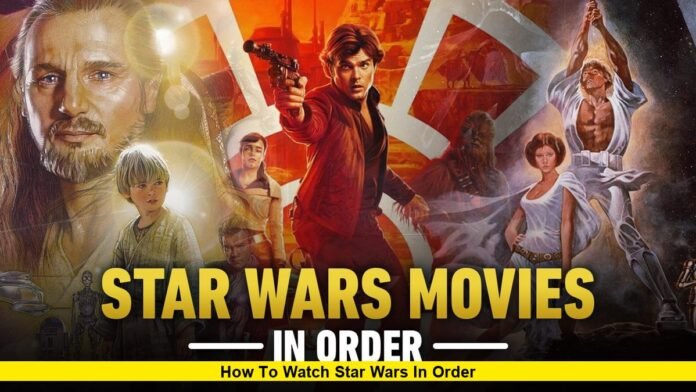

Millions of Americans are searching for the best way to experience the galaxy far, far away right now, and with a major new theatrical film arriving this May, knowing how to watch Star Wars in order has never mattered more.
The Star Wars franchise is one of the most sprawling entertainment universes ever built. What began as a single film in 1977 has grown into a collection of 12 theatrical movies, multiple live-action Disney+ series, animated shows, and spin-off stories that stretch across thousands of years of in-universe history. Whether you are brand new to the saga or a longtime fan planning a complete rewatch before the next big release, choosing the right viewing order will completely shape how the story feels.
Ready to start your Star Wars marathon? Pull up Disney+ right now and bookmark this guide — The Mandalorian and Grogu hits theaters on May 22, 2026, and you will want to be ready.
Two Main Approaches: Release Order vs. Chronological Order
There is no single “correct” way to watch Star Wars, but there are two approaches that fans consistently return to, each with real advantages depending on your goals.
Release order follows the films and shows in the sequence they were made available to the public. This means starting with Episode IV — A New Hope from 1977, moving through the original trilogy, then circling back to the prequels, and finishing with the sequel era. This method is widely recommended for first-time viewers because it preserves some of cinema’s most iconic storytelling moments — including one of the greatest plot twists in film history — and lets you experience the saga the way audiences originally did over four decades.
Chronological order follows the in-universe timeline from earliest to latest, regardless of when each film or show was produced. This approach is popular with veteran fans doing a full rewatch because it gives the overall story a clean, linear flow. Anakin Skywalker’s tragedy carries greater emotional weight when watched from beginning to end. Political storylines feel more coherent, and character arcs that span multiple shows and films become easier to follow.
The Full Chronological Watch Order
For those going the timeline route in 2026, here is how the complete saga lines up. The journey begins in the High Republic era with The Acolyte, a Disney+ series set roughly a century before The Phantom Menace, showing the Jedi Order at its most powerful and confident.
From there, the prequel trilogy takes over: The Phantom Menace (1999), Attack of the Clones (2002), and Revenge of the Sith (2005). The Clone Wars animated series weaves throughout this era and is essential viewing for anyone who wants to fully understand Anakin Skywalker’s fall. It fills in major emotional gaps that the films alone cannot cover.
After the prequels comes the dark age of Imperial rule. The Bad Batch follows clone troopers navigating the collapse of the Republic. Solo: A Star Wars Story explores the criminal underworld of the early Empire. Obi-Wan Kenobi picks up a decade after Revenge of the Sith, and Andor — now complete with both seasons — delivers a grounded, political look at how the Rebellion began. Andor leads directly into Rogue One: A Star Wars Story, which itself connects seamlessly to the beginning of A New Hope.
The original trilogy — A New Hope, The Empire Strikes Back, and Return of the Jedi — follows next. These three films remain the emotional core of the entire saga. After them come the post-Empire stories: all three seasons of The Mandalorian, The Book of Boba Fett, and Ahsoka. The sequel trilogy — The Force Awakens, The Last Jedi, and The Rise of Skywalker — closes out the Skywalker Saga.
The Fan-Favorite Machete Order
A popular fan-created method called the Machete Order offers a compelling twist on the traditional release approach. In this order, viewers watch A New Hope and The Empire Strikes Back first, then jump to Attack of the Clones and Revenge of the Sith as an extended flashback, before returning to finish with Return of the Jedi. The prequel era hits much harder emotionally when viewed this way because viewers already know what Darth Vader becomes — and watching Anakin’s fall after that revelation adds real tragedy to what might otherwise feel like slow storytelling.
This method also skips The Phantom Menace entirely for casual viewers, which many fans consider an acceptable trade-off given how much of that film relies on Jar Jar Binks and trade federation politics. Veteran fans tend to love the Machete Order because it makes the ending of Return of the Jedi feel genuinely earned.
Where to Stream Every Star Wars Title
Every canon Star Wars film and series is available on Disney+. There is no need to juggle multiple platforms or hunt for physical copies. One subscription unlocks the entire saga — from animated classics to the newest live-action originals — in high definition. Hulu subscribers with a Disney bundle can also access the full library through that plan.
What to Watch Before The Mandalorian and Grogu
The most pressing reason to get caught up right now is the upcoming theatrical film. The Mandalorian and Grogu arrives in theaters and IMAX on May 22, 2026, marking the return of Star Wars to the big screen and the launch of a new era of theatrical releases. The film follows bounty hunter Din Djarin and his young companion Grogu as the New Republic draws them into a mission that echoes the stakes of the Rebellion itself.
To get the most out of this film, viewers should watch all three seasons of The Mandalorian and The Book of Boba Fett on Disney+ before heading to theaters. These shows build the relationships, world-building, and emotional foundation that the film will draw from. Going in cold is possible, but going in prepared will make the experience significantly richer.
Looking even further ahead, Star Wars: Starfighter is scheduled for a theatrical release on May 28, 2027, signaling that Lucasfilm has fully recommitted to annual big-screen Star Wars storytelling.
Tips for New Fans Just Getting Started
If you are completely new to Star Wars, release order remains the most viewer-friendly starting point. A New Hope drops you immediately into an accessible adventure with no prerequisites and hooks audiences fast. The prequels carry far more emotional weight once you already understand where Anakin’s story ends.
Families with younger children often find The Mandalorian to be the best entry point. Its self-contained episodes, warm tone, and the universal appeal of Grogu make it easy to watch together before introducing the classic films. Many parents use it as a gateway that sparks genuine interest in the broader saga.
Whatever order you choose, the most important step is simply pressing play. Star Wars rewards patience and investment. The deeper you go, the more the connections, callbacks, and emotional payoffs pile up across decades of storytelling that still feels alive in 2026.
Which Star Wars viewing order worked best for you — and are you planning to catch The Mandalorian and Grogu in theaters this May? Share your thoughts in the comments below and keep checking back as the galaxy keeps expanding.