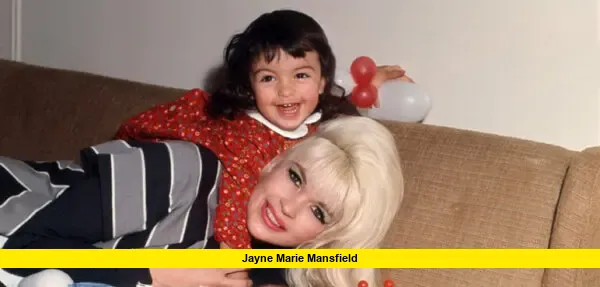

She is one of Hollywood’s most overlooked figures — a woman who grew up in the blinding glare of her mother’s fame, witnessed one of the most tragic deaths in entertainment history, and then quietly stepped away from public life for decades. But in 2025, Jayne Marie Mansfield returned to the spotlight, not chasing celebrity, but chasing truth. And what she revealed has captivated audiences across the country.
For the first time in her adult life, Jayne Marie sat down on camera and spoke openly about her mother, her childhood, and the complicated legacy of being the eldest daughter of one of the most photographed women of the 20th century. The occasion was HBO’s landmark documentary My Mom Jayne — a deeply personal film that has changed the way America remembers the Mansfield name.
Who Is Jayne Marie Mansfield? The Story Behind the Famous Last Name
Born on November 8, 1950, in Dallas, Texas, Jayne Marie Mansfield entered the world as the first child of a teenage mother who was already dreaming bigger than anyone around her. Her mother — the woman the world would come to know as Jayne Mansfield — was just 17 years old and newly married when Jayne Marie was born.
The early years were unstable. The family moved frequently, and when her parents divorced, Jayne Marie’s mother packed up her young daughter and drove them both to Los Angeles. She had little more than ambition and a small child in the back seat — and within a few years, she had become one of the biggest stars in Hollywood.
For Jayne Marie, growing up in that environment meant navigating a world where her mother was a public spectacle. She was raised in the shadow of a woman who was constantly photographed, constantly performing, and rarely allowed to simply be a mother. And when Jayne Marie was old enough to understand what all of it meant, she made a deliberate choice: she wanted nothing to do with the entertainment industry.
A Childhood Defined by Glamour and Grief
By the time Jayne Marie was a teenager, the cracks in her family life had become impossible to ignore. At 16 years old, she made a stunning and painful accusation — she claimed she had been physically abused by her mother’s companion and attorney, Samuel Brody. The matter went before a juvenile court, and a judge granted temporary custody of Jayne Marie to a great-uncle.
Two weeks later, her mother was dead.
The fatal car crash on June 29, 1967, near New Orleans, claimed Jayne Mansfield at the age of 34. Three of the younger children — Mariska, Mickey Jr., and Zoltan Hargitay — were in the backseat of the vehicle and survived, though they sustained injuries. The attorney and the driver also perished. Jayne Marie, who was not in the car, suddenly found herself a grieving teenager with no parents, no stable home, and the weight of a famous name she had never wanted.
She processed that grief in private. For years, she gave almost no interviews, made almost no public appearances, and built a life entirely on her own terms — far from the cameras and the tabloids that had defined her mother’s existence.
Jayne Marie Mansfield in My Mom Jayne — Speaking Out After Decades of Silence
The HBO documentary My Mom Jayne, directed by Mariska Hargitay, premiered at the 78th Cannes Film Festival in May 2025 and arrived on HBO and Max on June 27, 2025. It earned a perfect 100% on Rotten Tomatoes from critics and an audience score of 95% — numbers that speak to how hungry viewers were for this story.
At the heart of the film is something remarkable: the Mansfield siblings, sitting down together for the first time to talk about their mother. Jayne Marie, Mickey Jr., Zoltan, and Tony Cimber each share their own memories, their own wounds, and their own complicated love for a woman who left them all far too soon.
For Jayne Marie, participation in the film was an extraordinary act of openness. In the documentary’s trailer, she speaks one of the film’s most quietly devastating lines: “In the beginning, I had her to myself. She’d take me everywhere.” That single sentence encapsulates the complexity of her relationship with her mother — the genuine closeness they once shared before fame, scandal, and tragedy tore everything apart.
Mariska Hargitay, who has spoken about never having had conversations with her siblings about their shared experiences, describes approaching Jayne Marie before the cameras with a kind of awe — noting that she was envious of her older sister’s memories, of the years she actually spent with their mother as a young child.
The Woman Behind the Blonde Bombshell Image — What Jayne Marie Witnessed
One of the most powerful contributions Jayne Marie makes to the documentary is her account of who her mother actually was when the cameras were off. The film explores the persona Jayne Mansfield constructed for Hollywood — the breathless voice, the bombshell image, the constant press-seeking — alongside the woman who existed beneath all of it.
Mansfield biographers and cultural historians have long argued that the actress was far more intelligent and complex than her public image suggested. She spoke multiple languages, was a trained musician, and was deeply savvy about how the entertainment industry worked. In her own words, she once described her pinup image as “a means to an end” — a calculated tool she used to build a career in a system that gave women very limited options.
Jayne Marie grew up seeing both versions of that woman. She saw the public performance and the private exhaustion. She witnessed the toll that constant objectification took on a mother who was also a human being trying to raise five children across three marriages.
That dual perspective — intimate and unflinching — is precisely what makes Jayne Marie’s contribution to the documentary so irreplaceable. She is the only person who was there from the very beginning.
Jayne Marie Mansfield’s Career: Stepping Into the Spotlight on Her Own Terms
Despite her very public declaration that she wanted no part of show business, Jayne Marie did eventually allow herself a few appearances on screen. She appeared uncredited in the 1978 independent film Olly, Olly, Oxen Free, which starred the legendary Katharine Hepburn, and she made a television appearance in 2003 in a documentary series about Hollywood’s classic sex symbols.
Her most talked-about public moment, however, came in 1976 when she became the first daughter of a Playmate to appear as a featured model in Playboy magazine. She was characteristically clear about her motivations — stating directly that she was not following in her mother’s footsteps or capitalizing on her physical similarity to her famous mother. She was doing things her way.
That combination of features made her a genuine rarity: the only model ever to appear alongside her mother in the magazine’s 1988 special issue, 100 Beautiful Women. Two generations. One extraordinary lineage. And a daughter who was always determined to be seen as something more than a reflection of the woman who raised her.
Why My Mom Jayne Matters to American Audiences in 2025 and 2026
The timing of the documentary could not be more culturally significant. America is in the middle of a long-overdue reassessment of how Hollywood treated women during the studio era — how the system reduced complex, talented, ambitious women to their physical appearance and then punished them for it.
Jayne Mansfield is the perfect case study. She was extraordinarily capable. She was a stage actress who starred on Broadway. She was a film star under contract at 20th Century Fox. She was a recording artist. She was a mother. And yet the entertainment press of her era boiled her entire existence down to measurements and publicity stunts.
My Mom Jayne refuses that reduction. And Jayne Marie Mansfield, by telling her part of the story, is one of the reasons why. She provides a grounding perspective — the view from inside the family, behind the pink mansion’s famous walls — that no biographer or film historian can replicate.
The documentary also ventures into genuinely shocking territory. During the production, Mariska Hargitay publicly confirmed for the first time that her biological father was not Mickey Hargitay, the man who raised her and whom she loved deeply, but Italian singer Nelson Sardelli — a man with whom Jayne Mansfield had a private affair. The revelation sent shockwaves through the entertainment world and added yet another layer to an already extraordinary family history.
Frequently Asked Questions About Jayne Marie Mansfield
Who is Jayne Marie Mansfield? Jayne Marie Mansfield is the eldest daughter of Hollywood icon Jayne Mansfield, born November 8, 1950, in Dallas, Texas. She is a half-sister of actress Mariska Hargitay and the only child Jayne Mansfield had with her first husband, Paul Mansfield.
Was Jayne Marie Mansfield in the car crash that killed her mother? No. The fatal 1967 car crash near New Orleans involved her younger half-siblings — Mariska, Mickey Jr., and Zoltan — who were in the backseat. Jayne Marie, then 16 years old, was not in the vehicle.
What happened to Jayne Marie Mansfield after her mother died? Following a juvenile court ruling made just two weeks before her mother’s death, custody of Jayne Marie was transferred to a great-uncle. She went on to live a largely private life away from Hollywood.
Did Jayne Marie Mansfield appear in My Mom Jayne? Yes. She was one of several siblings featured in the documentary, which premiered at Cannes in May 2025 and debuted on HBO and Max in June 2025.
What did Jayne Marie say about her mother in the documentary? She described their early relationship as close and loving, recalling that her mother used to take her everywhere. She also spoke on the painful events of the weeks leading up to her mother’s death.
Where can I watch My Mom Jayne? The documentary is available to stream on HBO and HBO Max, and can be rented or purchased through major digital platforms.
What is Jayne Marie Mansfield doing today? Now in her mid-70s, Jayne Marie remains largely private. Her participation in My Mom Jayne marks one of her most significant public appearances in decades and has introduced her story to a new generation of viewers.
A Legacy Reclaimed — and a Daughter Finally Heard
For most of her life, Jayne Marie Mansfield was an asterisk in someone else’s story. She was the daughter left behind, the teenager who survived not in a car crash but in the aftermath of one, picking up the pieces of a family shattered by fame, scandal, and sudden loss.
But My Mom Jayne changed that. For the first time in nearly sixty years, the full Mansfield family has come together to tell a story that tabloids and gossip columns spent decades distorting. And Jayne Marie — the woman who once said she wanted nothing to do with show business — chose to be part of that reclamation.
Her decision to speak takes courage that is easy to underestimate. She is not a public figure accustomed to interviews and red carpets. She is a private person who loved her mother, was hurt by her mother, lost her mother, and has lived with all of that complexity for over five decades. To sit in front of a camera and revisit that history — especially the painful final weeks before her mother’s death — is an act of remarkable bravery.
And what she offers in return is something genuinely rare: an honest, personal, eyewitness account of one of Hollywood’s most mythologized figures. Not the platinum blonde in the tight dress. Not the publicity stunt. Not the cautionary tale. But the real woman — the mother who once took her little girl everywhere, who had a fake voice and a real voice, and who was trying, imperfectly, to hold it all together.
That is the Jayne Mansfield that Jayne Marie Mansfield remembers. And thanks to this documentary, it is the version that America is finally getting to know.
If Jayne Marie Mansfield’s story moved you, share your thoughts in the comments below — this is a conversation long overdue, and every perspective matters.