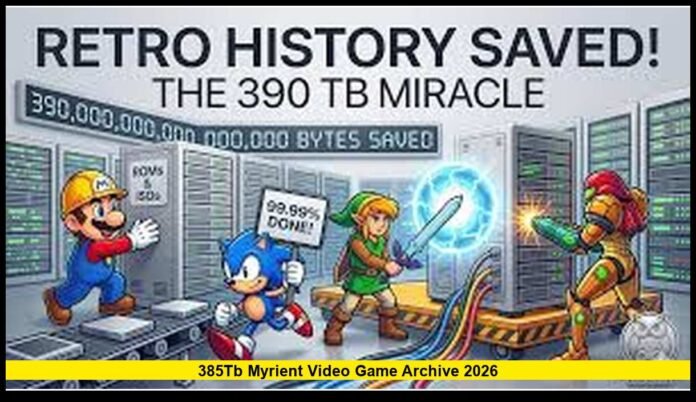

The 385TB Myrient video game archive is gaining widespread attention in 2026 as one of the largest publicly discussed collections of preserved video game data ever assembled. Gaming historians, retro enthusiasts, and digital archivists across the United States continue to highlight the enormous scale of this archive and its growing role in documenting decades of video game releases.
The archive reflects a broader shift in how the gaming community approaches preservation. As physical cartridges age and optical discs deteriorate, the importance of reliable digital archives continues to increase. The Myrient-hosted datasets represent a huge collection of verified game dumps gathered by several major preservation groups that focus on maintaining accurate records of original game media.
With hundreds of terabytes of verified files organized across multiple platforms, the archive demonstrates how far video game preservation has evolved since the early days of small ROM collections.
What the Archive Contains
At its core, the Myrient archive functions as a structured mirror for large preservation datasets created by independent archiving communities. These groups focus on documenting and verifying the contents of original video game media, including cartridges, discs, and older computer software formats.
The files within the archive generally include:
- Cartridge ROM dumps
- Optical disc images
- BIOS and firmware files
- Metadata used for verification
- Regional variations and revisions of games
Many preserved titles come from gaming systems that shaped the industry from the 1980s through the early 2000s. These systems include early consoles, handheld devices, and personal computers that used physical storage formats.
Each preserved game file typically matches a checksum recorded in specialized catalog databases used by archivists. This verification process helps ensure that the digital copy accurately reflects the original game media.
How Game Preservation Projects Work
Video game preservation requires specialized hardware, careful documentation, and collaboration between multiple collectors and archivists. Dumping a game cartridge or disc is not as simple as copying files.
Preservation groups often follow a multi-step process to ensure accuracy.
Typical verification process
- Original media is connected to dedicated dumping hardware.
- The game data is extracted from the cartridge or disc.
- The dump is compared against other copies of the same game.
- Hash values confirm that the file matches verified records.
- Metadata describing the release is added to the archive.
Only after these steps are completed does the game become part of a verified preservation set. This method helps prevent corrupted or incomplete data from entering official archives.
The result is a highly organized collection of authentic game files that match original retail releases.
Major Preservation Sets Included
Several well-known preservation initiatives contribute datasets that appear within the archive.
These groups maintain extensive catalogs of verified game media across many platforms.
Common preservation sets mirrored in large archives
| Preservation Project | Focus | Examples of Platforms |
|---|---|---|
| No-Intro | Cartridge-based games | NES, SNES, Game Boy, Game Boy Advance |
| Redump | Optical disc verification | PlayStation, Sega Saturn, Dreamcast |
| TOSEC | Computer software preservation | Commodore, Atari, MS-DOS systems |
| DAT catalog projects | Metadata verification | Multiple retro systems |
Each dataset includes detailed information about game releases, including version differences, regional variants, and updates.
This level of documentation helps historians track how games changed across different markets and production runs.
Why the Archive Size Reached Hundreds of Terabytes
The sheer scale of the archive surprises many gamers who remember earlier ROM collections that were only a few gigabytes in size.
Several factors explain the rapid growth.
First, optical disc systems introduced much larger game files. A single compact disc can store hundreds of megabytes of data, while later formats store several gigabytes.
Second, preservation groups document every known revision of a game. Different regions often receive slightly altered versions, and collectors work to preserve each one.
Third, prototype builds, demo discs, and promotional releases are also cataloged when available.
A comparison between cartridge and disc storage shows why modern preservation sets require massive capacity.
| Format | Approximate Game Size |
|---|---|
| NES cartridge | 40 KB – 1 MB |
| SNES cartridge | 1 MB – 6 MB |
| Nintendo 64 cartridge | up to 64 MB |
| PlayStation CD | about 650–700 MB |
| GameCube disc | roughly 1.35 GB |
When thousands of titles across multiple platforms are preserved, total storage requirements quickly reach hundreds of terabytes.
The Role of Myrient Hosting Infrastructure
Myrient serves as an infrastructure platform rather than a preservation organization itself. The service provides storage and structured directories for hosting verified preservation datasets.
Files are organized in directories that mirror the catalog systems used by preservation projects. This structure allows users to locate specific systems or collections quickly.
Each folder typically corresponds to a particular console or computing platform. Within those directories, games appear alongside metadata files that help ROM management tools verify file integrity.
Because of this organization, researchers and developers can confirm that their files match verified records.
Why Preservation Matters for Gaming History
Video games are now recognized as a major form of cultural and technological history. However, the medium faces several preservation challenges that other forms of media rarely encounter.
Physical game formats degrade over time. Cartridges contain electronic components that can fail after decades of use. Optical discs may suffer from disc rot or surface damage.
Many older systems also require hardware that is no longer manufactured.
Without preservation efforts, thousands of early games could disappear permanently.
Digital archives allow researchers to maintain playable versions of these titles while documenting the technical structure of original releases.
Preservation also protects games that were distributed in limited quantities. Some titles were sold only in specific regions or produced in small batches, making surviving copies extremely rare.
Research and Development Uses
Large archival datasets support many areas of research and development within the gaming ecosystem.
Emulator development
Programmers building emulators rely on verified game dumps to test software accuracy. Accurate files allow developers to reproduce the behavior of original gaming hardware.
Game translation projects
Fan translation teams use preserved ROM dumps to localize titles that never received official English releases.
Academic research
Universities increasingly study video games as cultural artifacts. Researchers analyze gameplay design, art styles, and software engineering methods used by earlier developers.
Historical documentation
Preservation datasets help historians track release dates, regional differences, and publisher changes across decades of gaming history.
These uses demonstrate that game archives support far more than casual retro gaming.
Legal Complexity Around Game Archives
Despite their preservation goals, large game archives operate within a complicated legal landscape.
Most commercial video games remain protected under copyright law in the United States. Publishers hold exclusive rights to distribute and reproduce their titles.
Preservation groups often emphasize that their work focuses on documentation and verification rather than commercial distribution.
Debates around digital preservation continue within the gaming industry.
Some developers support archival efforts because they protect the historical record of game development. Others raise concerns about unauthorized distribution of copyrighted titles.
The legal environment continues to evolve as video games gain recognition as important cultural works.
Growing Interest From the Retro Gaming Community
Retro gaming communities closely follow preservation efforts. Many players worry about losing access to classic games as original hardware becomes harder to maintain.
Interest has grown significantly in recent years.
Several factors contributed to this trend:
- Closure of older digital storefronts
- Increased popularity of retro game collecting
- Growth of emulation technology
- Online discussions about digital preservation
Gaming content creators often explore preservation topics in long-form videos and documentaries. These discussions help explain how archival datasets are created and why they matter.
As awareness spreads, more gamers recognize the importance of organized preservation efforts.
The Expansion of Digital Preservation
Video game preservation projects have expanded rapidly since the early 2000s.
In the beginning, small groups focused on collecting cartridge dumps from classic consoles. As technology improved, these efforts became more structured and collaborative.
Key developments helped accelerate preservation:
- Faster internet speeds for transferring large files
- Larger hard drives capable of storing entire system libraries
- Standardized verification databases
- Global collaboration among collectors and archivists
These advances made it possible to build extremely large digital archives that document thousands of games.
Today, the 385TB Myrient video game archive illustrates just how massive these collections have become.
Future Growth of Game Preservation Archives
Preservation experts expect archive sizes to continue expanding over the next decade.
Modern games are dramatically larger than titles released during the cartridge era. A single contemporary console game can exceed 100 gigabytes.
If similar verification projects expand to include modern digital releases, future preservation datasets could reach the petabyte scale.
Additional areas of preservation may include:
- Digital-only indie games
- Early mobile game software
- Online service-based game builds
- Unreleased prototype titles
These efforts will require even greater storage capacity and improved catalog systems.
A Turning Point for Video Game History
The scale of the Myrient archive reflects how seriously the gaming community now treats preservation.
For decades, video games were viewed primarily as disposable entertainment. Many publishers discarded source code and development materials after release.
Today, the industry increasingly recognizes the cultural significance of games.
Archivists, developers, and historians now work together to protect the medium’s legacy. Large digital repositories play a crucial role in ensuring that early software survives for future generations.
As gaming continues to grow into one of the world’s largest entertainment industries, preserving its history becomes even more important.
Do you think large preservation archives will shape the future of gaming history? Share your thoughts and stay tuned for more updates on digital game preservation