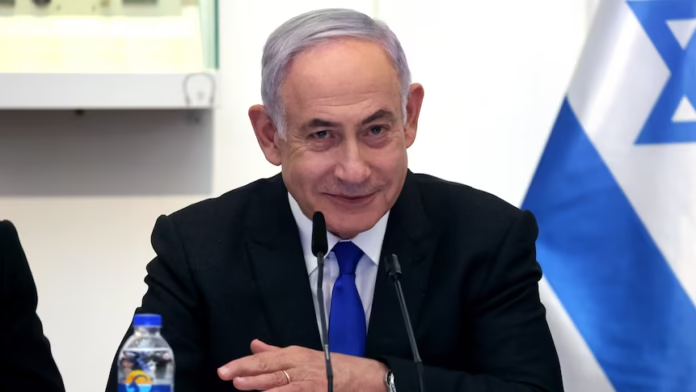

The question is benjamin netanyahu dead has dominated search engines, flooded social media timelines, and sparked debates across America for the past two weeks. The answer is an unambiguous no. Israeli Prime Minister Benjamin Netanyahu is alive, publicly active, and has held live press conferences, conducted in-person visits to strike sites, and engaged in high-level diplomatic calls throughout the ongoing Israel-Iran military conflict. The rumor is false. Here is a full breakdown of how it started, how far it spread, and where things actually stand as of today, March 14, 2026.
→ Bookmark this page and check back for the latest updates as the Israel-Iran conflict continues to develop.
How It All Started
On February 28, 2026, the United States and Israel launched coordinated air and missile strikes against multiple strategic targets inside Iran, including locations in and around the capital, Tehran. The strikes were part of a joint military operation aimed at degrading Iran’s nuclear infrastructure, military command structure, and leadership apparatus. Iranian Supreme Leader Ali Khamenei was killed in the assault. U.S. President Donald Trump announced the news on social media shortly after.
The regional shockwave was immediate. Iran’s military launched retaliatory ballistic missile barrages targeting Israeli cities. In the chaotic hours that followed, Netanyahu did not appear on camera. That brief, security-driven silence was all the rumor machine needed.
Iranian state-linked media moved quickly to fill the vacuum. Without any actual evidence, Iranian outlets began publishing speculation that Netanyahu had been killed or seriously wounded. They pointed to the short gap in his video presence, reports of heightened security around his residence, and the postponement of a U.S. diplomatic visit as supposed indicators of something sinister. None of those points constituted evidence of anything. But online, they spread as if they did.
The Specific Claims That Were Fabricated
The misinformation came in waves, and it grew more dramatic with each share. Some posts alleged that Iran had bombed Netanyahu’s personal home and killed his brother, Iddo Netanyahu. Others claimed National Security Minister Itamar Ben-Gvir had been seriously wounded in the same strike. A widely shared video was falsely labeled as showing grief inside Israeli bunkers following Netanyahu’s death. One social media post insisted that Al Jazeera had briefly reported his death before deleting the story — a claim that was never substantiated and that Al Jazeera itself did not acknowledge.
Blurry, unverifiable images circulated as supposed proof. Russian state-backed media amplified the claims. TikTok videos racked up millions of views before being flagged. A Facebook page titled something along the lines of “R.I.P. Benjamin Netanyahu” attracted a staggering number of interactions before it was widely identified as a hoax.
Not one of these claims was backed by evidence. Netanyahu’s office dismissed the Iranian assertions as deliberate misinformation. Israeli residents near his Jerusalem office reported seeing no signs of a missile impact in the area after Iran claimed to have struck it.
What Was Actually Happening
While the rumor circulated online, Netanyahu’s documented public activity told a very different story.
On March 1, he held a security meeting in Tel Aviv with the Minister of Defence, the IDF Chief of Staff, and the Director of the Mossad. His office released images from the meeting. On March 2, he visited Beit Shemesh in person, where a missile strike had killed nine civilians. He met with grieving families and first responders on-site — not via prerecorded video, but in person, in real time. That same evening, he sat for a live televised interview in which he addressed the ongoing military campaign and stated the war would not be an endless conflict.
On March 5, a readout from the French presidential office documented a phone call between Netanyahu and French President Emmanuel Macron. On March 6, he visited an impact site in Beersheba. On March 7, his office published an official statement attributed directly to him.
Every one of those events happened while the internet was insisting he was dead.
The March 12 Press Conference
The rumor effectively collapsed on March 12, 2026, when Netanyahu held his first full press conference since the war began thirteen days earlier. The event was broadcast live, streamed on multiple platforms, and watched by millions of people around the world.
He spoke at length about the military campaign, calling it an operation that had dealt historic damage to Iran’s military and nuclear apparatus. He stated that Israeli and American forces had eliminated top Iranian nuclear scientists. He described the strikes as having fundamentally altered the balance of power in the region, saying Iran was “no longer the same Iran.” He spoke about diplomatic efforts, referenced near-daily calls with President Trump, and addressed the situation with Hezbollah in Lebanon.
There was nothing ambiguous about it. A sitting prime minister speaking live, taking questions, and delivering detailed strategic statements is not a man who is dead.
Why the Rumor Worked — And Who Pushed It
Leadership death hoaxes are among the most effective tools in modern information warfare. They do not need to be believable to create confusion. They just need to spread faster than the truth. In a wartime environment where real events are already moving at extraordinary speed and official communications are occasionally delayed by security protocols, false narratives rush in to fill the gaps.
The Iran-linked media ecosystem had clear strategic incentives to push this particular story. Declaring that an enemy leader’s fate is “uncertain” — even without evidence — creates psychological pressure, sows doubt among the population, and generates confusion among international observers. It is a tactic with a documented history in conflict zones around the world.
The claims about Netanyahu’s brother and other Israeli officials were also false. Iddo Netanyahu was not killed. Ben-Gvir published a video on his own social media stating clearly that he was alive and unharmed.
Multiple fact-checking organizations around the world reviewed the claims independently and reached the same conclusion: the story was fabricated, amplified by adversarial state media, and spread virally by users who did not verify what they were sharing before hitting repost.
Is Benjamin Netanyahu Dead? The Definitive Answer
No. As of March 14, 2026, Benjamin Netanyahu is alive and serving as Israel’s Prime Minister. He is actively directing one of the most consequential military campaigns in Israeli history, speaking publicly on a near-daily basis, conducting diplomatic conversations with the leaders of allied nations, and making real-time decisions about a war that is reshaping the entire Middle East.
The question is benjamin netanyahu dead has a clear answer. What does not yet have a clear answer is how this war ends — and what the region will look like when it does. The conflict with Iran continues to escalate. Hezbollah is engaged on Israel’s northern border. Humanitarian pressure from European governments is growing. The diplomatic situation remains volatile and unpredictable.
Netanyahu is alive and at the center of all of it.
If you have been following this story and want to weigh in on how wartime misinformation spreads and who is responsible for it, drop your thoughts in the comments below — and keep coming back as this situation continues to evolve.