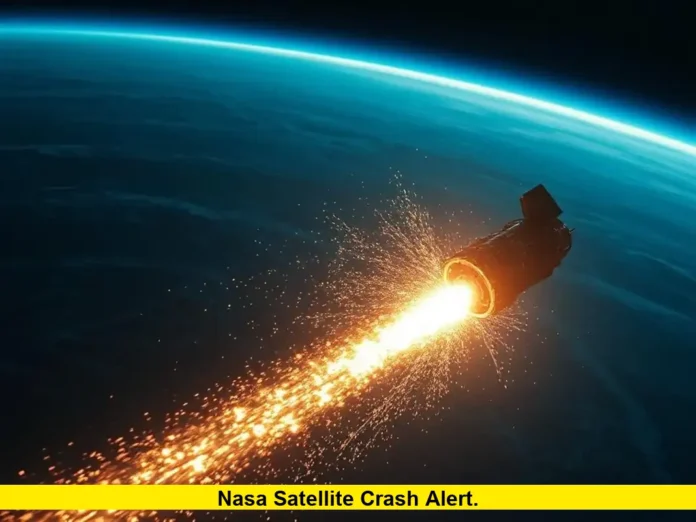

A nasa satellite crash event is drawing global attention as a spacecraft launched more than a decade ago prepares to reenter Earth’s atmosphere. The satellite, known as Van Allen Probe A, is expected to descend back toward Earth after nearly 14 years in orbit studying the planet’s radiation belts. The returning spacecraft weighs about 1,323 pounds (600 kilograms) and has been gradually losing altitude since its mission ended several years ago.
The spacecraft originally launched in August 2012 as part of a twin-probe mission designed to analyze the powerful radiation zones surrounding Earth. Those regions, known as the Van Allen belts, contain highly energetic charged particles trapped by Earth’s magnetic field that can affect satellites, astronauts, and communications systems.
Readers following major space developments can keep checking back as scientists track the satellite’s descent and share updates about its reentry timeline.
Why the Satellite Is Falling Back to Earth
Satellites cannot remain in orbit forever. Over time, subtle forces gradually pull them closer to the planet.
In the case of Van Allen Probe A, the spacecraft completed its scientific mission years ago and was deactivated in 2019 after delivering extensive data about Earth’s radiation environment. Without active propulsion or orbit-boosting maneuvers, the satellite began slowly descending due to orbital decay.
Orbital decay occurs when a spacecraft encounters tiny amounts of atmospheric drag. Even hundreds of miles above Earth, traces of the atmosphere create friction that gradually reduces a satellite’s speed. As speed drops, gravity pulls the object into a lower orbit.
Another contributing factor is increased solar activity. When the Sun becomes more active, it heats and expands the upper atmosphere, which increases drag on orbiting spacecraft and accelerates their descent.
Over time, these forces caused the satellite’s orbit to shrink until it reached the final stage of reentry.
What Happens During Reentry
When a spacecraft returns to Earth’s atmosphere, it encounters intense friction with atmospheric particles. This friction produces extremely high temperatures that can exceed 1,500 degrees Celsius.
At those temperatures, many parts of the spacecraft melt, fragment, or completely vaporize. Scientists tracking the nasa satellite crash say most of the vehicle will burn up before reaching the ground.
However, some components built from dense metals can sometimes survive reentry. Tanks, structural supports, or other heavy elements may remain intact long enough to fall toward Earth as small pieces of debris.
Because the majority of the spacecraft disintegrates during reentry, only a limited amount of material could potentially reach the surface.
Risk to People on the Ground
Although dramatic headlines often surround satellite reentries, the risk to people on Earth is extremely small.
Experts estimate the probability of someone being harmed by debris from this returning spacecraft is roughly 1 in 4,200.
There are several reasons the risk remains so low:
- About 70 percent of Earth’s surface is covered by oceans
- Large unpopulated areas exist across continents
- Most spacecraft components burn up during reentry
Because of these factors, any surviving fragments are far more likely to land in open water or remote areas rather than populated regions.
The Mission Behind Van Allen Probe A
Before the nasa satellite crash captured public attention, the spacecraft played an important role in space science.
Van Allen Probe A was part of a two-satellite mission that studied the structure and behavior of Earth’s radiation belts. These belts were discovered in the early days of the space age and remain a major focus for scientists who study space weather.
The probes helped researchers understand:
- How solar storms influence Earth’s radiation environment
- How high-energy particles move through space
- How radiation affects satellites and astronauts
The data collected by the mission helped improve models used to protect spacecraft and communication systems from space weather hazards.
Even though the mission originally planned to operate for about two years, both probes exceeded expectations and continued gathering valuable measurements for several years.
How Scientists Track a Reentry Event
Monitoring a satellite’s return to Earth requires a combination of advanced tracking technologies.
Space agencies and monitoring systems use several methods to predict where and when a spacecraft will reenter:
- Radar systems that detect objects in orbit
- Ground-based telescopes observing satellite paths
- Atmospheric models that estimate drag effects
- Computer simulations predicting reentry timing
As the spacecraft descends, scientists continuously update calculations. Reentry predictions often change by several hours because atmospheric conditions can shift rapidly.
Because of these uncertainties, experts typically provide a time window rather than an exact moment for when the spacecraft will enter the atmosphere.
Why Satellite Reentries Are Part of Space Operations
Events like this nasa satellite crash highlight a routine aspect of space activity. Thousands of satellites orbit Earth, and many eventually reenter the atmosphere once their missions end.
Modern spacecraft are often designed to minimize long-term space debris by allowing them to naturally fall back toward Earth after they complete their tasks.
This process helps keep orbital pathways safer for future missions by reducing the number of inactive satellites drifting through space.
The controlled or natural removal of satellites is considered a key strategy for managing the growing population of objects in orbit.
Looking Ahead
As tracking continues, scientists expect the spacecraft to break apart during its fiery descent through the atmosphere. Most of the material will disappear before reaching the ground, while any surviving fragments would likely fall into remote areas or the ocean.
The event marks the final chapter of a spacecraft that spent more than a decade helping scientists understand one of the most complex regions surrounding Earth.
Space agencies will continue monitoring the reentry and updating predictions until the spacecraft completes its descent.
What are your thoughts on this returning spacecraft? Share your perspective below and keep following for more space and science updates.