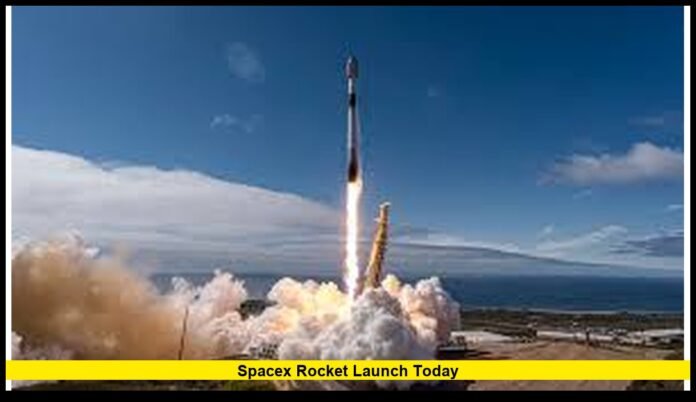

The SpaceX rocket launch today successfully sent a Falcon 9 rocket into space carrying a new batch of Starlink satellites, continuing the company’s mission to expand global satellite internet coverage. The launch took place from Florida’s Space Coast and followed the precise mission timeline SpaceX has become known for in recent years.
The Falcon 9 rocket lifted off from Space Launch Complex-40 at Cape Canaveral Space Force Station during an early-morning launch window. Within minutes, the rocket reached space and began delivering Starlink satellites into low-Earth orbit. The mission also included the recovery attempt of the rocket’s first-stage booster on a droneship positioned in the Atlantic Ocean.
Today’s mission highlights SpaceX’s ability to conduct frequent launches while continuing to build one of the largest satellite constellations ever deployed.
Falcon 9 Rocket Lifts Off From Florida
The launch began as Falcon 9’s nine Merlin engines ignited seconds before liftoff. The engines produced powerful thrust, pushing the rocket off the launch pad and into the sky above Cape Canaveral.
The rocket quickly climbed through the atmosphere, following a carefully calculated flight path designed to place the Starlink satellites into their correct orbit.
The early phase of the mission unfolded in several key steps:
- Engines ignited just before liftoff
- Falcon 9 cleared the launch tower and began its ascent
- The rocket accelerated toward space
- First-stage booster separated from the upper stage
- The second stage continued carrying the satellites toward orbit
This sequence takes only a few minutes but requires extremely precise timing and engineering.
SpaceX has refined this launch process through hundreds of missions, making Falcon 9 one of the most dependable rockets currently operating.
Mission Overview
The goal of today’s launch was to deploy additional satellites for the Starlink broadband constellation.
Here are the confirmed mission details:
| Mission Detail | Information |
|---|---|
| Rocket | Falcon 9 |
| Launch Site | Cape Canaveral Space Force Station |
| Launch Complex | Space Launch Complex-40 |
| Mission | Starlink satellite deployment |
| Orbit | Low-Earth orbit |
| Operator | SpaceX |
After reaching the planned orbital altitude, the Falcon 9 upper stage began the deployment process for the satellites.
The spacecraft will gradually move into their assigned orbital positions in the coming weeks.
Starlink Satellites Expand Internet Coverage
Starlink is SpaceX’s satellite internet network designed to deliver high-speed connectivity across the globe.
The system uses thousands of small satellites orbiting Earth to create a massive communications network in space.
Unlike traditional satellites that operate at very high altitudes, Starlink satellites orbit much closer to Earth. This reduces signal delay and allows faster internet speeds.
The network aims to provide internet service to locations where traditional broadband infrastructure is difficult to build.
Examples include:
- Rural communities
- Remote islands
- Ships at sea
- Aircraft in flight
- Emergency response zones
- Mountain regions
Millions of people already rely on Starlink for internet access.
Each new launch strengthens the network and increases its overall capacity.
How the Satellites Reach Their Final Orbits
Once the Falcon 9 rocket reaches orbit, the satellite deployment sequence begins.
The satellites are stacked together in a compact configuration inside the rocket’s payload section.
After reaching the correct position in space, the rocket releases the stack of satellites.
The deployment process typically follows this timeline:
- The rocket reaches low-Earth orbit.
- The upper stage adjusts its orientation.
- The satellite stack separates from the rocket.
- Individual satellites activate onboard systems.
- Solar panels deploy to begin generating electricity.
Each satellite uses small ion propulsion systems to gradually move into its operational position.
This process may take several weeks before the satellites become fully active.
Reusable Booster Returns Toward Earth
A defining feature of Falcon 9 missions is the reuse of rocket boosters.
After the first stage completed its role during the launch, it separated from the upper stage and began its return to Earth.
Instead of burning up in the atmosphere, the booster executed a controlled descent.
The landing process includes several steps:
- The booster flips around in mid-air.
- Engines reignite to slow the rocket.
- Grid fins guide the rocket toward its landing location.
- The booster targets a landing platform in the ocean.
For this mission, the landing target was a SpaceX autonomous droneship stationed in the Atlantic Ocean.
Recovering boosters allows SpaceX to reuse the same rocket hardware multiple times.
This technology has dramatically reduced the cost of launching satellites into space.
Falcon 9: The Workhorse of SpaceX
Falcon 9 has become the backbone of SpaceX’s launch operations.
The rocket first launched in 2010 and has completed hundreds of successful missions since then.
Its design includes:
- Nine Merlin engines on the first stage
- One Merlin Vacuum engine on the upper stage
- Reusable booster technology
- Autonomous landing capability
The rocket can launch a wide range of payloads, including satellites, cargo spacecraft, and astronaut crews.
Falcon 9 also supports missions for NASA, commercial companies, and international partners.
Because of its reliability and reusability, Falcon 9 has become one of the most frequently launched rockets in the world.
SpaceX Maintains Rapid Launch Schedule
SpaceX has built a reputation for launching rockets at a remarkable pace.
The company conducts missions from multiple launch sites across the United States.
These sites include:
- Cape Canaveral Space Force Station in Florida
- Kennedy Space Center in Florida
- Vandenberg Space Force Base in California
Each location supports different mission profiles depending on the target orbit.
Many launches focus on expanding the Starlink constellation.
However, SpaceX also launches satellites for commercial customers and government agencies.
The company’s rapid launch cadence has set new records for the number of launches completed in a single year.
Why Starlink Matters
Starlink represents one of the most ambitious space infrastructure projects ever built.
Traditional internet infrastructure relies on fiber-optic cables and ground networks.
These systems can be expensive or difficult to build in remote areas.
Satellite internet provides a solution by delivering connectivity directly from space.
Starlink offers several advantages:
- Global coverage potential
- Faster speeds than older satellite systems
- Lower latency due to low-Earth orbit
- Portable user terminals
The network has already supported communications during natural disasters and emergencies.
It has also provided internet access in remote regions that previously had limited connectivity.
SpaceX’s Broader Spaceflight Vision
Although Falcon 9 continues to power most launches, SpaceX is developing a next-generation rocket called Starship.
Starship is designed to carry far larger payloads into space and support long-distance missions.
The system aims to enable:
- Future Moon missions
- Mars exploration
- Large satellite deployments
- Deep-space cargo transport
While Starship undergoes testing, Falcon 9 remains the primary rocket supporting SpaceX’s current missions.
The rocket continues to launch satellites, cargo spacecraft, and astronauts into orbit.
Rocket Launches Continue to Inspire
Rocket launches remain some of the most dramatic events in modern technology.
Watching a rocket rise into the sky is a powerful reminder of humanity’s progress in space exploration.
Launches from Florida often attract spectators along the Space Coast.
When weather conditions are clear, the bright plume from a Falcon 9 rocket can be visible across large areas of the southeastern United States.
Many people gather at beaches and viewing locations to watch launches in person.
For space enthusiasts, each launch represents another step forward in expanding human activity beyond Earth.
The Importance of Today’s Mission
The SpaceX rocket launch today demonstrates how routine orbital missions have become in the modern space era.
A single launch may last only a few minutes, but its impact extends much further.
Each Starlink deployment strengthens a global network that connects people around the world.
The mission also shows how reusable rocket technology continues to transform the economics of spaceflight.
SpaceX has proven that rockets do not have to be single-use machines.
Instead, they can be recovered, refurbished, and flown again.
What Comes Next for SpaceX
More missions are already planned as SpaceX continues expanding the Starlink constellation.
Future launches are expected to include:
- Additional Starlink deployments
- Commercial satellite missions
- Cargo flights to the International Space Station
- Continued testing of the Starship rocket
As the company increases its launch capabilities, the pace of space missions is likely to continue growing.
SpaceX remains one of the key drivers behind this transformation.
What do you think about the SpaceX rocket launch today and the growing network of Starlink satellites in orbit? Share your thoughts in the comments and stay tuned for the next spaceflight update.