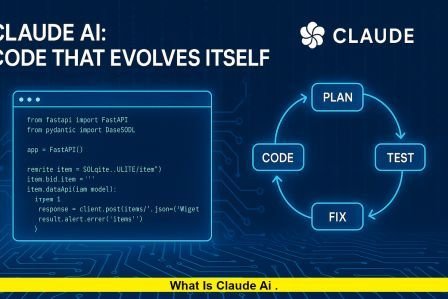

OpenAI’s ChatGPT isn’t the only major name in artificial intelligence anymore. What is Claude AI — a generative language model developed by Anthropic — and how did it surge to become the No.1 free app on U.S. app charts this week? The term what is Claude AI has spiked across search engines as users, businesses, and even some government groups take a fresh look at this next-generation assistant. Claude uses cutting-edge large language models designed to assist with writing, coding, data analysis, and everyday tasks.
Just this weekend, Claude AI climbed to the top of the Apple U.S. App Store free rankings, overtaking long-dominant competitors. The surge followed a highly public dispute between Anthropic and U.S. defense authorities over ethical guardrails for AI use in military systems. The result? Massive online attention and a wave of downloads from users curious about this model’s capabilities.
If you’ve ever wondered what what is Claude AI actually means for your own work or digital life, this in-depth article lays out the facts behind Claude’s technology, recent developments, and why it’s gaining real traction across industries and communities.
Start thinking about how AI could help you streamline work, get creative, or solve problems in new ways.
Anthropic’s Strategy and Recent Growth
Anthropic built Claude as an alternative to other major generative AI systems, focusing on constitutional AI — a training approach that emphasizes ethical and aligned responses. Claude has been through multiple versions, with recent releases including Sonnet 4.6 and Opus 4.6. These models bring strong reasoning, multitask workflows, and integrations with coding and business software. Claude Sonnet 4.6 is now the default model on many Claude plans, offering improved reasoning, planning, and connection to software tools.
In early 2026, Anthropic also expanded Claude’s enterprise features. The company rolled out enhancements that let Claude help automate tasks across platforms like spreadsheets, presentations, design tools, and document processing. Businesses of all sizes are now embedding Claude into everyday workflows to improve productivity and reduce manual steps previously done by humans.
Claude’s No.1 Rank on the U.S. Store
In a striking rise, Claude’s app skyrocketed to the top of the Apple U.S. free app store rankings this weekend. Many analysts point to the ongoing headline around the Pentagon contract dispute as a driver of this interest. Users disenchanted with other platforms or curious about Claude’s capabilities downloaded the app en masse — enough to unseat heavyweights and land it squarely in first place on U.S. charts.
That shift is notable because it reflects not just a momentary spike, but growing curiosity about alternative large language model tools and how AI can be used responsibly.
Government and Military Use Controversy
A major part of the story shaping Claude’s public profile has to do with its contract with the U.S. Department of Defense. In February 2026, Anthropic refused Pentagon demands to remove safety constraints prohibiting Claude from supporting fully autonomous weapons or mass surveillance systems. The company’s leadership argued those use cases crossed ethical boundaries for AI. As a result, government agencies were directed to phase out Claude within a six-month timeline.
Despite that directive, reports have emerged that military units continued to use Claude in real operations shortly after the ban, including intelligence and planning support in complex operations overseas. This contradiction highlights how deeply integrated powerful AI tools have become in advanced systems, and how policy changes can lag behind real-world deployments.
Outage and Platform Availability Today
As of today — the date of publication — Claude is experiencing a widespread service outage across its web and mobile platforms. Users around the world have reported elevated errors, failed requests, and difficulty accessing the main interface. Anthropic has acknowledged the incident and says its engineering teams are investigating. Interestingly, some backend services, including the Claude API, remain operational, suggesting developers and businesses may still leverage certain functions while the main user portal recovers.
Service disruptions like this can affect adoption sentiment in the short term, but many users continue to explore Claude’s advanced tools through code environments or integrated business applications that bypass the primary interface.
New Learning Platform for Developers and Enthusiasts
In addition to its core AI assistant, Anthropic launched a free online learning platform geared toward developers, students, and educators. The courses cover the basics of using Claude AI, API integration, coding workflows, and building applications with the Model Context Protocol (MCP). This educational push is designed to deepen the skill base around Claude’s technology and help users get practical experience with generative AI tools.
What This Means for AI Adoption in 2026
Claude’s rapid momentum — from enterprise adoption to mainstream user charts — illustrates a broader truth about the AI market: users want performance, flexibility, and ethical guardrails. Claude’s unique framing around safety and responsible use has resonated with many audiences, even as it battles regulatory and political challenges.
For U.S. audiences, this moment is significant because it shows how AI tools are no longer niche technology. They’re part of daily life, shaping how people communicate, learn, work, and even how governments think about innovation and control.
Claude’s rise signals broader competition across the generative AI landscape — with tools tailored to different needs and communities. Whether you’re a developer, creative professional, or just curious about the future of AI, understanding what is Claude AI is a key part of keeping pace with today’s digital evolution.
We want to hear what you think about Claude and the future of AI — share your thoughts or questions below!