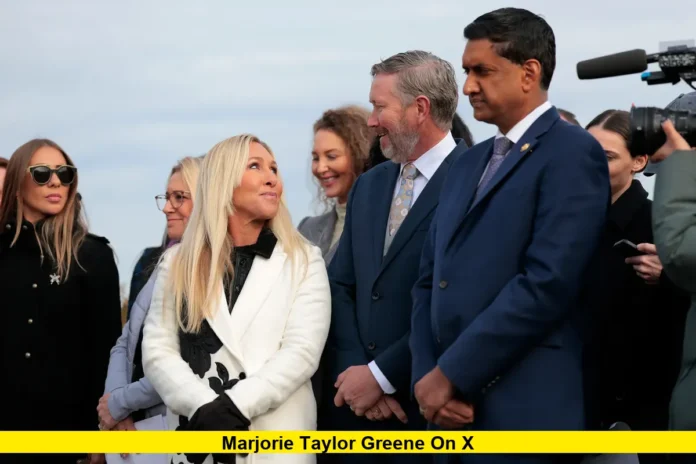

Former Georgia Republican lawmaker Marjorie Taylor Greene is again at the center of national political debate after sharply criticizing the 79-year-old president and warning voters about what she described as “performative” politics in Washington ahead of the 2026 midterm elections. Greene, who retired from Congress last month after serving two terms in the U.S. House of Representatives, posted her remarks on X, arguing that meaningful legislative action has effectively stalled as election season intensifies.
In her post, Greene claimed that lawmakers internally acknowledged early in 2025 that there was only a limited window — “six to nine months” — to accomplish serious policy goals before campaign considerations overtook governance. According to Greene, by the third quarter of 2025, political courage would fade and lawmakers would shift fully into campaign mode ahead of November’s midterm elections.
“Everything in Washington will be purely performative, for the remainder of the year, to gaslight you to vote in the midterms,” Greene wrote, asserting that voters were being manipulated through messaging rather than substantive policy action.
Allegations and Political Rhetoric
Beyond her criticism of Washington’s political strategy, Greene faulted the president for what she characterized as ignoring domestic issues. She also referenced the late convicted sex offender Jeffrey Epstein, alleging that the administration was attempting to cover up involvement connected to Epstein’s network.
Epstein, who died in federal custody in 2019 while awaiting trial on sex trafficking charges, has remained a focal point of political speculation and public scrutiny. His associations with numerous high-profile individuals have been widely reported over the years. However, no new official findings have emerged publicly linking the current president to criminal wrongdoing beyond previously documented interactions reported in the past.
Greene’s remarks did not cite new evidence but instead framed her claims as part of broader dissatisfaction with federal leadership and transparency.
Midterm Elections and Washington Strategy
The 2026 midterm elections are shaping up to be a pivotal moment for both major political parties. Historically, midterm contests often serve as a referendum on the sitting president’s performance. Control of Congress is at stake, and voter turnout patterns can significantly shift the balance of power in Washington.
Greene’s comments reflect a long-standing critique of election-year governance: that legislative productivity slows as campaigns ramp up. Political analysts frequently observe that lawmakers prioritize fundraising, messaging, and party unity as elections approach, often at the expense of bipartisan cooperation or sweeping legislative initiatives.
Her assertion that Washington would become “purely performative” echoes frustrations expressed by some voters across the political spectrum who believe Congress becomes more focused on optics than outcomes during campaign season.
Greene’s Post-Congress Influence
Although she stepped down from Congress after two terms, Marjorie Taylor Greene remains a prominent voice within conservative politics. During her tenure in the House, she was known for her combative rhetoric, strong alignment with conservative grassroots movements, and active use of social media to communicate directly with supporters.
Her retirement has not diminished her public platform. In fact, her ability to speak without the constraints of office may allow her to frame critiques more aggressively as the midterm season accelerates.
Within Republican circles, reactions to Greene’s statements have varied. Some conservative commentators have echoed concerns that the GOP must prioritize concrete policy wins rather than campaign messaging. Others argue that public attacks on party leadership or the broader political system could create internal divisions at a crucial electoral moment.
Domestic Policy Debate
Greene’s criticism also centers on what she describes as insufficient attention to domestic priorities. Economic conditions, inflation trends, border security, and national security continue to rank among top voter concerns heading into November.
The administration has pointed to legislative accomplishments and economic indicators it says demonstrate progress. Meanwhile, Republican messaging has increasingly emphasized cost-of-living pressures and border policy as defining issues of the midterm campaign.
Whether Greene’s warning resonates with a broad segment of voters remains uncertain. Midterm outcomes typically depend on a combination of economic conditions, turnout dynamics, and national political sentiment.
Broader Implications
The public dispute underscores a deeper debate about governance in election years. Critics often argue that Washington’s rhythm shifts dramatically as campaigns begin to dominate political calculations. Lawmakers, aware of voter perception and media cycles, may focus on positioning rather than compromise.
Greene’s accusation that voters are being “gaslighted” reflects a broader mistrust in federal institutions that has grown in recent years. Such rhetoric can energize certain segments of the electorate but may also intensify partisan divides.
As February 28, 2026 approaches, political messaging is expected to sharpen across party lines. Campaign infrastructure is expanding nationwide, fundraising totals are climbing, and candidates are solidifying their platforms.
Looking Ahead to November 2026
With months remaining before Americans cast their ballots, debates over leadership, transparency, and policy priorities will likely intensify. Greene’s comments serve as an early indicator of the tone that could define the midterm season: sharp, confrontational, and deeply partisan.
Whether voters view her warning as a credible critique of Washington’s political culture or as campaign rhetoric will ultimately be decided at the ballot box. What is clear is that even outside of elected office, Marjorie Taylor Greene continues to influence national political conversations at a pivotal moment in the election cycle.