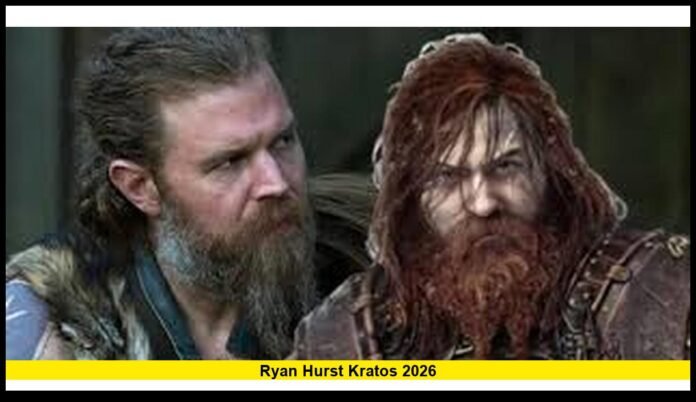

Ryan Hurst Kratos remains a trending search combination in 2026 as gamers continue revisiting God of War Ragnarök and discussing the unforgettable clash between Thor and Kratos. While Ryan Hurst did not portray Kratos himself, his performance as Thor placed him directly opposite Christopher Judge’s Spartan warrior in one of PlayStation’s most successful titles.
Interest around Hurst’s involvement has remained strong years after the game’s release. As players on PlayStation 5, PlayStation 4, and PC revisit the Norse saga, conversations about his portrayal continue across gaming communities in the United States.
Here is a detailed, factual look at Ryan Hurst’s role in God of War Ragnarök, his acting background, the performance capture process, and why his work remains central to the franchise’s modern legacy.
Ryan Hurst’s Background in Film and Television
Ryan Hurst was born on June 19, 1976, in Santa Monica, California. He built his career through physically demanding and emotionally layered roles in film and television.
Many American viewers first recognized him in:
- Remember the Titans (2000) as Gerry Bertier
- Sons of Anarchy (2008–2012) as Opie Winston
- The Walking Dead (2019–2020) as Beta
Across these roles, Hurst developed a reputation for portraying imposing characters with quiet vulnerability. His deep voice and commanding presence made him a strong fit for larger-than-life figures.
That skill set translated naturally into performance capture work for video games.
Casting as Thor in God of War Ragnarök
Santa Monica Studio cast Ryan Hurst as Thor in God of War Ragnarök, which launched in November 2022. The title concluded the Norse storyline that began with the 2018 reboot of the franchise.
Thor serves as a central antagonist in the narrative. He confronts Kratos early in the game and returns for pivotal encounters that shape the emotional direction of the story.
The studio reimagined Thor as a battle-scarred warrior burdened by expectation. This interpretation avoided glamorized mythology and instead emphasized physical realism and emotional conflict.
Hurst delivered full performance capture for the character. That process required him to perform physical movements, facial expressions, and dialogue simultaneously on a motion-capture stage.
Performance Capture and Acting Approach
Modern PlayStation productions rely heavily on cinematic presentation. For Ragnarök, actors performed scenes together to create authentic interactions.
Ryan Hurst worked closely with Christopher Judge, who portrays Kratos, as well as the broader cast. Directors captured body language and subtle facial movements to preserve nuance.
This method allowed Thor to feel grounded and human. Hurst’s vocal performance carried weight and restraint, reinforcing the character’s internal struggle.
The game’s seamless camera presentation heightened the impact of these performances. Players never experience visible cuts during story sequences, which keeps the emotional intensity consistent.
The Rivalry Between Thor and Kratos
The on-screen tension between Thor and Kratos drives much of Ragnarök’s narrative momentum. Their relationship goes beyond a simple hero-versus-villain structure.
Both characters are fathers grappling with past violence. Each faces pressure from powerful forces within their respective mythologies.
Key thematic parallels include:
- Responsibility toward their children
- Regret over past brutality
- Struggles with identity
- Questions about destiny
Hurst’s Thor is volatile yet reflective. Judge’s Kratos is controlled but haunted. Their confrontations deliver emotional stakes alongside cinematic combat.
This dynamic explains why search interest around Ryan Hurst Kratos continues years after release. Their performances feel interconnected, even though they portray opposing forces.
Commercial Success of Ragnarök
God of War Ragnarök became one of the fastest-selling first-party PlayStation titles at launch. It debuted on PlayStation 5 and PlayStation 4 before arriving on PC in 2024.
Confirmed sales milestones include:
- Over 15 million copies sold globally
- Franchise total exceeding 60 million units
In the United States, the title ranked among the top-selling console games during its release window. Strong word-of-mouth and critical acclaim sustained momentum beyond launch month.
The commercial performance solidified Ragnarök as a cornerstone of Sony’s first-party lineup.
Critical Reception and Awards Recognition
Upon release, Ragnarök received widespread praise for storytelling, world-building, combat design, and acting performances.
Christopher Judge earned major industry recognition for his portrayal of Kratos. The game also won numerous awards across categories such as narrative design, accessibility, and audio performance.
Ryan Hurst’s portrayal of Thor drew attention for its emotional complexity. Many players noted that his version of Thor felt layered and unpredictable.
Gaming communities highlighted the realism of his physical performance. His movements carried weight and fatigue, reinforcing the character’s lived experience.
Distinguishing the Roles Clearly
Search behavior often combines Hurst’s name with Kratos due to their shared screen time. For clarity:
- Christopher Judge portrays Kratos in the Norse-era titles.
- Ryan Hurst portrays Thor in God of War Ragnarök.
The two actors share multiple scenes that form the emotional core of the game. Their collaboration fuels ongoing online discussions and analysis videos.
Understanding this distinction helps explain why interest around their pairing remains strong.
Impact on Modern Game Storytelling
Ragnarök demonstrated how video games can deliver cinematic experiences rivaling film and television. The performances from its cast elevated storytelling standards across the industry.
Hurst’s work reinforced the idea that video game acting demands the same emotional commitment as traditional screen roles. Performance capture blends physical theater with voice work, requiring sustained focus and coordination.
The success of the Norse saga has encouraged other studios to prioritize narrative depth alongside gameplay innovation.
Thor’s Character Arc and Emotional Weight
Thor enters the story as a looming threat. However, as the narrative unfolds, players see glimpses of insecurity and frustration.
Hurst portrays a character caught between loyalty to Odin and personal doubt. His strained relationship with his sons adds complexity to his motivations.
Rather than portraying a straightforward villain, the performance reveals a man wrestling with his own legacy.
This layered depiction strengthens the broader themes of change and accountability that define the game.
Ongoing Cultural Relevance
Years after release, Ragnarök remains widely discussed within gaming circles. Streamers continue replaying major battles, including the confrontations between Thor and Kratos.
Fan art, cosplay, and convention panels keep interest alive. The franchise’s transition into television through a live-action adaptation has further boosted awareness of its characters.
Although casting for the television adaptation has not been publicly finalized, the game’s actors continue to be associated with their roles in fan discussions.
Hurst’s portrayal stands as one of the defining interpretations of Thor in interactive media.
Career Influence and Industry Recognition
Ryan Hurst’s work in Ragnarök introduced him to millions of gamers who may not have followed his earlier television roles.
The performance strengthened his reputation as an actor capable of bringing emotional nuance to physically imposing characters.
Video game performance capture continues to gain industry respect. Major awards ceremonies now include categories recognizing acting in interactive media.
Hurst’s contribution to the Norse saga represents a key moment in that evolution.
The Lasting Power of Character-Driven Conflict
What keeps audiences returning to Ragnarök is not just spectacle. It is the human conflict beneath the mythological scale.
The tension between Thor and Kratos reflects universal struggles with family, pride, and redemption.
By grounding these themes in authentic performances, Santa Monica Studio delivered a story that resonates beyond gaming.
The connection between the two characters explains why the pairing of their names continues to trend in online searches.
Final Thoughts
Interest in Ryan Hurst Kratos reflects the powerful rivalry that defined God of War Ragnarök. Hurst’s portrayal of Thor brought emotional depth and physical realism to one of gaming’s most intense confrontations.
His performance remains a standout in modern interactive storytelling and continues to spark discussion among U.S. gamers.
What was your reaction to the Thor and Kratos showdown? Join the conversation and keep following for more gaming updates.