
Is there a federal inheritance tax in the United States? As of 2026, the answer remains no — the federal government does not impose an inheritance tax, but federal estate tax rules still apply and several states continue to charge inheritance taxes.
Understanding this distinction matters because confusion between estate tax and inheritance tax affects financial planning, wealth transfers, and family expectations after a death. Current federal tax law maintains a historically high estate tax exemption, while inheritance tax remains a state-level issue.
Federal Inheritance Tax: The Current Rule in 2026
There is no federal inheritance tax in the United States today. Beneficiaries who receive money, property, or assets generally do not pay a federal tax simply because they inherited them.
Instead, the federal government uses an estate tax, which applies before assets pass to heirs.
Key facts for 2026:
- The federal government taxes large estates, not individual inheritances.
- Beneficiaries usually receive assets without federal inheritance tax liability.
- Estate tax responsibility falls on the estate itself, not the person inheriting.
This distinction is the most important takeaway for families reviewing estate plans.
Estate Tax vs. Inheritance Tax: The Critical Difference
Many Americans use the terms interchangeably, but they work differently.
Estate tax
- Paid by the estate before distribution.
- Applies only when an estate exceeds the federal exemption.
- Managed by the executor.
Inheritance tax
- Paid by the beneficiary receiving assets.
- Set and collected by individual states.
- Often depends on relationship to the deceased.
Because there is no federal inheritance tax, beneficiaries typically avoid federal tax bills tied directly to inheritance.
Federal Estate Tax Exemption in 2026
Federal estate tax remains in effect for high-value estates.
For 2026, the exemption remains historically high due to current federal tax law adjustments tied to inflation.
Verified structure:
- Only estates exceeding the federal exemption threshold may owe estate tax.
- Most U.S. households remain below the threshold.
- Married couples can combine exemptions using portability rules.
Tax planning professionals continue to monitor future legislative changes because the current higher exemption is scheduled to change after 2025 unless lawmakers act.
This potential shift keeps the question — is there a federal inheritance tax — relevant for families planning ahead.
States That Do Have Inheritance Tax
Although the federal government does not impose an inheritance tax, some states still do.
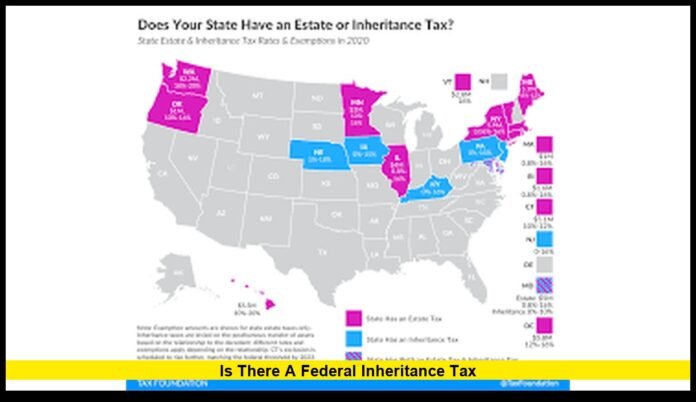
As of 2026, inheritance tax exists in a small number of states:
- Iowa (phasing out but still applicable in limited situations during transition)
- Kentucky
- Maryland
- Nebraska
- New Jersey
- Pennsylvania
Each state applies different rules based on:
- Relationship to the deceased
- Size of inheritance
- Type of asset
Close relatives such as spouses are often exempt. Children may pay reduced rates or none, depending on the state.
Who Actually Pays Taxes on Inherited Assets
Even without a federal inheritance tax, taxes can still arise in other ways.
Beneficiaries may face:
- Capital gains tax when selling inherited property
- Income tax on inherited retirement accounts
- State inheritance tax where applicable
However, most inherited assets receive a step-up in basis, which reduces future capital gains exposure.
This rule remains a central feature of federal tax policy and significantly affects real estate and investment inheritance.
Why Confusion About Federal Inheritance Tax Continues
The question appears frequently because tax terminology overlaps.
Reasons confusion persists:
- Estate tax and inheritance tax sound similar
- Media coverage focuses on “death taxes” broadly
- State inheritance tax still exists
- Federal estate tax debates occur regularly in Congress
Financial headlines about estate tax changes often lead people to assume a federal inheritance tax exists when it does not.
Potential Changes After 2025
Tax law uncertainty is the biggest reason planners discuss this topic now.
Current law indicates:
- The federal estate tax exemption is scheduled to decrease after 2025 if no legislation changes it.
- Estate tax exposure could expand to more households.
- Inheritance tax remains a state decision.
Even if the exemption drops, that would not automatically create a federal inheritance tax. It would expand estate tax reach instead.
Planning Strategies Families Use
Because there is no federal inheritance tax, planning often focuses on estate tax exposure and asset structure.
Common strategies include:
- Lifetime gifting within annual limits
- Trust structures
- Spousal portability elections
- Retirement account planning for beneficiaries
- Reviewing state inheritance tax exposure
These strategies remain standard practice in 2026 estate planning.
Retirement Accounts and Inheritance Rules
One area where beneficiaries may face taxes involves retirement accounts.
Current rules:
- Many non-spouse beneficiaries must withdraw inherited retirement funds within 10 years.
- Withdrawals can create income tax liability.
- Spouses retain more flexible options.
This is not an inheritance tax but often feels similar because taxes occur after inheritance.
What Most U.S. Families Should Know
For the majority of Americans:
- There is no federal inheritance tax.
- Estate tax affects only large estates.
- State inheritance tax may apply depending on location.
- Beneficiaries should still understand capital gains and retirement account rules.
Estate planning conversations increasingly focus on future exemption changes rather than creation of a federal inheritance tax.
Bottom Line
The answer remains clear in 2026: there is no federal inheritance tax in the United States. Federal tax applies to estates above certain thresholds, while inheritance taxes exist only in a handful of states.
Understanding this difference helps families avoid unnecessary worry and make informed estate planning decisions.
What questions do you still have about inheritance taxes or estate planning rules? Share your thoughts below and stay updated on the latest changes.