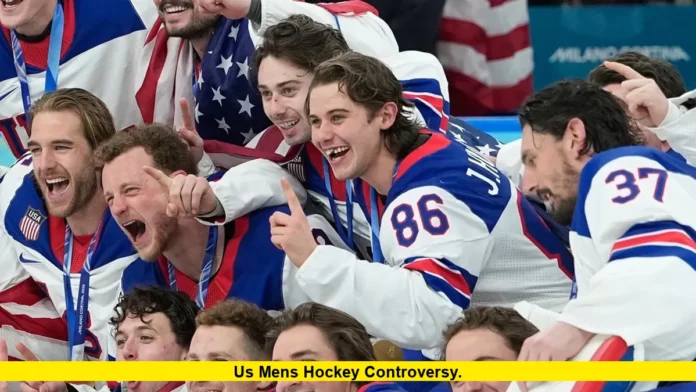

The U.S. men’s hockey team captured global attention after securing a dramatic Olympic gold medal victory over Canada, but the celebration quickly shifted into controversy. In the days following the historic win — the program’s first Olympic gold in more than four decades — political reactions, viral locker-room moments, and questions about public officials’ involvement turned a triumphant sports story into a broader national debate.
Historic victory sparks massive spotlight
The United States defeated Canada 2–1 in overtime in the Olympic gold-medal game, delivering one of the most significant moments in modern American hockey. The victory immediately drew comparisons to the “Miracle on Ice” era because of the long gap since the team’s last Olympic gold.
The dramatic finish, standout goaltending, and emotional celebration placed the players at the center of worldwide coverage. That intense attention meant that everything surrounding the win — including post-game interactions — was amplified across television, social media, and political circles.
As a result, what began as a celebration of athletic achievement rapidly evolved into a multi-layered controversy.
Locker-room phone call becomes viral flashpoint
One of the biggest talking points emerged from a locker-room phone call made shortly after the game. The president congratulated the team and invited players to attend the upcoming State of the Union address as honored guests.
During the call, a remark referencing the U.S. women’s hockey team circulated widely online. Critics argued the comment appeared dismissive toward women’s sports, while supporters said it was meant as light humor during a celebratory moment.
Video footage showed players laughing during the call, which fueled debate across social platforms. Some commentators said the reaction placed athletes in a political spotlight they did not seek, while others argued the moment was being overinterpreted.
The clip quickly became the most viral element of the post-gold celebration.
Celebration involving federal official draws scrutiny
Another controversy developed after images surfaced showing a senior federal official joining the team’s locker-room celebration overseas.
Critics questioned whether the official’s presence blurred the line between personal celebration and government travel. The issue centered on whether public resources were used in connection with the appearance.
In response, the official stated the trip was primarily for official business and said any personal expenses related to the celebration would be reimbursed.
The explanation did little to quiet debate, particularly among political commentators who argued that the optics of the moment overshadowed the team’s achievement.
Political messaging intensifies reaction
The aftermath of the victory also included official social media messaging celebrating the U.S. win over Canada. Some posts used aggressive rivalry imagery that critics described as overly political for a sporting event.
Supporters defended the messaging as typical sports rivalry enthusiasm, noting that intense symbolism often follows major international victories.
Still, the reaction illustrated how quickly sports moments can become entangled with national identity, political narratives, and online discourse — especially when the event involves a historic win against a major rival.
State of the Union invitation creates debate
The invitation for players to attend the State of the Union added another layer to the controversy.
While invitations to championship teams are common, the timing raised logistical questions because of professional league schedules and existing commitments. Reports indicated that attendance decisions varied among players, and scheduling conflicts complicated participation.
Discussion also emerged about recognition across men’s and women’s programs, further extending the conversation beyond a single event.
The debate highlighted the increasingly complex relationship between sports milestones and political ceremonies.
Athletes caught in the middle
For many players, the controversy unfolded largely outside their control. Athletes who had just achieved a career-defining accomplishment suddenly found themselves part of a political conversation spanning television panels, opinion columns, and social media debates.
Sports analysts noted that this dynamic has become more common in recent years, particularly when major victories intersect with national politics or cultural issues.
Some commentators urged restraint, emphasizing that the central story remains the team’s performance and historic achievement rather than the surrounding noise.
Why the story grew so quickly
Several factors explain why the controversy escalated:
- The victory itself was historic, increasing visibility
- The rival matchup with Canada amplified national interest
- Viral video accelerated online reaction cycles
- Political figures were directly connected to post-game moments
- The State of the Union invitation extended the news cycle
Together, these elements created a perfect environment for a sports story to evolve into a broader national conversation.
Broader trend: sports and politics increasingly overlap
The situation reflects a wider trend in modern sports where major events frequently intersect with politics, public officials, and cultural debates.
Championship visits, ceremonial invitations, social media messaging, and viral locker-room content can quickly shift narratives beyond the playing field. Analysts say this dynamic is unlikely to change as athletes, teams, and political figures all operate in highly visible digital environments.
The U.S. men’s hockey controversy illustrates how rapidly attention can move from performance to perception.
Impact on the team and public perception
Despite the controversy, the team’s on-ice achievement remains widely celebrated. Fans and hockey organizations continue to emphasize the significance of the gold medal, the dramatic overtime finish, and the long wait since the previous Olympic title.
However, the off-ice discussion has shaped how the story is remembered in real time. Instead of a singular focus on the championship, coverage now includes political optics, public reaction, and questions about the intersection of sports and national messaging.
This dual narrative — triumph and controversy — often defines major modern sports moments.
What happens next
The controversy is expected to fade as attention shifts back to league play and upcoming international competitions, but several elements may continue to generate discussion:
- Player decisions regarding ceremonial appearances
- Public responses from athletes if they choose to comment
- Ongoing debate about sports recognition across programs
- Media analysis of political involvement in sports celebrations
Whether the story remains prominent will depend largely on new developments or direct responses from players and officials.
The bottom line
The U.S. men’s hockey controversy is not rooted in gameplay, officiating, or competitive integrity. Instead, it emerged from the aftermath of a historic Olympic victory — specifically the viral locker-room call, the presence of a federal official at celebrations, political messaging following the win, and debate over ceremonial invitations.
At its core, the episode demonstrates how major sports achievements now unfold in a highly connected environment where celebration, politics, and public perception can collide almost instantly.
Even as debate continues, the team’s gold medal stands as one of the most significant milestones in recent American hockey history — a reminder that historic victories can generate both national pride and national conversation.