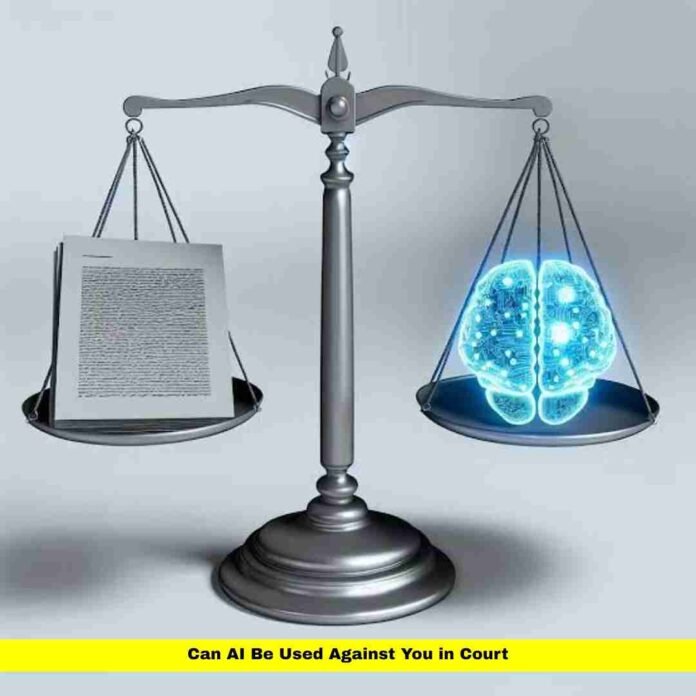

Artificial intelligence is transforming nearly every industry, and the justice system is no exception. One of the most pressing legal questions today is Can AI be used against you in court — either as evidence, through AI-generated materials, or indirectly through tools used by lawyers or opposing parties. As the technology grows more powerful and widely available, judges and attorneys alike are confronting real challenges about how AI fits into courtroom rules, evidentiary standards, and attorney-client privilege.
In early 2026, several U.S. courts issued rulings and statements confirming that AI-generated content can be introduced in legal proceedings, that AI materials are not automatically privileged, and that lawyers who rely on unverified AI outputs may face sanctions. These developments are reshaping the landscape of legal responsibility, evidence authentication, and courtroom procedure.
How AI-Generated Content Is Appearing in Courts
Artificial intelligence tools — especially large language models — can generate text, summaries, arguments, and even legal citations.
In one confirmed 2026 case, a federal appeals court sanctioned an attorney for submitting a legal brief containing multiple AI-generated inaccuracies and fabricated citations. The court emphasized that the attorney failed to verify the content produced by AI, leading to penalties because courts hold each lawyer responsible for the accuracy of their filings.
Meanwhile, another federal decision ruled that AI-generated documents created by a defendant and shared with counsel were not protected by attorney-client privilege or the work product doctrine. The judge explained that using a public AI platform — whose terms do not guarantee confidentiality — does not preserve legal protections typically reserved for communications between a client and their lawyer.
These confirmed rulings show that AI-created material can be produced, examined, and used in court settings, especially when it relates to legal strategy, evidence, or document submissions, so long as it meets admissibility standards and is not inherently protected from discovery.
Attorney-Client Privilege Doesn’t Automatically Cover AI Use
One of the most significant verified developments in early 2026 involved a federal district court in New York.
In that case, a criminal defendant used a publicly available AI chatbot to draft reports related to defense strategy and legal arguments and then shared the results with his lawyers. When federal prosecutors sought access to those AI-generated files, the court ruled they were not protected by attorney-client privilege or work product protections because:
- The AI tool used was not subject to confidentiality guarantees.
- The defendant voluntarily gave material to a third-party platform.
- The output did not directly reflect privileged communications between attorney and client.
By holding that AI outputs shared with prosecutors could be examined, the ruling confirmed that using AI does not automatically shield material from government review, and that such items can be used against a party if they become part of court records or discovery.
Sanctions for AI “Hallucinations” Are Increasing
Accurate legal research and citation are foundational in court filings. Recently, appellate courts have shown little tolerance for legal briefs containing false or fabricated authority generated by AI.
In one verified appellate decision from February 2026, a lawyer was fined for including scores of invented cases and misrepresented facts in a brief that the attorney admitted was drafted with the assistance of AI. The court criticized the reliance on unverified AI output and pointed out that existing professional conduct rules were sufficient to police such behavior — even without new AI-specific regulations.
This trend shows that if a lawyer uses AI without verifying its outputs, opposing counsel — and ultimately the court — can treat those errors as misconduct, giving prosecutors or opposing parties an advantage in litigation.
Judges Are Grappling With AI’s Place in Evidence Rules
U.S. courts and federal judicial panels are actively discussing how to handle AI-generated evidence and whether current rules are sufficient.
A federal judiciary advisory committee recently released a draft proposal that would require machine-generated evidence to meet the same admissibility standards as expert testimony. While the proposal has drawn mixed reactions, it reflects the judiciary’s acknowledgment that AI evidence — whether forensic reports, summaries, or algorithmic analysis — raises unique questions about reliability and standards.
Judges have also expressed broader concern that AI technology, including deepfake media and AI-enhanced evidence, threatens to complicate long-standing evidentiary practices. Courts historically require parties to authenticate evidence and establish chain of custody. With sophisticated AI-generated content now in circulation, judges and attorneys face a harder task distinguishing legitimate digital evidence from machine-generated fabrications.
Juries and AI Evidence: A Credibility Challenge
As artificial intelligence becomes more prevalent, jurors are increasingly likely to encounter machine-related evidence, summaries, or even arguments that reference AI outputs. This trend raises concerns among legal professionals that juries might assign undue credibility to AI because of the perception that computers are “objective.”
Judges and legal scholars have highlighted that juries must be instructed on how to evaluate AI-related evidence carefully, and attorneys must present it within the context of existing rules governing expert testimony, hearsay, and authentication.
Ethical Responsibilities for Lawyers Using AI
The use of AI in legal practice does not exempt attorneys from their ethical duties.
Recent discussions among legal professionals emphasize that lawyers must remain technologically competent and ensure that any AI tools they use or rely on comply with professional conduct obligations. Failing to understand the scope and limitations of AI technology has already resulted in sanctions when courts held attorneys accountable for careless use of machine-generated materials.
Ethical rules require lawyers to verify any facts, citations, or legal references before submitting them to a court. As AI’s capacity to “hallucinate” false information becomes more widely known, courts expect attorneys to exercise due diligence — and punish lapses that prejudice opposing parties or confuse the record.
AI in Criminal Trials: Reliability and Litigation Impacts
In criminal cases, technology like AI-generated forensic analysis tools is under scrutiny. Research and litigation trends indicate variability in how courts treat such evidence.
At present, forensic evidence derived solely from automated AI systems must still satisfy standards for admissibility, usually requiring expert testimony about how the evidence was generated, its reliability, and its relevance to the case.
The justice system’s established standards for scientific and expert evidence apply to AI evidence as well. This means that AI output alone cannot replace foundational evidentiary requirements, and attorneys must be prepared to explain and defend the technology’s accuracy in court.
Defamation and Deepfake Content in Legal Disputes
Courts are also beginning to address cases involving AI-generated defamatory content or deepfake videos and images.
Judges have acknowledged that existing defamation law may need adaptation as AI-created content becomes more convincing and widespread. Parties involved in such cases are navigating how to prove whether content is authentic or manipulated, and how AI’s role affects legal liability.
While this area of law is still evolving, confirmed reports show increasing judicial attention to AI’s impact on defamation and reputation disputes — especially when such content is introduced during litigation.
Courtroom Technology and Privacy Implications
Not all AI-related courtroom issues involve evidence directly. Recent courtroom events highlighted privacy and surveillance concerns tied to AI-enabled devices, such as smart glasses capable of recording audio and video.
In one incident, a judge prohibited AI-enabled smart glasses in the courtroom and ordered any recordings deleted, reinforcing longstanding rules that restrict unauthorized recordings in legal proceedings. Although not directly related to AI evidence admissibility, this development illustrates the judiciary’s broader effort to protect fair trial rights and jury privacy as new technologies enter legal spaces.
Regulation and Future Legal Standards
As of today’s confirmed reporting, federal judicial panels are considering proposed rules for how AI-generated evidence should be treated. These discussions acknowledge that current evidence rules may need clarification as machine-generated content becomes more common.
Legal professionals remain skeptical that a single new rule will immediately address all challenges. However, the ongoing dialogue between courts, attorneys, and policymakers shows that the legal system is actively responding to the realities of AI.
Conclusion
U.S. courts have made it clear that artificial intelligence can be used in legal proceedings — and that in many situations, AI-generated content, statements, or materials can be admitted, challenged, scrutinized, and even used by opposing parties. Rulings in early 2026 confirm that AI outputs are not inherently privileged, that lawyers must verify AI-generated content or face sanctions, and that judges and juries must navigate evidence standards in an increasingly digital legal environment.
As courts continue to develop rules, procedures, and best practices around AI use, the message is clear: technology will play a role in litigation, and individuals and attorneys alike must understand how it intersects with legal rights and responsibilities.
Have questions or experiences with AI in legal settings? Join the conversation in the comments and keep following developments on this evolving issue.