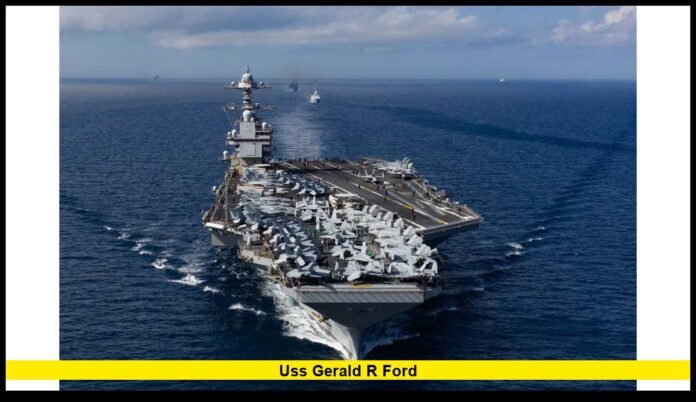

USS Gerald R Ford continues to serve as the U.S. Navy’s most advanced aircraft carrier in 2026, operating as the lead ship of the Ford-class and homeported at Naval Station Norfolk, Virginia. Since completing its first full operational deployment in 2023, USS Gerald R Ford has remained central to carrier strike group readiness, fleet integration, and global maritime presence missions.
Named after the 38th President of the United States, who also served in the Navy during World War II, CVN-78 represents a generational shift in aircraft carrier design. Built to replace aging Nimitz-class carriers over time, it introduces new launch systems, upgraded nuclear propulsion, and improved sortie generation capacity.
Commissioning and Construction Background
The carrier was commissioned on July 22, 2017, in Norfolk, Virginia. Huntington Ingalls Industries’ Newport News Shipbuilding division constructed the vessel, continuing its long-standing role as the sole builder of U.S. nuclear-powered aircraft carriers.
Key specifications include:
- Hull designation: CVN-78
- Length: Approximately 1,092 feet
- Beam (flight deck width): About 256 feet
- Displacement: Roughly 100,000 tons
- Propulsion: Two A1B nuclear reactors
- Crew size: Approximately 4,500 including air wing
The A1B reactor design generates more electrical power than previous carrier reactors. That increase supports advanced onboard systems and future technology integration.
USS Gerald R Ford is the first of four Ford-class carriers currently in development or construction. USS John F. Kennedy (CVN-79) follows, with USS Enterprise (CVN-80) and USS Doris Miller (CVN-81) in earlier stages of completion.
First Full Deployment and Operational Validation
In 2023, USS Gerald R Ford completed its first full deployment. The carrier strike group operated in the Atlantic Ocean and Mediterranean Sea, primarily within the U.S. Sixth Fleet area of responsibility.
This mission marked a turning point. It validated years of system testing and performance upgrades.
During deployment, the ship conducted:
- Continuous flight operations
- NATO maritime exercises
- Joint training with allied navies
- Maritime security patrols
- Air defense drills
The strike group included guided-missile cruisers and destroyers, providing layered protection and extended capabilities.
The successful deployment demonstrated the reliability of new systems that faced early development scrutiny.
Electromagnetic Aircraft Launch System (EMALS)
One of the most significant innovations aboard USS Gerald R Ford is EMALS. Unlike traditional steam catapults used on Nimitz-class carriers, EMALS uses electromagnetic energy to launch aircraft.
Benefits of EMALS include:
- Smoother aircraft acceleration
- Reduced wear on aircraft frames
- Lower maintenance requirements
- Enhanced launch precision
The system supports a broader range of aircraft weights. It accommodates both lightweight drones and heavier strike fighters.
EMALS also reduces mechanical complexity compared to steam-driven systems.
Advanced Arresting Gear (AAG)
The ship’s Advanced Arresting Gear system recovers aircraft during landing. It replaces older hydraulic arresting systems.
AAG improves:
- Aircraft recovery control
- Maintenance efficiency
- Adaptability to multiple aircraft types
This system enhances compatibility with next-generation aircraft, including the F-35C Lightning II.
Advanced Weapons Elevators
USS Gerald R Ford includes 11 advanced weapons elevators. These elevators transport munitions from lower storage decks to the flight deck.
Early construction challenges delayed certification. Before its first full deployment, the Navy certified all elevators as operational.
The improved elevator design increases speed and reliability. Faster ordnance movement supports higher sortie rates.
Increased Sortie Generation Rate
The Ford-class design allows up to 25 percent more aircraft sorties per day compared to the Nimitz-class under high-tempo conditions.
Higher sortie rates mean:
- Faster response to emerging threats
- Greater sustained air presence
- Increased operational flexibility
This improvement stems from flight deck redesign, upgraded launch systems, and optimized aircraft flow patterns.
Carrier Air Wing Composition
USS Gerald R Ford embarks a Carrier Air Wing consisting of multiple squadrons.
Typical aircraft assignments include:
- F/A-18E/F Super Hornet strike fighters
- EA-18G Growler electronic warfare aircraft
- E-2D Advanced Hawkeye airborne early warning planes
- MH-60R and MH-60S Seahawk helicopters
- F-35C Lightning II stealth fighters
The F-35C enhances stealth strike capability and advanced sensor integration.
Carrier air wings provide air superiority, reconnaissance, electronic warfare, and close air support.
Strategic Role in Global Operations
Aircraft carriers remain a central pillar of U.S. defense strategy.
USS Gerald R Ford delivers:
- Mobile airpower without foreign basing agreements
- Rapid response to international crises
- Deterrence through visible presence
- Support for joint operations
Nuclear propulsion allows the ship to operate for decades without refueling.
This endurance enables long-term deployments far from U.S. shores.
Mediterranean and NATO Integration
During its initial operational cycle, USS Gerald R Ford conducted exercises with NATO partners.
Operations in the Mediterranean strengthen alliances and reinforce maritime security cooperation.
The Sixth Fleet region includes strategic waterways that connect Europe, Africa, and the Middle East.
Carrier deployments in this region signal U.S. commitment to collective defense agreements.
Technological Advancements Over Nimitz-Class
| Capability | Ford-Class | Nimitz-Class |
|---|---|---|
| Launch System | EMALS | Steam Catapult |
| Reactor Output | Increased power generation | Standard output |
| Crew Requirement | Reduced manpower | Larger crew |
| Sortie Capacity | Higher potential rate | Baseline rate |
The Ford-class reduces overall lifecycle costs through automation and energy efficiency.
Lower crew requirements also decrease long-term personnel expenses.
Industrial and Economic Significance
USS Gerald R Ford supports thousands of American shipbuilding and defense jobs.
Newport News Shipbuilding employs skilled tradespeople, engineers, and technicians across Virginia.
Each carrier represents billions of dollars in industrial investment.
The Ford-class program sustains the nation’s only nuclear aircraft carrier production line.
Maintaining domestic shipbuilding capacity remains a priority in national defense planning.
Ongoing Readiness and Training
After deployment, carriers enter maintenance and training cycles.
USS Gerald R Ford participates in:
- Strike group integration exercises
- Air wing certification drills
- Fleet readiness inspections
Training ensures crew proficiency and mission preparedness.
Carrier strike groups operate as coordinated units. Seamless communication between ships, aircraft, and command centers remains essential.
Sister Ships and Future Fleet Transition
The Navy plans to gradually replace older Nimitz-class carriers with Ford-class vessels.
USS John F. Kennedy (CVN-79) continues outfitting and sea trials.
USS Enterprise (CVN-80) and USS Doris Miller (CVN-81) are under construction at Newport News.
This transition ensures sustained aircraft carrier presence through mid-century.
Each new ship incorporates lessons learned from CVN-78’s initial operations.
Humanitarian and Disaster Response Capabilities
Beyond combat missions, USS Gerald R Ford can support humanitarian assistance.
Aircraft carriers provide:
- Helicopter lift capability
- Medical facilities
- Freshwater production
- Logistics support
In past global crises, carriers have delivered rapid aid after natural disasters.
Their ability to operate offshore reduces reliance on damaged port infrastructure.
Current Status in 2026
As of 2026, USS Gerald R Ford remains assigned to Naval Station Norfolk.
The carrier continues fleet readiness operations and training cycles following its initial deployment.
Defense leadership evaluates deployment schedules based on global requirements.
The ship stands fully integrated into the Navy’s operational rotation.
Its systems now operate with proven reliability after early developmental adjustments.
Why USS Gerald R Ford Defines Modern Naval Power
USS Gerald R Ford represents the future of American sea power.
Advanced launch systems, increased sortie capability, and nuclear endurance provide unmatched flexibility.
The carrier’s presence reinforces U.S. maritime strategy in both deterrence and partnership missions.
As geopolitical challenges evolve, CVN-78 remains prepared to deploy wherever national interests require.
What are your thoughts on USS Gerald R Ford’s role in modern naval operations? Share your perspective and follow ongoing updates about the U.S. Navy’s newest carrier class.