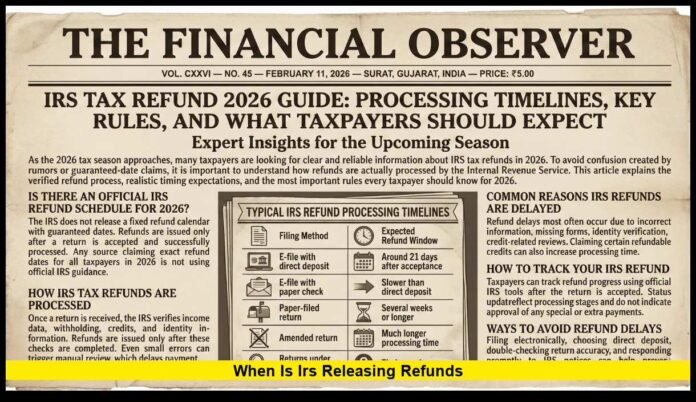

If you are asking when is IRS releasing refunds, the 2026 federal tax season is already in motion and payments are actively being issued. The Internal Revenue Service began accepting 2025 tax year returns on January 26, 2026. Since that date, eligible taxpayers who filed electronically and selected direct deposit have started receiving their refunds.
Here is what U.S. taxpayers need to know right now about refund timelines, key release dates, common delays, and how to track payments during the 2026 filing season.
IRS Filing Season 2026: Refund Processing Is Underway
The IRS officially opened the 2026 filing season in late January. From day one, the agency began processing electronic returns in batches. Refunds are issued daily as returns move through verification and approval stages.
Taxpayers who e-filed accurate returns with direct deposit information are seeing refunds within the standard 21-day window. Direct deposit remains the fastest way to receive payment. Paper checks are limited, and electronic transfers are now the primary delivery method.
Processing operates on a rolling schedule. That means refunds are not released on one single date. They are sent continuously as returns are approved.
Standard Refund Timeline in 2026
Most taxpayers fall into one of three categories: electronic filers with direct deposit, electronic filers requesting checks, and paper filers.
Here is how timing works this year:
- E-file with direct deposit: Most refunds arrive within 21 days of IRS acceptance.
- E-file with mailed check: Processing may take slightly longer than direct deposit.
- Paper returns: Six to eight weeks is common, sometimes longer.
- Returns flagged for review: Timing depends on issue resolution.
The 21-day guideline applies only when the return is complete and accurate. Even small data mismatches can pause processing.
2026 Estimated Refund Deposit Calendar
The IRS does not publish exact payment dates for each filer, but historical processing patterns and current confirmed timelines provide reliable estimates for electronic filers who choose direct deposit.
Below is the expected deposit window based on return acceptance date:
| Return Accepted By | Estimated Direct Deposit Date |
|---|---|
| January 26, 2026 | Around February 6, 2026 |
| February 2, 2026 | Around February 13, 2026 |
| February 9, 2026 | Around February 20, 2026 |
| February 16, 2026 | Around February 27, 2026 |
| February 23, 2026 | Around March 6, 2026 |
| March 2, 2026 | Around March 13, 2026 |
| March 9, 2026 | Around March 20, 2026 |
| March 16, 2026 | Around March 27, 2026 |
| March 23, 2026 | Around April 3, 2026 |
| March 30, 2026 | Around April 10, 2026 |
| April 6, 2026 | Around April 17, 2026 |
| April 13, 2026 | Around April 24, 2026 |
These timeframes apply to standard returns that pass automated checks without additional review.
Refund Delays for EITC and Additional Child Tax Credit
Many families qualify for the Earned Income Tax Credit (EITC) or the Additional Child Tax Credit (ACTC). Federal law requires the IRS to delay refunds that include these credits until mid-February.
Here is how that rule works in 2026:
- Refunds that include EITC or ACTC cannot be released before February 15.
- Even if you file in late January, your refund will not be issued until after the mandatory hold lifts.
- Most eligible taxpayers receive those refunds by early March if no verification issues arise.
This delay applies nationwide every year under federal law. It is not caused by IRS processing problems.
Why Some Refunds Take Longer Than 21 Days
While most refunds follow the standard timeline, certain issues can slow the process.
Common reasons include:
- Incorrect routing or account numbers
- Name and Social Security number mismatches
- Income discrepancies between your return and employer filings
- Missing forms such as 1099s or W-2s
- Identity verification requirements
- Recovery rebate credit miscalculations
When the IRS identifies an inconsistency, it may pause processing. In some cases, the agency sends a notice requesting clarification. Refunds remain on hold until the matter is resolved.
Filing accurately the first time is the best way to avoid delays.
How the IRS Processes Refunds
Understanding how refunds move through the system can help explain timing.
- Return Submission: You file electronically or by mail.
- Acceptance: The IRS confirms the return meets basic requirements.
- Review: Automated systems verify income, credits, and identity markers.
- Approval: Once verified, the refund is scheduled.
- Payment Issued: Funds are sent via direct deposit or check.
Electronic filing allows most of this process to occur automatically. Paper returns require manual handling, which increases wait times.
Where’s My Refund? Tracking Your Payment
Taxpayers can monitor refund progress using the IRS “Where’s My Refund?” tool or the IRS2Go mobile app.
The system updates once per day and shows three stages:
- Return received
- Refund approved
- Refund sent
For e-filed returns, tracking information typically appears within 24 hours of submission. Paper filers may need to wait four weeks before status becomes available.
If the tool does not show movement after 21 days, the IRS recommends reviewing the return for potential issues or waiting for official correspondence.
Direct Deposit vs. Paper Check in 2026
Direct deposit remains the fastest and most secure refund method. Most refunds issued in 2026 are sent electronically to a bank account.
Benefits of direct deposit:
- Faster delivery
- Reduced risk of lost or stolen checks
- Immediate access once funds clear
Taxpayers must enter routing and account numbers correctly. Errors can cause refunds to bounce back or enter manual review.
Paper checks take longer due to printing and mailing time. They may also be delayed if address information is outdated.
What Happens If the IRS Adjusts Your Refund
Sometimes the IRS makes corrections to a filed return. This can happen if:
- Math errors are detected
- A credit amount is adjusted
- Income reported does not match employer records
If the IRS changes your refund amount, it sends a notice explaining the adjustment. The revised refund may be higher or lower than expected.
Receiving an adjustment notice does not always mean you made a major mistake. Minor calculation errors are common and often corrected automatically.
Peak Season Processing: March and Early April
As April 15 approaches, the IRS handles a significant increase in return volume. During peak weeks, processing can extend closer to the full 21-day window for electronic returns.
Early filers generally experience shorter waits. Filing closer to the deadline increases the chance of slower processing due to volume.
The 2026 federal filing deadline remains April 15, unless a taxpayer qualifies for an extension.
How to Avoid Refund Delays
Taxpayers can take several practical steps to keep refunds on schedule:
- File electronically
- Use direct deposit
- Double-check Social Security numbers
- Confirm employer income forms match your return
- Keep personal information current
- Respond quickly to any IRS notice
Preparation before filing makes a noticeable difference in processing speed.
Identity Verification and Fraud Prevention
The IRS continues to strengthen fraud detection systems in 2026. Returns flagged for potential identity theft undergo additional review.
If selected for verification, taxpayers may need to confirm identity online or by mail. Refunds will not be released until verification is complete.
While this process can extend timelines, it protects taxpayers from fraudulent claims filed under stolen information.
Final Answer: When Is IRS Releasing Refunds in 2026?
The IRS is releasing refunds now for accepted 2025 tax year returns. Most electronic filers using direct deposit receive payment within 21 days. Taxpayers claiming EITC or ACTC can expect refunds beginning after mid-February, with many arriving by early March.
Refunds continue to be issued daily throughout tax season. Timing depends on filing method, accuracy, credit claims, and verification requirements.
Are you still waiting for your 2026 refund, or has it already arrived? Share your experience below and check back for the latest IRS payment updates.