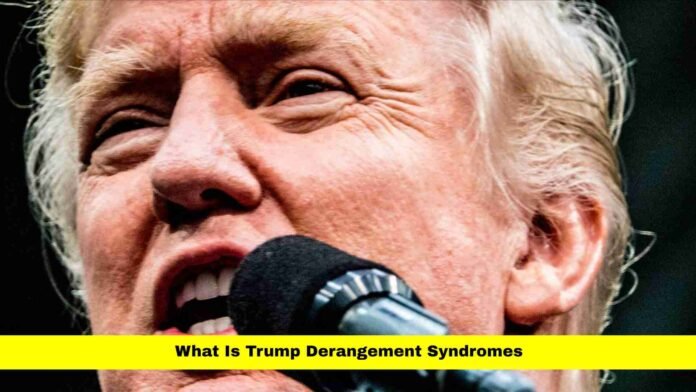

The phrase what is trump derangement syndromes has emerged in political conversations as one of the most recognized and debated labels used in American public discourse today. It refers to a specific kind of reaction that critics and supporters describe in very different ways, and it has evolved into a significant part of how people talk about political polarization in the United States.
In 2025 and 2026, this phrase has gained even more attention because state lawmakers have introduced legislation aimed at defining it in legal terms, political figures use it in public statements, and social commentators debate its meaning and implications. Understanding this term, how it originated, and how it is used can help readers make sense of broader conversations about politics, criticism, and public discourse in the modern era.
The Origins of the Term and Its Historical Roots
The phrase emerged as a direct descendant of an earlier expression coined by a political commentator in the early 2000s. That original term was applied to intense criticism of President George W. Bush and was framed as a kind of irrational response. Over time, commentators adapted that concept to refer specifically to reactions toward Donald J. Trump, using a similar structure and idea.
This evolution reflects the broader pattern in political language where terms are repurposed to describe emotionally charged responses to leadership. In this case, the contemporary label was popularized in the mid-2010s, during and after Trump’s initial presidential campaign, and it gained widespread usage in commentaries and media as both supporters and critics grappled with increasingly polarized reactions.
How the Phrase Is Commonly Defined Today
At its core, the phrase describes intense emotional or cognitive reactions to Donald Trump that critics claim go beyond ordinary political disagreement. Supporters of the term argue that some critics do not assess Trump’s actual policy positions or actions with balanced reasoning, but instead respond with disproportionate anger or hostility.
Those who use the phrase often characterize it as an exaggerated form of critical response that “distorts perception” and focuses less on specific policies and more on emotive rejection of the individual. They argue that this kind of response can hinder constructive debate by dismissing substantive discussion in favor of relentless opposition.
Political Usage: How Supporters Employ the Term
Supporters of Donald Trump and allied commentators frequently use the term to challenge or undermine criticism from political opponents, media figures, or public commentators. When critics respond strongly or emotionally to Trump’s statements or decisions, supporters may label that reaction as a symptom of this syndrome, implying that the critic cannot engage with facts soberly.
In this usage, the phrase functions as a rhetorical tool to reframe political debate. Instead of directly responding to a critique, a supporter might argue that the critique itself is not rational but the product of emotional overreaction. Over time, this deployed strategy has become common in political speeches, interviews, and online commentary.
Criticism and Pushback Around the Term
Not everyone agrees that the phrase reflects a genuine behavioral phenomenon. Critics argue that it is a pejorative label used to silence or dismiss legitimate political dissent. Because the term does not have a formal clinical basis and does not appear in medical or psychological diagnostic manuals, many argue it should not be taken as an actual syndrome in the medical sense.
Opponents of the phrase maintain that labeling passionate criticism of a public figure as a “syndrome” risks oversimplifying complex political views and undermining healthy debate. For these critics, the term’s popularity reflects political bias rather than a meaningful diagnosis of emotional or cognitive patterns.
Legislative Efforts to Define or Study It
In 2025, political activity around the concept expanded beyond rhetoric into legislative proposals. In Minnesota, a group of Republican state senators introduced a bill that would classify the so-called syndrome as a mental illness under state law. The proposed definition in that bill described the phenomenon as the “acute onset of paranoia in otherwise normal persons” in reaction to Trump’s policies and presidency.
The Minnesota proposal drew significant attention because it attempted to place the term into a legal and psychiatric context. Under its language, symptoms could include intense hostility and inability to distinguish political disagreement from pathology. This legislative effort faced scrutiny and debate because mental illness classification traditionally rests on established psychiatric criteria, not political reactions.
Federal Proposals to Study the Phenomenon
At the federal level, lawmakers introduced a bill aimed at directing a national health research agency to study what supporters call this syndrome. The proposed research act would task the agency with studying emotional or cognitive reactions tied to Trump’s presence and role in public life, exploring contributing factors like media exposure and social dynamics.
This research-focused proposal did not seek to define the syndrome as a disease but rather to examine potential behavioral patterns and their impact on public discourse. It reflects a broader effort by some lawmakers to understand how partisan reactions affect political engagement and community interactions without making clinical claims.
Notable Public Commentary Around the Term
Prominent public figures, including Trump himself, have used the phrase to describe critics or political opponents. On multiple occasions, he has stated that intense opposition or fixation on him represents this syndrome, reinforcing the term’s place in political conversation.
At the same time, opponents have responded by applying similar language to Trump, suggesting that he exhibits his own form of emotional fixation or exaggerated behavior toward political rivals. Such back-and-forth usage highlights how the term has permeated not just political rhetoric but popular culture and media commentary.
Psychological and Ethical Considerations
Although some practitioners in mental health contexts have commented on polarized reactions to political figures, professional psychiatric organizations maintain that genuine diagnoses require individual evaluation and clinical criteria. The American Psychiatric Association’s ethical guidelines discourage diagnosing public figures without proper examination.
This ethical framework matters because it underscores why many experts push back against treating any politically coined term as a clinical condition. True psychological diagnoses are based on standardized criteria, not on public reactions to political leadership.
The Phrase in Online Culture
Online and social platforms have amplified the term’s reach. It appears in memes, social posts, discussion forums, and political commentary, often used humorously or sarcastically. Different users interpret it in varying ways—some as a critique of political opponents, others as a self-aware joke about extreme reactions in modern politics.
In these informal spaces, the term has taken on layers of meaning beyond its original context, sometimes used ironically to poke fun at anyone whose opinions appear unreasonably emotional or entrenched.
Why It Resonated in the Trump Era
The intensity of political polarization in the U.S. during and after the Trump presidency has been unmatched in recent decades. The phrase gained traction in part because it offered a way to label and respond to the strong emotions that many people felt, both for and against the former president.
Rather than simply describing policy debates, the label captured how political disagreements often became personal and emotionally charged across media ecosystems, public discourse, and everyday conversations.
Broader Impacts on Public Discourse
Whether used as a rhetorical weapon, a term of critique, or a humorous descriptor, the phrase reflects broader communication patterns in American political life. It has encouraged people to examine how emotional language affects debate, how political allegiance colors interpretation of facts, and how labels shape perceptions of critics and supporters.
The conversation around it also highlights the tension between political expression and personal insult, especially when terms designed to dismiss opponents are used in place of substantive discussion.
As the Concept Continues to Be Discussed
By 2026, this phrase has not disappeared from public discussion. It remains a point of controversy, language of political identity, and an example of how modern politics blends rhetoric, psychology, and social behavior.
As people continue to use and debate it, the term serves as a mirror for broader questions about how society talks about disagreement, criticism, leadership, and the emotional dimensions of political engagement.
Whether you see this phrase as a political label, cultural shorthand, or a reflection of deeper divides, share your experiences and perspectives on how political language shapes public discourse and community conversations.