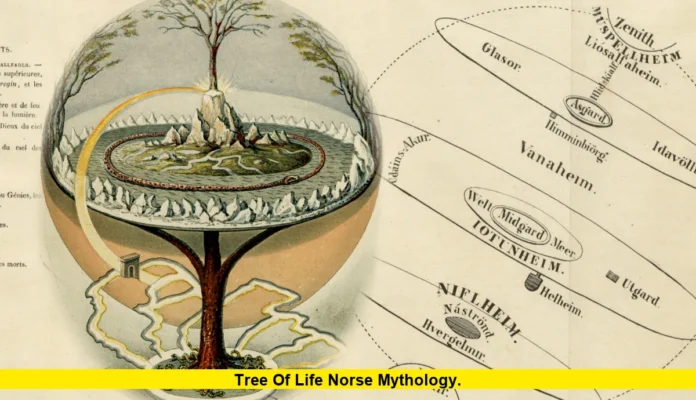

The tree of life Norse mythology – known to the Vikings as Yggdrasil – stands as one of the most enduring symbols from ancient Scandinavian belief, a cosmic ash that united all realms of existence in a single living structure. In a year defined by remarkable archaeological discoveries and renewed interest in Viking culture and cosmology, understanding this world-tree goes beyond legend into the fabric of how early Norse societies saw their world and themselves.
Experience the awe of ancient myth and human history through one of the most iconic symbols ever imagined.
Scroll to explore how the tree of life shaped Norse cosmology and what recent finds are teaching us today.
What Is the Tree of Life in Norse Mythology?
At the heart of Norse cosmology sits an immense tree called Yggdrasil, imagined as an enormous ash that connects nine distinct worlds. These realms included everything from the home of the gods to the land of humans and the shadowy regions of the dead. According to the mythic texts we have today, the branches of this tree reach high into the heavens while its roots extend deep beneath the surface. Around it exists all that was, is, and will be in the Norse imagination.
The tree was not merely a passive cosmic symbol. Gods met there daily, creatures large and small made their homes in its bark and boughs, and its health was tied to the fate of all life. When the tree shuddered, the ancients believed the cosmos itself could tremble. Its vitality was central to existence, reflecting a worldview where life, death, and destiny were tangled like roots in deep earth.
Yggdrasil’s Role in Ancient Norse Belief Systems
In ancient Norse belief, Yggdrasil wasn’t presented as a dry allegory but as a living part of the universe’s structure. The old sagas describe three great roots of the tree, each reaching into separate cosmic locations, with sacred wells at their ends. Beneath one root rested Urðarbrunnr, a well associated with the three norns who governed fate. Another root plunged into the world of giants, close to the primal yawning gap of Ginnungagap. The final root reached down toward the realm of the dead, where serpents and mythic beings gnawed at the roots and tested the tree’s endurance.
Odin, the chief of the Norse gods, was said to have hung himself from this cosmic ash for nine nights in his quest for wisdom, paying a great price to understand the runes and deepen his insight. This powerful image of sacrifice and knowledge is woven through the old poetic traditions, emphasizing that even gods must wrestle with fate and the mysteries of life.
Archaeology and the Norse Spiritual World
While Norse mythology itself originates in medieval manuscript sources compiled centuries after the Viking Age, archaeology continues to illuminate the material culture of the people who told these stories. In central Norway, archaeologists uncovered the grave of a Viking Age woman interred in remarkable condition, offering an unusually vivid glimpse into the burial practices of early Scandinavians. Dressed in traditional garb and accompanied by personal adornments, her burial suggests strong ritual traditions that intersect with spiritual ideas about life, death, and the afterlife — concepts central to Norse cosmology. The unusual placement of scallop shells in the burial raises questions about symbolic customs that remain under study by researchers today.
Though this find doesn’t directly depict Yggdrasil, it highlights how deeply Norse societies engaged with ritual and meaning in the world around them, affirming that myth and everyday life were often intertwined.
Symbolism: Life, Connection, and Balance
What made the tree of life in Norse belief so powerful was its role as a unifying symbol. It connected multiple worlds — gods, humans, spirits, and giants — into a living network. This symbol of connection was not static or peaceful but dynamic and fraught. Creatures gnawed at its roots, and cosmic battles loomed on the horizon. The tree’s health mirrored the state of existence, and its decline was tied to the apocalyptic vision of Ragnarök — a final, catastrophic conflict that would reshape the cosmos.
In this way, the Norse tree of life represented both hope and fragility. It was a source of life and a battleground for cosmic forces. It taught that all life is interconnected, subject to danger and decay, and dependent on forces beyond human control.
Cultural Legacy and Modern Resonance
Across the modern world, the symbolism of the tree of life has outlived the fall of the Viking world. Whether in literature, art, jewelry, or spiritual reflection, the image of Yggdrasil still resonates. It appears on modern carvings and crosses that blend Norse and Christian elements, testifying to how these symbols evolve across time and culture.
What Yggdrasil represents — connection, endurance, and the woven nature of existence — appeals across eras and continents. It transcends its origins as a mythic cosmogony and becomes a universal metaphor for how all life is bound together on many levels.
Understanding the Roots — And What They Teach Us
Studying the tree of life in Norse mythology helps us understand not just a mythic story but a worldview. In a world where life was unpredictable and often brutal, ideas like Yggdrasil offered a framework for meaning. They provided a way of situating human experience within a larger cosmic tapestry and helped shape moral, spiritual, and cultural identities.
Today, scholars and enthusiasts continue to explore the legacy of these myths, combining textual study with archaeology and cultural analysis. This rich field of inquiry deepens our appreciation for how ancient peoples saw themselves and the universe around them.
We’d love to hear what part of the Norse tree of life myth resonates most with you and why — leave a thought below or check back soon for deeper explorations into ancient worlds.