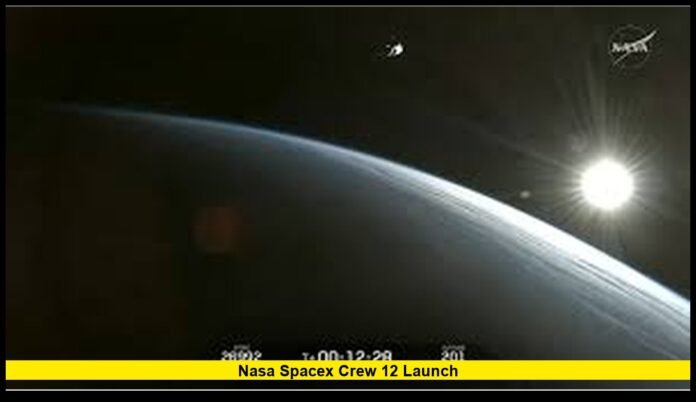

NASA SpaceX Crew 12 launch roared to life at 5:15 a.m. EST on February 13, 2026, as a Falcon 9 rocket carried four astronauts into orbit from Cape Canaveral Space Force Station. The early morning liftoff marked the latest crew rotation mission to the International Space Station and continued NASA’s steady cadence of human spaceflight operations in partnership with SpaceX.
The rocket climbed into clear Florida skies from Space Launch Complex 40, drawing attention from spectators along the Space Coast and viewers across the country. Within minutes, the Crew Dragon spacecraft reached orbit and began its carefully choreographed journey toward the orbiting laboratory.
A Precise and Powerful Liftoff
Launch day began hours before sunrise. Engineers and flight controllers worked through final systems checks while the astronauts suited up inside NASA’s Kennedy Space Center. After traveling to the pad and boarding Crew Dragon “Freedom,” the crew completed communications and seat checks ahead of propellant loading.
At T-0, the Falcon 9’s nine Merlin engines ignited, producing roughly 1.7 million pounds of thrust. The vehicle cleared the tower and accelerated downrange over the Atlantic Ocean.
About two and a half minutes after liftoff, the rocket’s first stage separated cleanly. The booster then executed a controlled descent and landing, demonstrating SpaceX’s reusable rocket capability once again. Meanwhile, the second stage engine continued firing, placing the spacecraft into its intended orbit roughly 12 minutes after launch.
Crew Dragon separated from the rocket shortly thereafter and began autonomous flight toward the International Space Station.
Meet the Crew of NASA SpaceX Crew 12 Launch
The mission carries a diverse international team representing NASA, the European Space Agency, and Roscosmos. Each astronaut brings unique experience and training to the expedition.
Jessica Meir – Commander (NASA)
Jessica Meir returns to space for her second mission. During her first flight, she participated in multiple spacewalks and conducted a wide range of scientific research. As commander, she leads the spacecraft during critical phases of flight and will oversee operations once aboard the station.
Jack Hathaway – Pilot (NASA)
Jack Hathaway makes his first journey to orbit. A former U.S. Navy fighter pilot and test pilot, he supports spacecraft systems, navigation monitoring, and docking operations. His aviation background plays a key role in mission safety and performance.
Sophie Adenot – Mission Specialist (ESA)
Sophie Adenot begins her first spaceflight as part of Europe’s astronaut corps. She trained extensively in robotics, station systems, and emergency procedures. Her mission highlights ESA’s ongoing participation in ISS operations.
Andrey Fedyaev – Mission Specialist (Roscosmos)
Andrey Fedyaev joins the crew as a representative of Russia’s space agency. His experience strengthens long-standing collaboration between NASA and Roscosmos aboard the International Space Station.
Together, the four astronauts will integrate with the station’s existing Expedition crew following docking.
Docking and Arrival at the ISS
After reaching orbit, Crew Dragon initiated a series of orbit-raising maneuvers. The spacecraft uses onboard thrusters and GPS-guided navigation to gradually align its path with the space station.
The docking target is the forward-facing port of the Harmony module. As the spacecraft approaches, it performs a series of automated holds to confirm alignment and system health.
Once docking completes, the crew will conduct standard leak checks before opening the hatch. A welcome ceremony traditionally follows, giving the combined team time to greet one another and review safety briefings.
Crew overlap ensures a smooth transfer of responsibilities between outgoing and incoming astronauts.
Mission Duration and Objectives
The NASA SpaceX Crew 12 launch supports a long-duration stay of approximately eight to nine months aboard the ISS. During that time, the astronauts will manage research experiments, maintain station systems, and conduct possible spacewalks if required.
The International Space Station remains the world’s only continuously inhabited microgravity laboratory. Research conducted there influences medicine, technology development, and future exploration planning.
Key Research Areas
- Human health studies: Scientists examine how long-term spaceflight affects muscles, bones, and immune responses.
- Biological experiments: Researchers study microbial behavior and cellular processes in microgravity.
- Plant growth investigations: Experiments focus on sustainable food production for deep-space missions.
- Materials science: Testing in microgravity helps engineers design stronger and lighter materials.
- Technology demonstrations: Equipment trials support NASA’s Artemis lunar missions and future Mars planning.
Each crew rotation ensures that research continues without interruption.
The Role of the Commercial Crew Program
The NASA SpaceX Crew 12 launch highlights the success of NASA’s Commercial Crew Program. This initiative allows private companies to provide astronaut transportation services while NASA concentrates on exploration beyond low Earth orbit.
Since the first operational crew mission in 2020, SpaceX has delivered multiple astronaut teams safely to and from the ISS. Falcon 9’s reusability reduces cost and turnaround time while maintaining rigorous safety standards.
The program also restores routine human launch capability from American soil. For U.S. audiences, that reliability reflects a strong partnership between government and private industry.
Reusability and Rocket Performance
Falcon 9’s reusable design continues to shape modern launch operations. After stage separation, the booster performed entry burns and landing maneuvers with precision.
Reusing rocket stages lowers mission expenses and increases launch frequency. It also demonstrates how commercial innovation drives spaceflight efficiency.
Crew Dragon, designed specifically for human spaceflight, includes advanced life-support systems, touchscreen interfaces, and automated docking capabilities. The spacecraft can remain docked at the ISS for months before returning astronauts to Earth.
Life Aboard the International Space Station
Once aboard the ISS, the Crew-12 astronauts will settle into a structured daily routine. Crew members typically wake to mission control calls, conduct experiments, exercise for two hours to counteract microgravity’s effects, and maintain station equipment.
The ISS orbits Earth approximately every 90 minutes at an altitude of about 250 miles. Astronauts witness multiple sunrises and sunsets each day.
Spacewalks may occur if external maintenance or hardware installation becomes necessary. Those operations require weeks of preparation and coordination with ground teams.
International Cooperation Continues
Despite political tensions on Earth, cooperation in orbit remains steady. The International Space Station represents more than two decades of collaboration among the United States, Russia, Europe, Japan, and Canada.
Crew-12’s multinational composition reflects that shared commitment. Astronauts train together for years before launch, building trust and teamwork that extends beyond national boundaries.
The ISS partnership remains one of the longest-running international scientific collaborations in history.
What Comes After Crew-12
When their mission concludes, the astronauts will return to Earth aboard Crew Dragon. The spacecraft will undock, reenter Earth’s atmosphere, and deploy parachutes for a controlled splashdown.
Recovery teams will retrieve the capsule and crew, marking the end of their months-long expedition.
Future crew rotation missions are already planned as NASA maintains a continuous presence aboard the station through the end of the decade.
Why This Mission Matters for the United States
The NASA SpaceX Crew 12 launch reinforces America’s leadership in human spaceflight. Regular crewed launches from Florida showcase reliable access to orbit.
Research conducted aboard the ISS supports advancements in pharmaceuticals, materials engineering, and Earth observation. Many findings have practical applications for industries and healthcare systems across the United States.
In addition, experience gained during long-duration missions informs NASA’s Artemis program, which aims to return astronauts to the Moon and build a sustainable lunar presence. Lessons learned in orbit today help prepare astronauts for deeper space journeys tomorrow.
A Steady Path Forward
The successful liftoff of NASA SpaceX Crew 12 launch demonstrates continued progress in human exploration. Smooth ascent, precise booster landing, and stable orbital insertion all point to mature systems and experienced teams.
As the crew settles into life aboard the International Space Station, the mission enters its most important phase: months of scientific discovery and international collaboration.
Follow ongoing mission milestones and share your thoughts as Crew-12 begins its work high above Earth.