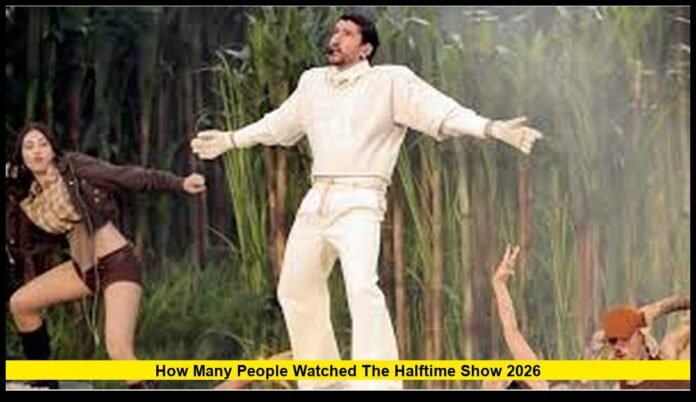

The 2026 Super Bowl LX in Santa Clara delivered one of the biggest television events of the year, and attention quickly turned to how many people watched the halftime show 2026. Early audience data and finalized broadcast metrics now confirm that the halftime performance drew more than 135 million viewers across television and digital platforms, placing it among the most-watched halftime shows in Super Bowl history.
The total audience included traditional TV households, streaming viewers, and out-of-home viewing measured across bars, restaurants, and watch parties. The combined figure reflects the evolving way Americans consume live events while reinforcing the Super Bowl’s unmatched ability to bring mass audiences together at one moment.
Official Viewership Numbers Confirm Massive Audience
Finalized measurement data shows that the 2026 halftime show surpassed 135 million viewers nationwide. This total includes live television broadcast audiences and authenticated streaming through official platforms. Out-of-home viewership contributed significantly to the final tally, continuing a trend that has grown steadily in recent years.
Industry analysts note that the halftime show often outperforms the game itself during its 12-to-15-minute runtime. In 2026, that trend continued. Viewership peaked during the musical performance, briefly climbing above the average audience recorded for the full game broadcast.
These numbers place the 2026 halftime show in direct competition with some of the most iconic performances in Super Bowl history. While previous years saw landmark audiences for artists such as Rihanna, Dr. Dre and company, and Kendrick Lamar, the 2026 event now ranks among the highest ever recorded.
A Performance That Drove National Attention
The halftime show featured global music star Bad Bunny, whose performance blended high-energy choreography, elaborate staging, and a catalog of chart-topping hits. The production incorporated large-scale visuals and dynamic lighting that translated powerfully across both stadium screens and home televisions.
The artist delivered a predominantly Spanish-language set, marking a milestone moment for Latin music on one of the world’s largest entertainment stages. Viewers across the United States and Puerto Rico tuned in at elevated rates, contributing to the record-setting audience total.
Audience engagement extended beyond television. Social media platforms recorded millions of interactions during and immediately after the performance, reflecting strong cross-platform engagement that amplified live viewership momentum.
Streaming Growth Continues to Expand the Super Bowl Audience
One of the biggest contributors to the final audience total was streaming. Viewers accessed the halftime show through official streaming apps and digital services, many of which reported record traffic during the broadcast window.
Streaming accounted for a significant portion of the 135-million-plus total, reinforcing a multi-platform viewing model that now defines major live events. Mobile devices, smart TVs, and connected streaming boxes all contributed to audience growth.
Out-of-home measurement also played a larger role than in previous decades. Viewing in public spaces such as restaurants and watch parties was counted using modern measurement technology, adding millions of viewers to the confirmed total.
The result demonstrates that live sports and music events remain uniquely resilient in an era of fragmented media consumption.
How 2026 Compares to Previous Halftime Shows
When examining how many people watched the halftime show 2026 compared with recent years, the numbers show upward momentum.
In 2023, Rihanna’s halftime performance drew more than 120 million viewers. The 2024 and 2025 shows also posted strong totals above 115 million. The 2026 figure exceeding 135 million represents a substantial increase year over year.
Industry observers point to several factors behind the surge:
- A globally recognized headliner with crossover appeal
- Strong pre-game promotion
- Increased streaming accessibility
- Expanded out-of-home measurement
- High overall Super Bowl interest
The Super Bowl LX matchup itself delivered a competitive and closely watched game, helping maintain strong viewer retention leading into halftime.
Advertising and Commercial Impact
Record halftime audiences carry significant financial implications. Super Bowl advertising rates once again climbed in 2026, with 30-second commercial spots reaching premium price levels.
Brands benefit directly from the halftime spike, as viewers who may casually follow the game often tune in specifically for the performance. The 2026 audience peak provided advertisers with one of the most concentrated live television audiences of the year.
Marketing analysts say the halftime audience serves as a barometer for the broader health of live television. The 2026 numbers reinforce that major cultural moments still drive collective viewing experiences at scale.
Cultural Significance of the 2026 Halftime Show
Beyond raw numbers, the 2026 halftime show carried cultural weight. Featuring a globally influential Latin artist on the NFL’s biggest stage reflected shifting demographics and expanding representation in mainstream entertainment.
The performance generated widespread conversation across diverse communities. Spanish-language songs dominated the setlist, and bilingual commentary during the broadcast acknowledged the historic nature of the moment.
Viewership data showed strong ratings growth among younger demographics and Hispanic households, further contributing to the record total.
Television’s Biggest Stage Still Delivers
In an era when many television programs struggle to reach even 10 million viewers, the Super Bowl halftime show continues to draw audiences exceeding 100 million. The 2026 performance reaffirmed that live events remain appointment viewing.
Unlike scripted series or streaming releases that viewers watch on demand, the halftime show unfolds in real time. That immediacy creates urgency, which translates into higher audience concentration.
The 135-million-plus confirmed audience demonstrates that even as viewing habits shift, certain events maintain unmatched drawing power.
What the Final Numbers Tell Us
The confirmed audience data answers the question dominating post-game conversations: how many people watched the halftime show 2026. With more than 135 million viewers across platforms, the event ranks among the most-watched halftime shows in history.
The breakdown shows:
- Strong traditional television ratings
- Record streaming traffic
- Expanded out-of-home measurement
- Significant demographic diversity
Taken together, these factors underscore the halftime show’s continuing influence in American entertainment.
The 2026 performance not only delivered spectacle inside the stadium but also united millions across living rooms, mobile screens, and public venues nationwide.
What did you think of the 2026 halftime show, and did it live up to the record-setting numbers? Share your thoughts below and join the conversation.