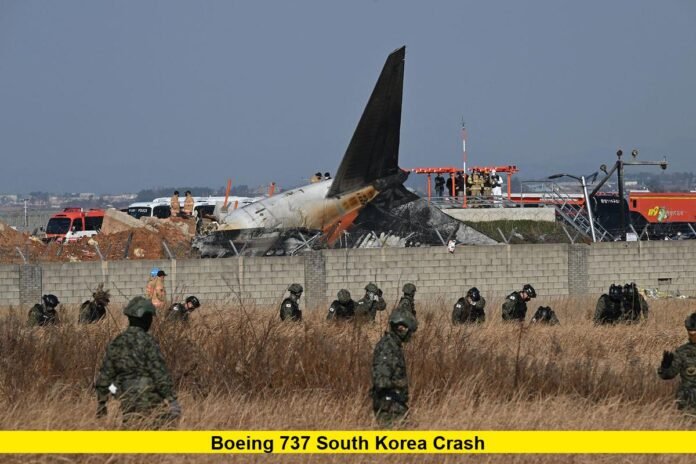

The Boeing 737 South Korea Crash continues to reshape global aviation safety conversations as legal action grows and new findings about infrastructure failures emerge. The deadly December 29, 2024 accident involving Jeju Air Flight 2216 has led to multiple lawsuits in U.S. courts and fresh scrutiny of airport safety standards in South Korea, underscoring complex questions about aircraft systems, runway design, and accountability in one of the worst aviation disasters in recent memory.
The legal developments and safety revelations are unfolding now, with families seeking justice and regulators reassessing what went wrong.
If you’re trying to understand the evolving legal and safety situation surrounding this major aviation tragedy, read on for key developments and what they mean for the industry and public trust.
What Happened in the Crash
Jeju Air Flight 2216, operated with a Boeing 737-800, was approaching Muan International Airport in South Korea on the morning of December 29, 2024. The aircraft experienced a bird strike during its final approach, which investigators believe affected critical flight systems. The plane’s landing gear did not deploy, and the aircraft made a belly landing on the runway. With limited deceleration, it overran the runway and collided with a concrete structure at the end of the airfield. The impact triggered a fiery explosion that claimed 179 lives. Only two flight attendants survived with injuries. The crash represents the deadliest aviation disaster in South Korea’s history and one of the most serious Boeing 737 accidents in decades.
Emerging Legal Battles in U.S. Courts
In the months since the tragedy, families of victims have taken legal action in the United States. Several lawsuits have been filed against Boeing, alleging that outdated and malfunctioning systems played a significant role in the sequence of events that led to the fatal landing and crash.
Lawsuits brought in courts in Washington state and other jurisdictions accuse Boeing of manufacturing defects and design shortcomings in the 737-800’s electrical, hydraulic, and landing systems. Plaintiffs contend these flaws deprived the flight crew of critical capabilities needed to respond effectively after the bird strike.
These legal claims are part of a growing body of litigation asserting that Boeing’s aircraft did not perform as needed under emergency conditions. The growing docket reflects increasing scrutiny of how aircraft systems are engineered and whether manufacturers bear responsibility for failures that contribute to catastrophic accidents.
South Korean Safety Findings and Infrastructure Admissions
In early 2026, South Korean authorities publicly acknowledged that a concrete structure at the end of Muan International Airport’s runway did not meet internationally recognized safety standards. Government-commissioned simulations indicated that the presence of this concrete mound — which supported a navigation aid — dramatically increased the severity of the crash’s outcome. Without the rigid embankment, the aircraft might have come to a safer stop on the runway following its belly landing, greatly increasing chances of survival for passengers and crew.
This admission reversed earlier denials by the Ministry of Land, Infrastructure and Transport, which had previously defended the installation as compliant. The new assessment has driven calls for deeper investigation into how airport structures are designed and regulated in relation to aircraft overrun safety zones.
Technical Factors Under Review
Investigators looking into the Boeing 737 South Korea Crash have identified a cascade of technical challenges surrounding the flight’s final moments. The initial bird strike appears to have damaged engine and flight control systems, prompting the crew to declare an emergency. Both flight data and cockpit voice recorders stopped recording just seconds before the critical landing attempt, complicating efforts to fully reconstruct the sequence of technical events.
Analysis suggests that once key systems were compromised, the aircraft lacked sufficient power and redundancy to deploy landing gear or execute alternative safety procedures. Questions remain about system behaviors, human factors, and whether aircraft design could have mitigated the severity of the emergency. These technical inquiries are central to both the legal claims and ongoing regulatory reviews.
Global and Industry Implications
The unfolding legal actions in the U.S. and safety admissions in South Korea have broader implications for the aviation industry. Aircraft manufacturers, regulators, and airlines around the world are watching closely as lawsuits progress and investigations reveal new details. The cases raise fundamental issues about how aging aircraft systems are evaluated and updated, how airports adhere to evolving safety standards, and how accountability is determined when people perish in high-profile air disasters.
Regulators may face pressure to tighten certification requirements for aircraft systems and to enforce more stringent runway safety zones, especially in locations prone to wildlife hazards or other risk factors. Airlines operating legacy aircraft models are also reassessing maintenance, training, and emergency response planning in light of lessons from this tragedy.
Continuing Scrutiny and Next Steps
As 2026 unfolds, families of victims, legal representatives, and aviation authorities are pressing for full transparency and thorough review of both technical and procedural aspects of the crash. South Korea’s parliament has initiated independent inquiries to examine how infrastructure decisions contributed to the loss of life. Meanwhile, U.S. courts prepare to hear evidence and arguments in the growing litigation against Boeing.
These developments reflect a larger push across the industry to examine how aviation safety is managed from design and manufacturing through airport operations and emergency response. For the families who lost loved ones, the legal and investigative process represents a search for answers and accountability that could shape future standards.
Tell us what you think about the legal and safety changes arising from this crash — share your thoughts below and stay informed as this story progresses.