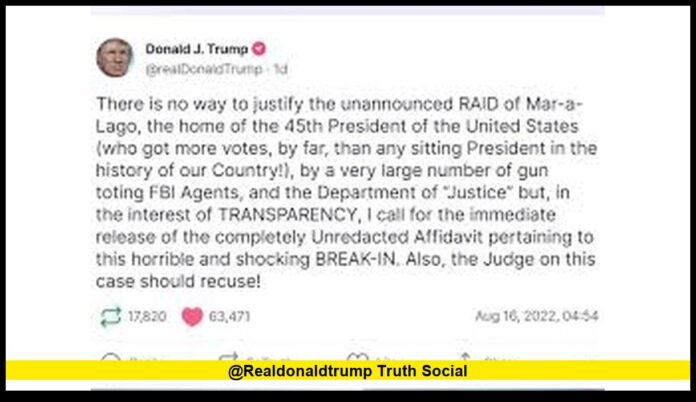

From controversial media posts to high-stakes policy shifts, President Donald Trump’s social media footprint continues to shape political discourse in the United States and around the world. In the past 48 hours alone, the president’s Truth Social presence — particularly through posts on his @realdonaldtrump truth social account — has triggered nationwide controversy, sparked international discussion, and highlighted how social platforms are now central battlegrounds for political messaging. This fresh round of developments reveals both the power and the pitfalls of a presidency amplified through its own unfiltered channels.
Controversy Erupts Over Racist AI Video Shared on Truth Social
On February 6, 2026, President Trump’s @realdonaldtrump truth social account became the center of a major controversy after a graphic and offensive video was posted, depicting former President Barack Obama and former First Lady Michelle Obama in racist portrayals as apes. The AI-generated clip sparked swift condemnation from political leaders, civil rights advocates, and public commentators, who labeled the post racist and deeply inappropriate. The video remained accessible on the platform for hours, amassing thousands of interactions and fueling debates over content moderation, presidential conduct, and responsibilities of social media platforms.
The backlash highlighted widespread concern that political messaging on Truth Social — a platform closely aligned with Trump’s political movement — can quickly spread harmful or incendiary material to large audiences. Critics argued that the use of AI to generate offensive depictions of public figures crosses ethical lines and underscores the challenges posed by deepfake technology in public discourse.
Truth Social Flooded With Broad Political Messaging
This incident came amid a broader surge of posts from the @realdonaldtrump truth social feed emphasizing combative political narratives. Recent content from the platform included posts accusing the U.S. election system of being “rigged” and calling for sweeping changes to voting laws. In these messages, Trump urged Republicans to back the controversial “SAVE America Act,” which advocates for stricter voter ID requirements and limits on mail-in voting. The proposals have drawn significant criticism for potentially disenfranchising millions of voters, particularly in historically marginalized communities.
These political messages reflect the ongoing trend of using Truth Social as a direct megaphone to communicate policy priorities and ideological positions without traditional media filtering. While supporters praise the unfiltered access, opponents warn that the platform’s lack of moderation risks spreading misinformation and fueling division.
Trade and Diplomacy: Truth Social Used to Announce Policy Shifts
Beyond domestic political debates, the @realdonaldtrump truth social account has been used to broadcast updates on major foreign policy developments. Earlier this week, Trump announced a new U.S.–India trade deal that would significantly lower reciprocal tariffs on Indian imports. In the Truth Social post, Trump stated that tariffs would be cut to 18%, marking a notable shift in trade policy between the world’s two largest democracies. The announcement followed direct communications between Trump and Indian Prime Minister Narendra Modi, signaling an era of enhanced economic cooperation.
The trade deal announcement illustrates how global diplomatic moves are now being amplified via social platforms, bypassing traditional press channels. Observers noted that using Truth Social for such announcements reflects both Trump’s preference for direct communication and his broader “America First” negotiating style.
Domestic Policy and Institutional Shifts Shared on Social Media
The Trump administration has also made other major public policy moves that were publicly shared or highlighted through Truth Social. In early February, Trump posted updates on his plans to close and renovate the Kennedy Center for the Performing Arts — now renamed the “Trump-Kennedy Center” — for approximately two years starting July 4, 2026. According to the posts, the closure would allow for a complete rebuild of the institution to create a “world-class performing arts center,” aligned with the nation’s 250th anniversary celebrations. The announcement drew mixed reactions, with supporters celebrating the modernization plan and critics decrying the renaming and potential impact on cultural heritage.
In tandem with these social media announcements, the administration is pressing forward with ambitious domestic projects, including proposals for a grand ballroom addition to the White House. Images and commentary shared on Truth Social have repeatedly underscored Trump’s vision for reshaping American cultural institutions — often meeting resistance from preservationists and legal challenges over funding and historical integrity.
National Security and Global Diplomacy: Social Messaging Meets Serious Issues
Amid these domestic and cultural headlines, Trump’s foreign policy decisions have also featured prominently in his Truth Social activity. In a separate post, Trump confirmed that the United States will not extend the New START nuclear treaty with Russia, allowing it to expire and opening the door to unconstrained nuclear arsenals. Trump advocated for negotiating a “new and improved” treaty that could include China, emphasizing modernization of arms control agreements. This move has raised concerns among global policymakers about a potential nuclear arms race and the future of international arms control frameworks.
Additionally, Trump used Truth Social to post about U.S. military movements, including claims of a large aircraft carrier strike group heading to the Middle East with “power, enthusiasm, and purpose.” These messages dovetail with public comments about confronting Iran’s nuclear ambitions and projecting strength in volatile regions. While operational details remain limited, the use of social media to signal geopolitical intent illustrates how @realdonaldtrump truth social posts are now part of strategic communication in international affairs.
Criticism Over Diplomacy Norms and Transparency
Observers have also pointed out that Trump’s approach to posting content on Truth Social has blurred the lines between private diplomacy and public messaging. In late January, posts from the president’s platform included screenshots of what appeared to be private messages between Trump and world leaders. These posts raised questions about diplomatic norms, privacy expectations, and the strategic use of social platforms to share otherwise confidential exchanges.
Experts have warned that such practices may damage trust among international partners and set new precedents for transparency — or lack thereof — in high-level negotiations. By making private communications public, critics argue that Trump’s social strategy could deter candid dialogue and hinder future diplomatic efforts.
How Truth Social Messaging Is Reshaping Political Dialogue
The recent flurry of activity on Trump’s @realdonaldtrump truth social account reflects a broader trend in which political and policy messaging bypasses traditional media pathways, instead traveling directly from the president’s platform to millions of followers. This approach has magnified both the reach and impact of presidential communications, making Truth Social a central tool in shaping national narratives.
As the 2026 midterm elections approach, these posts have taken on added significance. Trump’s messaging emphasizes themes of election integrity, immigration enforcement, national security, and American identity. Whether applauded or rebuked, the posts continue to drive media coverage, public debate, and legislative responses.
In many cases, these messages have sparked legal challenges, congressional inquiries, and bipartisan disputes — underscoring how a president’s social media activity can no longer be regarded as ancillary to governance. Instead, it now operates at the front line of public policy and political contestation.
What Lies Ahead for Trump’s Social Media Influence
As February unfolds, analysts expect Truth Social to remain a key platform for President Trump’s communications. Whether highlighting diplomatic achievements, criticizing political opponents, or sharing controversial content, the reach and tone of these messages will continue to shape public discourse. For supporters, the platform offers unfiltered insight into the administration’s priorities. For critics, it raises serious questions about accuracy, accountability, and the evolving role of social media in democratic governance.
Stay engaged and share your thoughts on how social media is transforming political communication.