
Jackie Robinson early life story begins in humble circumstances that set the stage for one of the most transformative athletic and cultural journeys in American history. Born into a world shaped by racial segregation and limited opportunity, Robinson’s early years forged the character, discipline, and courage that later helped him change Major League Baseball forever. His childhood, education, and early athletic achievements reveal how a determined young boy from modest beginnings grew into a national icon.
Early Years in Georgia and the Move West
Jack Roosevelt Robinson was born on January 31, 1919, in Cairo, Georgia. He was the youngest of five children born to Jerry and Mallie Robinson. His family worked as sharecroppers, and life in the rural South offered few opportunities for Black families at the time. When Jackie was still an infant, his father left the family. Soon after, his mother made the life-changing decision to move her children across the country to Pasadena, California, in search of better prospects.
The relocation proved pivotal. In Pasadena, Mallie Robinson worked multiple jobs to support her children and purchase a home. Her determination and resilience deeply influenced Jackie’s outlook on life. Growing up in a diverse but still segregated America, Robinson encountered racial prejudice, yet he also found mentors and supportive community members who encouraged his talents.
Athletic Talent Emerges
From a young age, Robinson displayed remarkable athletic ability. At John Muir High School in Pasadena, he excelled in football, basketball, track, and baseball. His speed, agility, and competitive spirit set him apart. Coaches quickly recognized his natural gifts, but it was his drive and discipline that truly defined him.
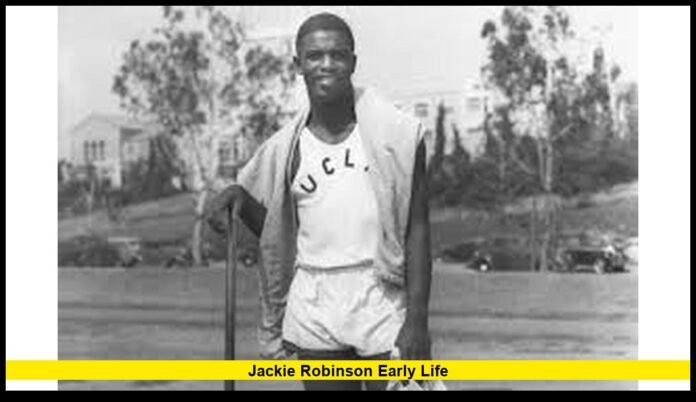
After high school, Robinson attended Pasadena Junior College, where he continued to shine in multiple sports. His performances attracted attention statewide. He later transferred to the University of California, Los Angeles (UCLA), where he made history as the first student-athlete to letter in four sports: football, basketball, track, and baseball.
At UCLA, Robinson became one of the most dynamic athletes on campus. In football, he led the nation in punt return average during the 1939 season. On the basketball court, he ranked among the conference’s top scorers. In track and field, he won the NCAA long jump championship in 1940. Though baseball was not his strongest collegiate sport statistically, his overall athletic dominance was undeniable.
Financial Struggles and Determination
Despite his success at UCLA, Robinson faced financial hardship. His family lacked the resources to fully support his education. He left college just shy of graduation in 1941 to help his mother financially. That decision reflected a pattern throughout his life: family responsibility always came first.
Before fully committing to professional sports, Robinson briefly played semi-professional football and worked various jobs. His path was not linear or guaranteed. Instead, it was shaped by perseverance and adaptability, traits he had developed during his youth.
Military Service and a Defining Stand
In 1942, during World War II, Robinson was drafted into the United States Army. He trained at Fort Riley, Kansas, where he met heavyweight boxing champion Joe Louis, who encouraged him to apply for Officer Candidate School. Robinson earned his commission as a second lieutenant.
While stationed at Fort Hood, Texas, in 1944, Robinson refused to move to the back of a segregated Army bus. His refusal led to a court-martial. Robinson stood firm, maintaining that he had broken no rules. The charges were eventually dismissed, and he received an honorable discharge later that year.
This episode revealed the depth of Robinson’s conviction. Even before he entered Major League Baseball, he had demonstrated a willingness to confront injustice directly and calmly. His actions in the Army foreshadowed the courage he would later show on a national stage.
Entry Into Professional Baseball
After leaving the military, Robinson joined the Kansas City Monarchs of the Negro Leagues in 1945. The Negro Leagues featured many of the era’s most talented Black players, yet they operated separately from Major League Baseball due to segregation.
Robinson quickly impressed observers with his athleticism, speed, and baseball instincts. His performance caught the attention of Branch Rickey, the general manager of the Brooklyn Dodgers. Rickey sought not only a gifted athlete but also a person strong enough to endure the hostility that would come with integrating Major League Baseball.
In 1946, Robinson signed with the Montreal Royals, the Dodgers’ Triple-A affiliate. During that season, he led the International League with a .349 batting average and energized fans with his aggressive base running. His success in Montreal proved he belonged at the highest level of professional baseball.
The Breakthrough Moment
On April 15, 1947, Jackie Robinson debuted with the Brooklyn Dodgers, becoming the first African American to play in Major League Baseball in the modern era. That moment marked the end of a decades-long color barrier in professional baseball.
Robinson endured racial insults, threats, and discrimination throughout his rookie season. Yet he maintained remarkable composure. He let his performance speak for itself, finishing the season with a .297 batting average and earning the inaugural Rookie of the Year Award.
His debut was not an isolated event but the culmination of everything that came before. The discipline instilled by his mother, the lessons learned in Pasadena, the competitive fire honed at UCLA, and the moral courage displayed in the Army all prepared him for this historic challenge.
Character Shaped by Community
The story of Jackie Robinson early life is not solely about athletic accomplishments. It is also about community influence and family strength. Pasadena’s Black community provided mentorship and stability. Local coaches nurtured his skills. His siblings offered support and companionship. Most importantly, his mother’s unwavering belief in her children laid the foundation for his resilience.
Robinson often credited his upbringing for shaping his response to adversity. He understood the responsibility placed upon him when he entered Major League Baseball. He carried not only his own ambitions but also the hopes of countless others.
Enduring Legacy Rooted in His Beginnings
Jackie Robinson retired from baseball in 1956 after a Hall of Fame career that included six All-Star selections, a National League Most Valuable Player Award in 1949, and a World Series championship in 1955. Yet his influence extended far beyond the diamond.
Major League Baseball permanently retired his number 42 across all teams in 1997, an honor unmatched in professional sports. Each year on April 15, players across the league wear number 42 to commemorate his legacy.
Museums, educational programs, and community events continue to highlight the importance of his journey. By understanding his early life, Americans gain deeper insight into how courage develops, how character forms, and how history can change through individual determination.
Jackie Robinson’s path from a small town in Georgia to the pinnacle of American sports remains one of the most powerful stories in U.S. history. His early experiences shaped the leader who broke barriers and inspired generations.
What lessons from Jackie Robinson’s journey inspire you most? Share your thoughts below and join the conversation.