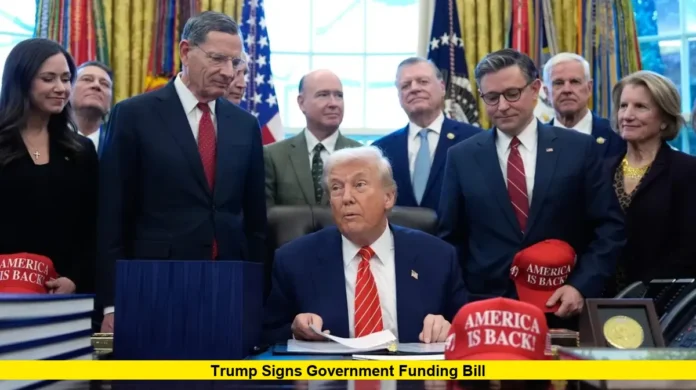

President Donald Trump signs government funding bill to end shutdown of the federal government on Tuesday, February 3, 2026, bringing a four-day partial shutdown to a close and reopening most federal departments and agencies that had been without appropriations. The move follows a narrow vote in the House of Representatives and sets the stage for a new round of negotiations over remaining funding priorities, particularly for Homeland Security.
If you’re looking for how this affects federal services, workers, and the next big Capitol Hill debate, read on for details.
Get clear insight into what passed and what comes next.
Partial Government Shutdown Ends After Bill Becomes Law
After a tense week of negotiations, Congress sent a major government funding package to President Trump’s desk, and he signed it into law in the afternoon. The legislation, totaling roughly $1.2 trillion, effectively ends the partial shutdown that began on January 31 when appropriations for several key departments lapsed due to legislative disagreements.
The House of Representatives passed the bill by a razor-thin margin of 217 to 214, with some members of both parties crossing party lines to help secure passage. Once approved by the Senate, the bill went to the White House, where Trump enacted it, reopening the portions of the federal government that had been shut down.
With Trump’s signature, most government functions — including defense, health, labor, education, housing, and transportation — now have funding through the end of the fiscal year on September 30. The rapid action from the White House and Congress ensures that federal operations resume and thousands of employees who were furloughed can return to work.
What the Funding Bill Includes and What It Temporarily Extends
The funding package is a comprehensive appropriations measure that covers 11 of the 12 annual funding bills that Congress must pass each year to keep the government running. Among the major provisions:
• Full-year funding for core federal agencies. Departments such as Defense, Health and Human Services, Education, Labor, and Housing and Urban Development will operate at enacted levels for the balance of the fiscal year.
• Temporary funding for the Department of Homeland Security (DHS). The bill includes a two-week extension of funding for DHS, pushing the funding deadline to February 13, 2026. This short-term extension buys lawmakers additional time to negotiate longer-term provisions for DHS funding and National security priorities.
The limited extension for DHS is a central issue in ongoing negotiations, as lawmakers remain deeply divided over immigration policy and enforcement measures.
Why DHS Funding Is Still Contentious
Although the majority of government funding is now secured through the fiscal year, Congress deliberately left long-term DHS funding unresolved. This decision was tied to broader disagreements over immigration enforcement policy, sparked by national outrage over fatal shootings involving federal agents in Minneapolis.
Democratic leaders have insisted on new oversight and accountability measures for agencies under DHS’s umbrella, including U.S. Immigration and Customs Enforcement (ICE) and Customs and Border Protection (CBP). Their demands include expanded use of body cameras for federal agents, clearer use-of-force guidelines, restrictions on certain immigration enforcement tactics, and judicial oversight requirements.
Republican lawmakers and the administration have been resistant to some of these reforms, especially requirements that immigration agents obtain separate judicial warrants before executing actions like arrests of undocumented individuals. Party leaders on both sides now face pressure from their own members to address these deeply divisive issues before extending DHS funding beyond the mid-February deadline.
This ongoing policy fight creates a potential flash point that could lead to another funding standoff if agreements aren’t reached quickly.
Impact on Federal Employees and Government Services
Federal departments affected by the partial shutdown have already begun resuming operations following the passage and signing of the funding bill. The Office of Management and Budget directed agencies to begin reopening in an orderly manner and return employees to their duty stations.
Employees who were furloughed during the brief shutdown can resume work and are slated to receive back pay for the days they were off the job. This outcome alleviates uncertainty for hundreds of thousands of workers, many of whom faced financial challenges during the shutdown period.
Most public services, including national parks, military installations, and essential administrative functions, are being restored or fully operational again. The quick resolution also helped avoid broader disruptions to government programs such as nutrition assistance, healthcare services, and veterans’ benefits.
Partisan Dynamics in Congress
The funding bill’s narrow margin in the House highlighted deep partisan divisions in Washington. The final tally of 217-214 saw 21 Republicans voting against the measure, mainly due to objections over language and priorities in the bill, while 21 Democrats joined Republicans to ensure passage.
House Speaker Mike Johnson played a key role in rallying support for the bill, stressing the importance of reopening government operations and preventing further economic impact from a prolonged shutdown. Senate leaders from both parties had previously backed the measure, setting the stage for final approval by lawmakers.
Yet the split votes and resistance to the DHS funding approach demonstrate how sharply divided Congress remains on federal spending priorities and immigration enforcement policy.
What Comes Next on Capitol Hill
With the shutdown behind them and most funding now in place, lawmakers must turn their attention to unresolved issues:
• DHS Funding Negotiations: Congress now has a 10-day window to reach a broader agreement on DHS funding that addresses partisan priorities. Without this consensus, another potential shutdown for that department looms in mid-February.
• Immigration Reform Efforts: Democrats are pushing for legislation that would mandate reforms in immigration enforcement practices nationwide, while Republicans seek to maintain operational flexibility for agencies like ICE and CBP.
• Budget Oversight and Appropriations: Beyond DHS, lawmakers also face the challenge of oversight of the wide range of federal spending included in the appropriations package, ensuring that funds are allocated effectively and responsibly.
These forthcoming negotiations will test the ability of Congress and the White House to bridge sharp ideological differences — particularly around immigration policy and national security — in a year where fiscal priorities and political pressures remain high.
What do you think this budget deal means for the future of federal spending and immigration policy? Share your thoughts below or stay tuned for updates.