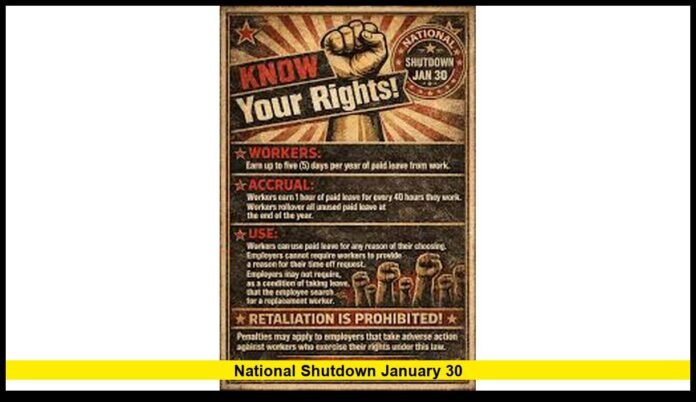

national shutdown January 30 has emerged as one of the most talked-about grassroots actions in the United States this winter, as people across the country respond to calls for a voluntary pause in work, school, and consumer spending. The movement, unfolding today, reflects mounting public frustration with immigration enforcement practices and growing pressure on federal leaders during a critical political moment.
Unlike a government-ordered closure, the national shutdown is driven entirely by individuals, communities, and advocacy groups. Participation varies widely by location, but the scale of conversation surrounding the event underscores how quickly the action captured national attention.
How the National Shutdown Took Shape
The national shutdown developed rapidly in January following a series of high-profile immigration enforcement incidents that triggered protests at the local and regional level. Public anger intensified after fatal encounters involving federal immigration agents in Minnesota, which led to days of demonstrations, business closures, and worker walkouts in several cities.
What began as localized protests soon evolved into a broader call for action. Activists used social media platforms, student networks, and community organizations to push the idea of a single day where Americans would collectively step back from routine economic activity.
January 30 was selected as a unifying date. Organizers believed a coordinated action on the same day could create a stronger national signal than scattered protests held weeks apart.
What Participants Are Being Asked to Do
The core idea behind the national shutdown is simple. Supporters are encouraged to pause participation in everyday systems that fuel the economy. Organizers emphasize choice rather than obligation.
The main actions promoted include:
- Staying home from work when possible
- Keeping children out of school for the day
- Avoiding shopping, dining out, and online purchases
Some participants are also attending rallies, marches, or community discussions depending on what is planned locally. Others are choosing quieter forms of protest, such as staying offline or withholding spending.
The approach reflects a belief that economic pressure can amplify political messages more effectively than demonstrations alone.
Why the Movement Resonated Nationally
Several factors contributed to the rapid spread of the shutdown call.
First, immigration enforcement remains one of the most polarizing issues in the U.S. Many communities feel directly affected, particularly those with large immigrant populations or recent enforcement activity.
Second, frustration has grown over what critics describe as a lack of transparency and accountability within federal agencies. Recent incidents intensified those concerns and reignited long-standing debates.
Third, the timing aligned with heightened political tension in Washington. Federal lawmakers are in the middle of negotiations involving immigration funding, making the moment feel especially urgent to activists.
Together, these factors created fertile ground for a nationwide response.
Who Is Participating Across the Country
Participation in the national shutdown spans a wide range of groups and individuals. College students have been among the most visible supporters, organizing walkouts, teach-ins, and campus rallies.
Immigrant advocacy organizations have played a central role in coordinating messaging and logistics. Faith-based groups, labor supporters, and civil rights advocates have also joined in various regions.
Some small businesses chose to close for the day, while others remain open but express support through signage or donations. In larger cities, participation tends to be more visible, with rallies drawing hundreds of people. In smaller communities, support is often quieter but still present.
Notably, the movement is decentralized. There is no single organization directing activities nationwide, which allows local groups to adapt the action to their circumstances.
What Is Happening on January 30
As the day unfolds, reports from across the U.S. show mixed but notable participation.
In several metropolitan areas, marches and rallies are taking place near government buildings, public squares, and college campuses. Attendance varies, but many events emphasize peaceful assembly and community solidarity.
Workplaces in some sectors report higher absentee rates, particularly among service workers and students. A limited number of businesses are closed entirely for the day, though most commercial activity continues at a reduced level.
Schools remain open in most districts, as the shutdown is not officially recognized. However, some parents have chosen to keep children home as a personal statement.
There is no indication of nationwide infrastructure disruption, but localized slowdowns are visible in protest-heavy areas.
Connection to Federal Budget Tensions
The national shutdown is unfolding against the backdrop of intense negotiations in Washington over federal spending. Immigration enforcement funding has become a key point of contention among lawmakers.
In recent days, federal leaders moved to temporarily extend funding levels to prevent an immediate government shutdown. That decision postponed, rather than resolved, debates over agency budgets and policy direction.
For many participants, this context reinforces the purpose of today’s action. Organizers argue that public pressure is necessary to influence negotiations that often happen out of view.
The shutdown is intended to keep immigration issues at the forefront of national attention while political discussions continue.
Public Response and Criticism
Public reaction to the national shutdown has been mixed.
Supporters argue that peaceful economic protest is a legitimate way to demand accountability and highlight systemic problems. They view the action as a reminder of how interconnected communities and economies are.
Critics, however, question the effectiveness of a one-day pause and express concern about lost wages or educational disruption. Some business owners worry about financial strain, particularly during an already challenging economic period.
Despite differing views, the shutdown has succeeded in sparking widespread discussion across social media, workplaces, and households nationwide.
Safety, Law Enforcement, and Local Guidance
Authorities in multiple cities have issued standard guidance for protests, emphasizing public safety and nonviolent participation. Organizers have echoed those messages, urging participants to remain peaceful and respectful.
There have been no reports of widespread unrest directly linked to the shutdown. Law enforcement presence is visible near major gatherings but remains routine.
Weather conditions have influenced turnout in some regions, with colder temperatures leading to smaller outdoor events and more indoor or online activities.
Overall, the day has unfolded without major incidents at a national level.
What the Shutdown Means Beyond Today
While the national shutdown is focused on a single date, many organizers view it as part of a longer effort rather than an endpoint. Conversations are already underway about next steps, including continued advocacy, local organizing, and future demonstrations.
The event highlights a growing willingness among Americans to use economic action as a form of protest. It also reflects a broader shift toward decentralized movements that rely on social networks rather than formal leadership structures.
Whether today’s action leads to policy changes remains uncertain. What is clear is that immigration enforcement has once again become a central topic in national discourse.
Why the Moment Matters
The national shutdown January 30 stands as a snapshot of current public sentiment. It captures frustration, solidarity, and a desire for change during a politically charged period.
Even for those who chose not to participate, the conversation surrounding the shutdown signals deeper questions about accountability, governance, and civic engagement in the U.S.
As political negotiations continue and community responses evolve, the impact of today’s action will be measured not just by turnout, but by how long the issues it raised remain in focus.
How do you see the national shutdown January 30 shaping the broader conversation in the U.S.? Share your thoughts and stay connected as developments continue.