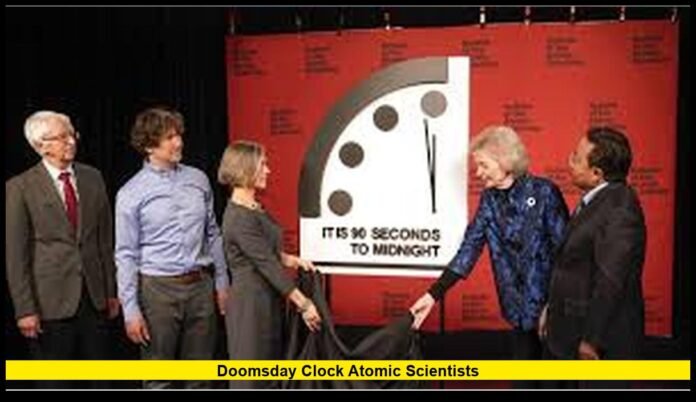

Doomsday clock atomic scientists have confirmed that the symbolic clock remains set at 90 seconds to midnight, marking the highest level of global risk ever recorded as of January 28, 2026.
The Bulletin of the Atomic Scientists reaffirmed this setting during its most recent annual review, signaling that humanity continues to face extraordinary danger from human-driven threats. The unchanged position reflects persistent global instability rather than a pause in concern.
Understanding the Meaning of the Doomsday Clock
The Doomsday Clock is a symbolic tool designed to communicate how close the world is to a catastrophic event caused by human actions. Midnight represents global disaster.
The clock does not function as a countdown. Instead, it reflects expert judgment about existential risks facing civilization.
Its purpose is to translate complex scientific assessments into a clear and accessible warning for the public and policymakers.
Why the Clock Remains at 90 Seconds to Midnight
The decision to keep the clock at 90 seconds to midnight reflects a consensus among experts that global conditions have not improved.
Key realities driving the decision include:
- Continued geopolitical conflict involving nuclear-armed nations
- Ongoing nuclear weapons modernization
- Escalating climate impacts
- Insufficient governance of emerging technologies
Atomic scientists determined that none of these threats have diminished enough to justify moving the clock back.
Who Oversees the Clock’s Annual Decision
The Bulletin of the Atomic Scientists is an independent nonprofit organization founded in 1945 by scientists involved in early nuclear research.
The clock is set by its Science and Security Board, which includes experts in:
- Nuclear risk and arms control
- Climate science
- Global security
- Public health
- Artificial intelligence and emerging technologies
The board also consults with Nobel Prize laureates to ensure rigorous evaluation.
Nuclear Weapons Remain a Primary Risk Factor
Nuclear danger continues to sit at the center of the clock’s assessment.
Current conditions include:
- Thousands of nuclear warheads deployed worldwide
- Weapons systems kept on high operational readiness
- Limited progress on arms reduction agreements
The continued reliance on nuclear deterrence increases the chance of miscalculation or escalation.
Geopolitical Tensions and Global Stability
Ongoing conflicts and strained diplomatic relationships amplify global risk.
Atomic scientists remain concerned about:
- Prolonged military confrontations
- Erosion of international trust
- Reduced effectiveness of conflict-prevention mechanisms
These conditions increase the likelihood that crises could spiral out of control.
Climate Change as a Compounding Threat
Climate change plays a major role in keeping the clock near midnight.
Verified conditions influencing the assessment include:
- Rising global average temperatures
- More frequent extreme weather events
- Increasing strain on food and water systems
Environmental stress acts as a multiplier, worsening humanitarian challenges and geopolitical tension.
Technology Risks Continue to Grow
Emerging technologies have become a central part of the Doomsday Clock evaluation.
Scientists have raised sustained concern about:
- Artificial intelligence used in military decision-making
- Autonomous weapons systems
- Cyber vulnerabilities affecting critical infrastructure
The speed of innovation has exceeded the pace of global regulation and oversight.
Public Health Preparedness Still Matters
Global health resilience remains part of the overall risk calculation.
Key issues include:
- Uneven access to medical resources
- Limited international coordination
- Vulnerability to future pandemics
These weaknesses can intensify other global threats when crises overlap.
Historical Perspective on the Clock’s Movement
The clock has shifted over decades in response to world events.
A brief historical overview shows its changing context:
| Year | Time to Midnight | Global Context |
|---|---|---|
| 1947 | 7 minutes | Clock introduced |
| 1953 | 2 minutes | Nuclear arms escalation |
| 1991 | 17 minutes | Cold War tensions eased |
| 2020 | 100 seconds | Rising global instability |
| 2023–2026 | 90 seconds | Highest risk level |
The current setting represents unprecedented concern.
How the Annual Review Process Works
Each year, the Science and Security Board conducts a comprehensive assessment.
The process includes:
- Reviewing scientific and security data
- Evaluating global political developments
- Consulting interdisciplinary experts
The final setting reflects consensus rather than reaction to a single event.
Why the Clock Did Not Move Back
Some observers expect change each year, but stability at a dangerous setting sends a strong message.
Atomic scientists have stated that:
- Global risks remain extremely high
- No major breakthroughs have reduced danger
- Inaction continues across multiple threat areas
Keeping the clock unchanged underscores the seriousness of the situation.
Why This Warning Matters for the United States
The United States plays a central role in issues tied to the clock.
These include:
- Nuclear policy decisions
- Climate leadership
- Technology governance
- International diplomacy
Actions taken domestically can influence global outcomes tied to the clock’s assessment.
Public Awareness and Global Impact
The Doomsday Clock continues to attract attention because of its clarity.
Its influence comes from:
- A simple visual metaphor
- Scientific credibility
- Decades of historical context
The message resonates across borders and political systems.
What Atomic Scientists Want the Public to Understand
The clock is not meant to cause fear. It is meant to inspire responsibility.
Key points emphasized by scientists include:
- Current risks are human-created
- Cooperative action can reduce danger
- Delay increases long-term consequences
The warning is urgent but grounded in evidence.
Why Multiple Threats Make This Moment Unique
Unlike earlier periods, today’s risks overlap and reinforce each other.
Nuclear tension, climate disruption, technological instability, and health vulnerabilities now coexist at once.
This convergence defines why the clock sits closer to midnight than ever before.
What Has Not Changed Since the Last Update
As of today:
- The clock remains at 90 seconds to midnight
- No reduction in overall risk has been identified
- Atomic scientists maintain their highest level of concern
The lack of movement reflects persistence of danger, not stability.
What Would Be Required to Move the Clock Back
Experts agree that meaningful progress must occur across several areas.
These include:
- Renewed arms control agreements
- Accelerated climate action
- Stronger international cooperation
- Responsible oversight of advanced technologies
Without progress on multiple fronts, risk levels remain high.
The Enduring Purpose of the Clock
The Doomsday Clock endures because it communicates urgency without complexity.
It serves as:
- A reminder of shared global responsibility
- A warning grounded in scientific expertise
- A call for leadership and cooperation
Its message remains relevant as long as existential threats persist.
Why the Present Moment Demands Attention
The current setting marks the most dangerous period since the clock’s creation.
Atomic scientists have made clear that humanity stands at a critical crossroads where decisions today will shape long-term survival.
Final Perspective
The Doomsday Clock remains at 90 seconds to midnight because atomic scientists see no meaningful reduction in global danger. Their warning reflects sustained, evidence-based concern about the world’s direction.
Join the conversation and stay engaged as experts continue to assess how close humanity stands to the edge.