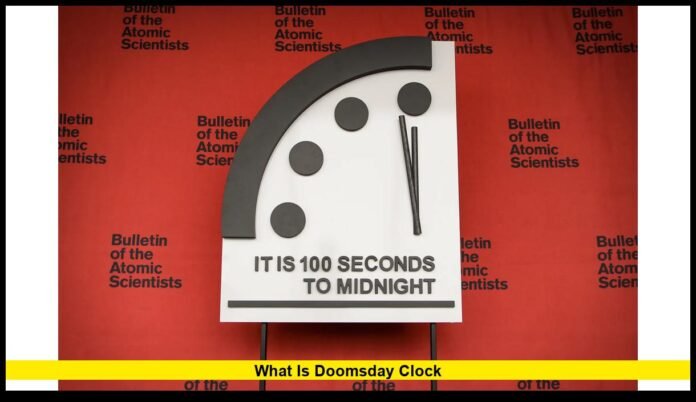

What is doomsday clock is a question gaining renewed attention in the United States as global risks continue to dominate international discussion. As of today, January 27, 2026, the Doomsday Clock remains set at 90 seconds to midnight, the most severe position in its history. This setting reflects an ongoing assessment that humanity faces extremely high levels of risk from nuclear threats, climate change, and rapidly advancing technologies.
The clock is not a prediction tool. It is a warning system designed to communicate how close the world is to a man-made global catastrophe.
What the Doomsday Clock Represents
The Doomsday Clock is a symbolic indicator of global danger created to help the public understand complex threats in a simple visual form. Midnight represents global catastrophe. The closer the clock moves toward midnight, the greater the perceived danger to human civilization.
Unlike an actual clock, it does not measure time. Instead, it measures risk based on scientific analysis and global conditions.
Origins of the Doomsday Clock
The Doomsday Clock was introduced in 1947, shortly after World War II. It emerged during the early nuclear age, when scientists who had worked on atomic research became deeply concerned about how such weapons could threaten humanity.
The concept was created to warn the public and policymakers that scientific progress, without responsibility, could lead to irreversible consequences.
Who Sets the Doomsday Clock
The clock is maintained by the Bulletin of the Atomic Scientists, an independent organization formed by researchers and scholars. Its Science and Security Board is responsible for evaluating global conditions and determining whether the clock should move.
The board includes experts in:
- Nuclear risk and arms control
- Climate science
- Global security
- Emerging and disruptive technologies
Their decisions are based on data, trends, and expert judgment rather than politics or public opinion.
The Current Setting: 90 Seconds to Midnight
As of the most recent confirmed update, the Doomsday Clock is set at 90 seconds to midnight. This position was first announced in early 2023 and has remained unchanged through the latest review.
This marks the closest the clock has ever been to midnight, signaling what experts describe as an exceptionally dangerous period in human history.
Why the Clock Is So Close to Midnight
The current setting reflects multiple overlapping risks rather than a single issue. Experts emphasize that these threats reinforce each other, increasing overall danger.
Nuclear Weapons and Global Security
Nuclear risk remains the original and central concern of the Doomsday Clock. Thousands of nuclear weapons remain active worldwide, many on high alert.
Key factors driving concern include:
- Weakening arms control agreements
- Rising tensions among nuclear-armed nations
- Increased risk of miscalculation or accidental escalation
Even without deliberate intent, experts warn that complex systems and geopolitical instability raise the likelihood of catastrophic outcomes.
Climate Change as a Threat Multiplier
Climate change plays a major role in the clock’s position. Rising global temperatures continue to drive extreme weather events, disrupt food and water systems, and increase migration pressures.
Scientists stress that climate change:
- Increases conflict risks
- Strains global cooperation
- Creates long-term instability
While some progress has been made in clean energy, current global efforts remain insufficient to reverse long-term trends.
Emerging Technologies and Artificial Intelligence
Rapid advances in technology have added new dimensions to global risk. Artificial intelligence, cyber capabilities, and autonomous systems now affect military, economic, and social stability.
Major concerns include:
- Autonomous weapons systems
- Cyberattacks on critical infrastructure
- Large-scale misinformation and manipulation
These technologies often advance faster than laws and international agreements can regulate them.
How Often the Doomsday Clock Changes
The Doomsday Clock is typically reviewed once per year, usually in January. However, it only moves when experts believe global risk has meaningfully changed.
Some years see no adjustment. Other years involve significant movement if conditions improve or deteriorate sharply.
Historical Perspective: How the Clock Has Moved
The clock’s history reflects major global events and shifts in international relations.
| Year | Setting | Context |
|---|---|---|
| 1947 | 7 minutes | Early nuclear era |
| 1953 | 2 minutes | Height of nuclear testing |
| 1991 | 17 minutes | End of Cold War |
| 2020 | 100 seconds | Rising global instability |
| 2023–2026 | 90 seconds | Combined global threats |
The current position underscores the seriousness of present conditions.
What the Doomsday Clock Is Not
The Doomsday Clock is often misunderstood. It is important to clarify what it does not do.
- It does not predict specific disasters
- It does not set a deadline
- It does not target any single nation
Its purpose is to communicate risk, not inevitability.
Why the Doomsday Clock Matters to Americans
In the United States, the clock has long been a symbol of scientific responsibility and civic awareness. It often appears in discussions about national security, climate policy, and technological ethics.
For many Americans, it serves as:
- A warning from scientists
- A reminder of shared global responsibility
- A prompt for informed discussion
Its clarity makes complex global issues more accessible to the public.
Public Reaction and Cultural Impact
Each update to the Doomsday Clock generates strong public interest. The phrase “seconds to midnight” has become part of everyday language to describe moments of extreme risk.
Schools, universities, and public forums often use the clock as a teaching tool to explain global challenges.
Can the Clock Move Away From Midnight?
Yes. The Doomsday Clock has moved farther from midnight in the past when conditions improved.
Positive changes that could move it back include:
- New nuclear arms agreements
- Meaningful reductions in emissions
- Stronger international cooperation
- Responsible governance of emerging technologies
The clock reflects human decisions, not destiny.
Why the Clock Has Not Changed Recently
Experts have not seen sufficient improvement across major risk areas to justify moving the clock farther from midnight. At the same time, conditions have not worsened enough to move it closer.
The current setting reflects sustained high risk rather than a sudden spike.
What Is Doomsday Clock Designed to Encourage
The goal of the Doomsday Clock is awareness, not panic. Its creators intended it to spark action and dialogue.
It encourages:
- Informed public engagement
- Evidence-based policymaking
- International cooperation
The message is that choices made today shape tomorrow’s risks.
How Individuals Can Interpret the Message
For individuals, the clock highlights how interconnected global challenges are. Decisions about energy, security, and technology all influence the same future.
Understanding the clock helps people:
- Evaluate global news critically
- Recognize long-term risks
- Support constructive solutions
The Situation Today
As of January 27, 2026, the Doomsday Clock remains at 90 seconds to midnight. This position reflects ongoing concerns about nuclear weapons, climate change, and technological disruption.
No confirmed update has altered this setting as of today.
Why the Clock Still Matters
Even after nearly eight decades, the Doomsday Clock remains relevant. Its power lies in its simplicity and credibility.
By translating complex scientific assessments into a single image, it continues to capture attention and prompt reflection.
What do you think the Doomsday Clock says about the world today? Share your thoughts and stay engaged as global developments continue to shape its message.