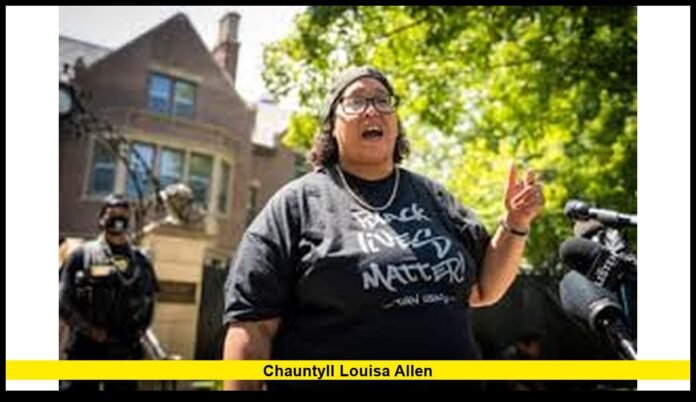

Chauntyll Louisa Allen became the subject of national attention in January 2026 after federal authorities took her into custody following a protest that interrupted a worship service at a church in St. Paul, Minnesota. As a sitting member of the St. Paul Public Schools Board of Education and a long-time community activist, her involvement in the incident placed the case at the center of a broader discussion about civil protest, religious freedom, and the legal responsibilities of public officials in the United States.
This report presents a complete, current, and factual account of the events, the legal process, and the public response, based solely on verified information available as of today.
Public Profile and Career
Chauntyll Louisa Allen was elected to the St. Paul School Board in 2020 and has since served in a leadership role focused on student equity, community engagement, and policy reform within Minnesota’s second-largest school district.
Beyond her work in education, Allen is known for years of involvement in grassroots organizing. Her activism has included campaigns related to racial justice, immigration policy, and youth advocacy. She has frequently spoken at public hearings, community forums, and demonstrations, building a reputation as a prominent voice in the Twin Cities civic landscape.
Her position as an elected official made the January 2026 arrest especially significant, as it marked one of the rare instances in which a sitting school board member in Minnesota became the subject of a federal civil rights investigation.
The Incident at the St. Paul Church
The events that led to the federal case unfolded during a Sunday morning service at a St. Paul church in mid-January 2026.
A group of demonstrators entered the sanctuary while worship was underway. The group began chanting and calling attention to immigration enforcement practices, specifically referencing concerns about the role of U.S. Immigration and Customs Enforcement in recent local events. The protest was organized to express opposition to perceived connections between a church leader and federal immigration authorities.
The demonstration disrupted prayers, preaching, and music. Church staff paused the service while attempting to restore order. Some attendees left the sanctuary, while others remained seated. Video recordings later confirmed that Chauntyll Louisa Allen was present inside the church during the protest and took part in the chanting.
The disruption lasted several minutes before the service resumed.
Federal Response and Arrest
Following the incident, federal agencies began reviewing video evidence, eyewitness accounts, and online material documenting the protest.
On January 22, 2026, agents from the Federal Bureau of Investigation and Homeland Security Investigations arrested Chauntyll Louisa Allen in Minnesota. The arrest was conducted as part of a coordinated federal operation, signaling that the matter had moved beyond a local disturbance investigation and into the scope of national civil rights enforcement.
The U.S. Department of Justice confirmed that the inquiry centers on whether the protest inside the church constituted unlawful interference with religious worship under federal law.
At this stage, Allen has not been convicted of any offense. She remains entitled to all constitutional protections, including the presumption of innocence.
Federal Law Under Consideration
Prosecutors are reviewing the incident under statutes that protect the free exercise of religion and the right of congregants to gather without intimidation or obstruction.
One of the primary laws being evaluated is the Freedom of Access to Clinic Entrances Act, which also covers houses of worship. The law prohibits:
- Intentional obstruction of religious services
- Actions that interfere with individuals seeking to practice their faith
- Conduct that disrupts religious gatherings through physical presence or coordinated interruption
If charges are ultimately filed, the court would examine whether the actions inside the sanctuary met the legal standard for intentional interference, rather than protected political expression.
As of today, no final charging instrument has been publicly issued.
Position of Federal Authorities
Justice Department officials have emphasized that the investigation does not concern the political beliefs of the participants. Instead, it focuses on conduct that occurred inside a protected religious space during active worship.
Federal statements have underscored three key principles:
- Peaceful protest in public forums is protected by the Constitution.
- Religious services are entitled to special legal protection from disruption.
- Elected officials are subject to the same federal laws as private citizens.
The Attorney General stated that houses of worship must remain places where individuals can practice their faith without fear of interruption or intimidation.
Reaction Across Minnesota
The arrest of Chauntyll Louisa Allen generated immediate reaction throughout the Twin Cities and across the state.
Supporters
Supporters described Allen as a long-time advocate for marginalized communities and framed the protest as an act of nonviolent civil disobedience. They emphasized her record of public service and argued that the demonstration was motivated by concern over immigration enforcement and community safety.
Several local organizations have called for dialogue and restraint, urging that the legal process consider the broader social context that led to the protest.
Critics and Faith Community
Many faith leaders and community members expressed concern about the disruption of worship. They stressed that religious services should remain free from political demonstrations, regardless of cause.
Some local officials stated that entering a sanctuary during prayer crosses a boundary between protest and interference, and that protecting the sanctity of religious gatherings is essential to preserving religious liberty.
Role on the St. Paul School Board
At present, Chauntyll Louisa Allen continues to serve on the St. Paul School Board.
District representatives have confirmed that:
- No removal or suspension action has been taken.
- Minnesota law requires formal legal findings before an elected board member can be removed.
- The board is monitoring the situation while respecting due process.
The case has prompted discussion among parents and educators about leadership stability, public trust, and the potential impact of ongoing legal proceedings on board operations.
Any future action would require compliance with state statutes governing elected education officials.
Key Dates and Developments
| Date | Event |
|---|---|
| 2020 | Election of Chauntyll Louisa Allen to St. Paul School Board |
| Mid-January 2026 | Protest disrupts worship service in St. Paul |
| January 22, 2026 | Federal arrest carried out |
| Present | Case under active review by federal prosecutors |
Constitutional Questions Raised
The case involving Chauntyll Louisa Allen highlights the intersection of two fundamental constitutional rights:
- Freedom of Speech and Assembly: The right to protest government actions and policies.
- Freedom of Religion: The right to worship without obstruction or intimidation.
Courts have long recognized that while protest is protected, certain locations and circumstances receive heightened protection, including courtrooms, polling places, and houses of worship.
The outcome of this case may help clarify how federal law applies when political demonstrations occur inside religious spaces rather than in traditional public forums.
National Attention and Broader Implications
Because Allen is an elected official, the case has drawn attention beyond Minnesota. Legal observers are closely watching how prosecutors balance civil rights enforcement with First Amendment protections.
The situation also raises questions about:
- The limits of civil disobedience
- The responsibilities of public officeholders
- The role of federal law in protecting religious institutions
Any judicial ruling or prosecutorial decision could influence how similar incidents are handled across the country.
Current Legal Status
As of today:
- Chauntyll Louisa Allen has not been convicted of any crime.
- Federal prosecutors continue to evaluate evidence.
- No trial date has been announced.
- The investigation remains active.
Defense counsel is expected to challenge the application of federal statutes and argue that the actions constituted protected expression rather than criminal interference.
Prosecutors, in turn, must determine whether the conduct met the threshold for intentional obstruction of religious worship.
Looking Ahead
The next steps in the process are expected to include:
- Completion of evidence review
- Possible filing of formal charges
- Initial court hearings, if charges are brought
- Motions addressing jurisdiction and constitutional questions
The legal path forward will determine whether the case proceeds to trial or is resolved through other judicial means.
The unfolding developments surrounding Chauntyll Louisa Allen continue to draw close attention as federal authorities, community leaders, and legal experts watch how the justice system navigates the balance between protest rights and the protection of religious freedom.
Readers are encouraged to follow future updates and share their perspectives as this significant case moves forward in the federal courts.