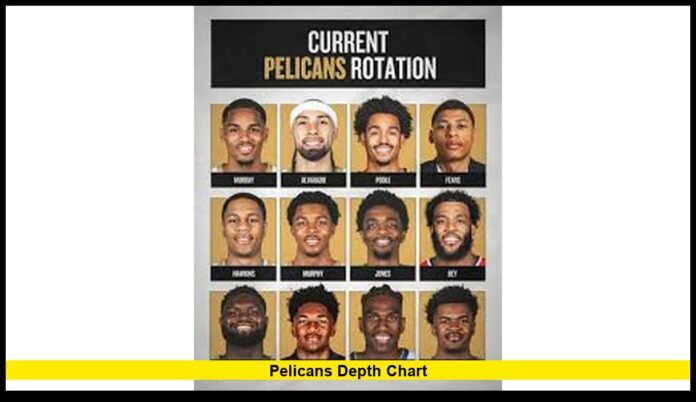

The Pelicans depth chart as of today provides a clear, confirmed look at how New Orleans is deploying its roster across all five positions during the 2025–26 NBA season. With defined starters, a structured second unit, and situational reserves, the team’s rotation reflects both its developmental direction and its effort to stay competitive in a demanding Western Conference.
This breakdown focuses only on active roster roles and on-court usage. Every position group is examined with attention to current minutes, responsibilities, and lineup balance, giving a complete picture of how the Pelicans are built from the opening tip through the closing stretch of games.
Backcourt Structure and Guard Rotation
Point Guard
Jeremiah Fears currently leads the depth chart at point guard. He controls the pace, initiates half-court sets, and handles primary ball distribution. His role has grown steadily, and he now logs starter-level minutes while being trusted with late-clock decisions.
Jose Alvarado serves as the first guard off the bench. His impact comes from defensive pressure, quick hands, and the ability to disrupt opposing ball-handlers. When he enters, the tempo often increases, and the Pelicans lean into transition opportunities.
Jordan Poole adds another layer to the backcourt. While not always used as a traditional point guard, he provides shot creation, secondary playmaking, and scoring bursts that can swing momentum. Trey Alexander rounds out the position group, seeing floor time when injuries, foul trouble, or matchup needs arise.
Shooting Guard
Trey Murphy III holds the starting spot and remains one of the most important offensive pieces on the roster. His shooting range stretches defenses, and his off-ball movement opens driving lanes for teammates. Murphy also carries a heavy workload in crunch time, frequently defending the opponent’s top perimeter scorer.
Bryce McGowens anchors the second unit at shooting guard. His athleticism and ability to attack the rim give the bench a downhill threat. Jordan Hawkins provides additional spacing and is often used in lineups that emphasize perimeter shooting.
Wing Depth and Forward Versatility
Small Forward
Saddiq Bey starts at small forward and brings two-way reliability. He defends multiple positions, rebounds effectively for his size, and knocks down open perimeter shots. Bey’s presence allows the coaching staff to switch defensive schemes without making substitutions.
Micah Peavy operates as the primary backup on the wing. His minutes often come against high-energy opponents or when defensive length is needed. Peavy’s role is less about volume scoring and more about containment, rebounding, and transition defense.
Power Forward
Zion Williamson anchors the power forward position and remains the central figure in the frontcourt. When he is on the floor, the offense frequently runs through him in the post, on drives, and in pick-and-roll actions. His physicality draws double teams, which creates open looks for shooters along the perimeter.
Karlo Matković fills the primary reserve role. He provides size, screen setting, and interior presence, allowing the Pelicans to maintain structure when Williamson rests. Matković’s minutes often come in second-quarter and early fourth-quarter stretches, where stability in the paint is crucial.
Interior Defense and Center Rotation
Center
Derik Queen has taken over starting duties at center. His responsibilities include rim protection, defensive rebounding, and finishing around the basket. Queen’s ability to run the floor also fits well with the team’s transition offense, especially when paired with guards who push the pace.
Yves Missi backs him up and supplies energy, shot-blocking, and second-chance opportunities. Missi’s athleticism allows the Pelicans to switch between physical half-court defense and faster, more aggressive styles.
Veteran big men Kevon Looney and DeAndre Jordan provide depth and experience. While their minutes are more situational, their presence offers stability in games that require physical interior defense or when younger players encounter foul trouble.
Complete Pelicans Depth Chart Overview
| Position | Starter | Second Unit | Additional Depth |
|---|---|---|---|
| Point Guard | Jeremiah Fears | Jose Alvarado | Jordan Poole, Trey Alexander |
| Shooting Guard | Trey Murphy III | Bryce McGowens | Jordan Hawkins |
| Small Forward | Saddiq Bey | Micah Peavy | Jordan Hawkins |
| Power Forward | Zion Williamson | Karlo Matković | Saddiq Bey |
| Center | Derik Queen | Yves Missi | Kevon Looney, DeAndre Jordan |
This structure illustrates how the rotation balances youth, athleticism, and veteran presence across the floor.
How the Pelicans Depth Chart Shapes Game Strategy
Offensive Flow
The Pelicans rely on spacing and interior pressure. Williamson’s presence in the paint forces defensive collapses, while Murphy and Hawkins stretch the floor. Fears orchestrates pick-and-roll actions, often pairing with Queen or Matković to create mismatches.
Poole’s role as a scoring guard allows the offense to remain aggressive when starters rest. His ability to create off the dribble prevents stagnation and keeps defenses honest.
Defensive Identity
On defense, the team emphasizes perimeter pressure and help-side rim protection. Alvarado and Peavy set the tone with ball pressure, while Queen and Missi protect the basket. Bey’s versatility allows for frequent switching, which is critical against wing-heavy lineups.
Bench Production and Rotation Patterns
The second unit typically features a mix of speed, shooting, and interior defense. Common combinations include:
- Alvarado with Poole or McGowens in the backcourt
- Hawkins providing spacing on the wing
- Matković or Missi anchoring the paint
These groups are designed to maintain pace while limiting defensive drop-off. The rotation also allows starters to return with manageable workloads, especially in tightly contested games.
Development Focus Within the Depth Chart
A major theme of the current Pelicans depth chart is growth. Fears and Queen are being entrusted with significant responsibilities, signaling a commitment to building around a young core. Murphy’s continued rise as a two-way wing gives the roster a reliable scoring foundation, while Williamson remains the physical centerpiece when available.
Veteran contributors, though not always featured heavily in the box score, provide structure, communication, and situational awareness that supports the development of the younger players.
Why the Pelicans Depth Chart Is Central to the Season Outlook
The rotation shows a team focused on balance:
- Ball-handling and tempo from the guard group
- Shooting and versatility from the wings
- Power and rim protection from the frontcourt
This alignment allows New Orleans to adapt to different opponents, whether facing small, fast lineups or teams that rely on size and physicality.
The Pelicans depth chart continues to be a key indicator of how the franchise is shaping its identity, distributing minutes, and building continuity across the roster as the season progresses.