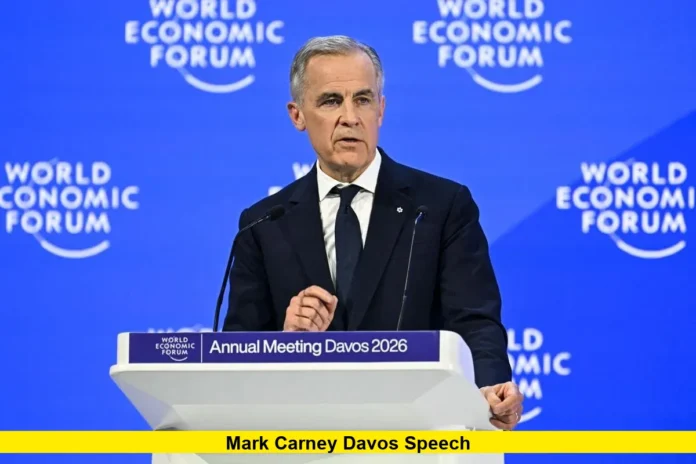

Canadian Prime Minister Mark Carney’s mark carney davos speech at the 2026 World Economic Forum in Switzerland has emerged as one of the most influential and widely discussed political addresses of the year. Delivered to an audience of global leaders, CEOs, economists, and diplomats, the speech confronted the growing instability of the international system and warned that the long-standing rules-based global order is now under severe strain.
In his remarks, Carney painted a picture of a world entering a more fragmented and confrontational phase. He argued that economic integration, once a tool for cooperation and shared prosperity, is increasingly being used as an instrument of pressure and leverage. He also stressed that traditional assumptions about stability can no longer be taken for granted and that countries must adapt quickly to a changing geopolitical reality.
The address resonated strongly across diplomatic and financial circles, setting the tone for discussions throughout the Davos forum and beyond.
A Defining Moment at Davos 2026
The World Economic Forum in Davos has long served as a platform for shaping global narratives. This year, however, the atmosphere was notably tense. Rising geopolitical rivalry, disputes over territory, and the weaponization of trade dominated private and public conversations.
Against this backdrop, Carney’s speech stood out for its clarity and urgency. He stated that the international system built after World War II is no longer functioning as intended. According to his assessment, cooperation based on shared rules is being replaced by power politics, economic coercion, and strategic competition.
His message was not framed as theoretical. It reflected real-world developments that are reshaping global relations, particularly among advanced economies and emerging powers.
Warning of a Fractured Global Order
One of the most striking elements of Carney’s address was his declaration that the world is experiencing a rupture rather than a gradual transition. He said that the structures designed to manage conflict, trade, and diplomacy are being tested in ways not seen for generations.
He emphasized that nations can no longer rely on assumptions that economic interdependence alone will prevent conflict or guarantee stability. Instead, he argued, countries must recognize that power dynamics have shifted and that the international environment is becoming more transactional and less predictable.
This assessment drew attention to growing concerns that multilateral institutions are struggling to keep pace with geopolitical change.
Middle Powers and the Call for Collective Action
A central theme of the speech was the role of so-called middle powers. Carney described countries such as Canada, Germany, France, Japan, South Korea, and Australia as essential pillars of stability in a world where superpower rivalry is intensifying.
He urged these nations to coordinate more closely, strengthen their economic and security partnerships, and defend shared principles through collective action rather than isolated responses. In his view, unity among middle powers could serve as a stabilizing force capable of countering coercion and preserving open, rules-based cooperation.
This message was widely interpreted as a call for deeper alignment among democratic and market-based economies.
Economic Pressure as a Geopolitical Tool
Carney also focused on the growing use of trade, investment, and supply chains as strategic weapons. He warned that when economic relationships are manipulated for political ends, trust erodes and global markets become more volatile.
He noted that tariffs, sanctions, and investment restrictions can have far-reaching consequences, not only for targeted countries but for the entire global economy. According to his remarks, such measures can disrupt supply chains, increase inflationary pressures, and undermine long-term growth.
The speech underscored the need for resilience, diversification, and cooperation to ensure that economic systems remain sources of stability rather than instruments of conflict.
Canada’s Position on Sovereignty and Alliances
While maintaining a diplomatic tone, Carney made it clear that Canada opposes the use of economic or political pressure to challenge the sovereignty of other nations or territories. He reaffirmed support for allied countries and stressed the importance of respecting international law and established borders.
This stance reflected Canada’s broader foreign policy approach, which emphasizes multilateralism, alliance solidarity, and peaceful resolution of disputes.
Global Reaction to the Address
The reaction inside the Davos Congress Centre was immediate and intense. Many attendees described the speech as one of the most candid and consequential delivered at the forum in recent years. Political leaders and business executives alike acknowledged that Carney had articulated concerns shared across capitals and boardrooms.
Analysts noted that his remarks captured a growing sense that the world is entering a more complex and uncertain era, one in which economic policy, national security, and diplomacy are increasingly intertwined.
Implications for Trade and Investment
Carney’s warning about fragmentation resonated strongly with investors and corporate leaders. Companies operating across borders face rising risks from trade disputes, regulatory divergence, and geopolitical tensions.
His call for coordinated action among middle powers was seen as an effort to preserve open markets and predictable rules, even as global competition intensifies. The speech highlighted the importance of strengthening institutions that support fair trade, financial stability, and dispute resolution.
A Broader Strategic Vision
Beyond immediate geopolitical concerns, Carney’s address outlined a longer-term vision for international cooperation. He argued that countries must modernize global institutions to reflect today’s economic realities and power distribution.
He also emphasized the need to invest in climate resilience, technological innovation, and inclusive growth, warning that failure to address these challenges could further destabilize the international system.
Social Media Buzz
X (formerly Twitter):
“Carney’s Davos speech cuts through the noise. A clear message: the world order is shifting, and middle powers must act together.”
LinkedIn:
“Powerful address by Canada’s PM at Davos. Economic integration is no longer just about growth, it’s about security and stability.”
What Comes After Davos
As leaders return to their capitals, the themes raised in the speech are expected to influence policy debates in the months ahead. Discussions on trade diversification, alliance coordination, and institutional reform are likely to gain momentum.
For Canada, the address reinforced its role as a vocal advocate for multilateral cooperation and responsible global leadership. For the wider international community, it served as a reminder that the foundations of global stability cannot be taken for granted.
Why the Speech Matters
The mark carney davos speech did more than diagnose global challenges. It called for practical action, strategic unity, and a renewed commitment to cooperation at a time when the international system faces unprecedented pressure.
By articulating the risks of fragmentation and the necessity of collective leadership, Carney positioned his address as a reference point for policymakers navigating an increasingly uncertain world.
What do you think this shift in global dynamics means for the future of international cooperation? Share your perspective and stay tuned for further developments.