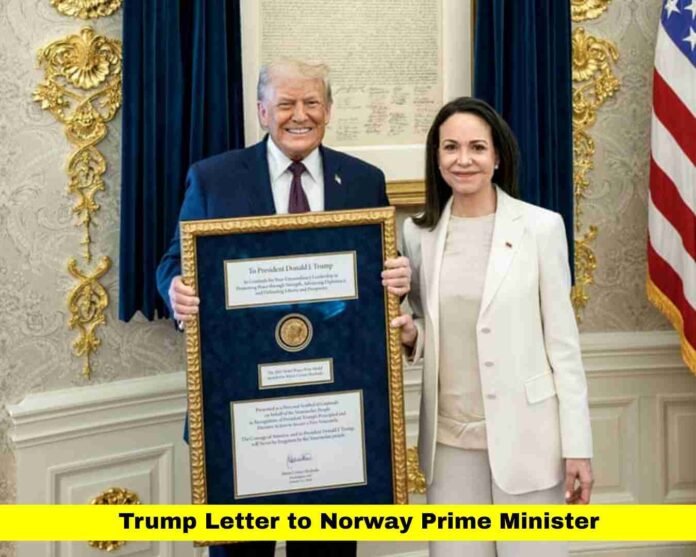

A recent Trump letter to Norway Prime Minister has captured global attention, raising questions about diplomacy, U.S.-European relations, and Arctic policy. The letter, personally addressed to Prime Minister Jonas Gahr Støre, linked U.S. interests in Greenland with the Nobel Peace Prize, generating widespread discussion and concern among governments and international observers.
The correspondence demonstrates an unusual intertwining of personal political recognition with international strategy, revealing how a single document can influence alliances, trade considerations, and regional security in Northern Europe. Here’s a detailed look at what the letter contains, the reactions it provoked, and the broader implications for global diplomacy.
The Contents of the Letter
In the letter, President Donald Trump expressed disappointment at not receiving the 2025 Nobel Peace Prize and tied it to his perception of global leadership achievements. He claimed that this perceived snub had affected his approach to international diplomacy, stating that he could now prioritize what he deemed “good and proper for the United States of America.”
Trump also raised concerns about Greenland, emphasizing its strategic significance and questioning Denmark’s capacity to defend it against foreign influence. He suggested that controlling Greenland was critical for U.S. security and regional stability. Additionally, he highlighted his contributions to NATO and implied that U.S. leadership in the alliance should be recognized and supported.
The letter blends personal commentary with diplomatic messaging, an unusual approach for communications between heads of state.
Norway’s Official Response
Prime Minister Jonas Gahr Støre confirmed receipt of the letter, noting that Norway’s government does not decide Nobel Peace Prize winners—the independent Norwegian Nobel Committee does. He clarified that Norway remains committed to Denmark’s sovereignty over Greenland and emphasized responsible NATO cooperation.
The prime minister stressed dialogue and collaboration, seeking to reduce potential tensions and reaffirming Norway’s commitment to international norms and alliances. His response highlighted the distinction between personal opinions expressed by foreign leaders and official government policy.
Greenland’s Strategic Importance
Greenland’s location in the Arctic makes it a critical point of interest for global powers. Its proximity to North America and Europe, combined with resources and military potential, has long attracted attention from multiple nations. The letter’s focus on Greenland underscores how regional control is increasingly viewed through a strategic lens, connecting security, trade, and climate considerations.
Despite this interest, Greenlandic leaders and citizens have reiterated their commitment to remaining part of the Kingdom of Denmark. They oppose any external pressure or claims that threaten their autonomy, reinforcing the importance of respecting local governance and territorial integrity.
European Reactions and Trade Implications
The letter and related discussions sparked reactions from European governments. Concerns about potential tariffs or coercive economic measures prompted discussions among Norway, Denmark, and other EU countries. European leaders emphasized diplomatic engagement over unilateral pressure, underlining that Arctic issues should be addressed collaboratively within established alliances.
The situation has encouraged broader reflection on how trade, diplomacy, and security intersect in the Arctic, with leaders seeking ways to maintain stability while respecting sovereign decisions.
Nobel Peace Prize Context
Trump’s connection between the Nobel Peace Prize and his policy priorities is highly unusual. Traditionally, the award is independent and symbolic, not tied to immediate strategic decisions. The letter’s framing suggests that personal recognition was perceived as influencing U.S. diplomatic posture, highlighting the complex interplay between political ego, public perception, and international relations.
Implications for NATO and Transatlantic Relations
The letter also touched on NATO, emphasizing the president’s view of U.S. contributions to the alliance. By linking alliance cooperation with territorial and strategic interests, the letter raises questions about the foundations of collective security. European leaders have reiterated that NATO commitments are grounded in shared responsibilities and mutual defense, not individual recognition or transactional considerations.
The correspondence illustrates how personal leadership styles can influence alliance dynamics and provoke reassessment of diplomatic priorities.
Arctic Policy and International Security
The Arctic region is becoming a focal point for global competition. Climate change, resource availability, and evolving security considerations have increased the stakes. Most Arctic nations advocate cooperative approaches that respect sovereignty, maintain stability, and leverage multilateral frameworks.
Trump’s letter, with its emphasis on U.S. control over Greenland, highlights tensions between unilateral strategic ambitions and collaborative international norms. How this will influence policy discussions moving forward remains closely watched.
Public Reaction and Media Attention
The letter received widespread attention from citizens and media outlets alike. Public responses have ranged from concern over diplomatic overreach to analysis of the interplay between personal recognition and statecraft. Governments in Europe and North America are monitoring reactions closely, balancing public interest with the need to maintain stable relations and effective policy coordination.
Future Outlook
Moving forward, diplomatic engagement between Norway, Denmark, and the United States is expected to continue. Discussions will likely focus on clarifying intentions, reinforcing alliance norms, and ensuring that Arctic policies are pursued collaboratively.
The letter has sparked reflection on how communication between leaders can shape policy, perception, and strategy, highlighting the ongoing importance of diplomacy in maintaining international order and mutual trust.
What are your thoughts on how this diplomatic exchange might impact Arctic policy and U.S.–European relations in the coming months? Share your perspective and stay informed.