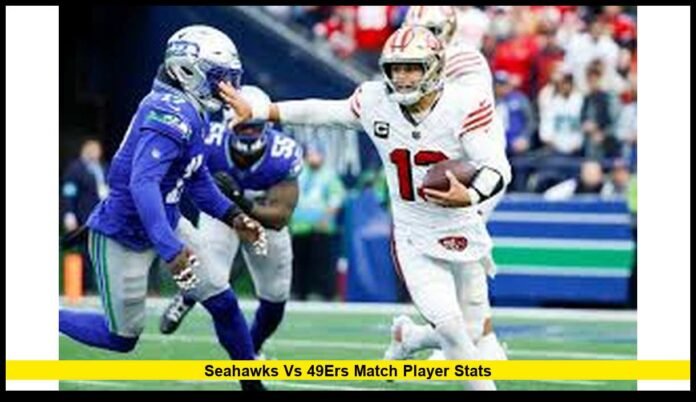

The Seahawks vs 49ers match player stats from the most recent NFC Divisional Round game paint a clear picture of one-sided dominance, as Seattle delivered a commanding 41–6 victory that showcased efficiency on offense, physical control in the run game, and relentless pressure on defense.
From the opening kickoff to the final snap, the Seahawks dictated tempo, field position, and momentum. Every major statistical category reflected their control, while the 49ers struggled to generate sustained drives or explosive plays.
Game Flow and Momentum
Seattle seized control immediately when Rashid Shaheed returned the opening kickoff 95 yards for a touchdown. That play not only provided an instant lead but also shifted the emotional balance of the stadium. The 49ers were forced into catch-up mode from the very first minute, allowing Seattle to operate with an aggressive yet controlled game plan.
The Seahawks built their lead through balanced scoring drives, a powerful rushing attack, and defensive stops that repeatedly handed the ball back to their offense in favorable field position. By halftime, the outcome already felt tilted heavily in Seattle’s favor.
Quarterback Performance Comparison
Seattle Seahawks: Sam Darnold
Sam Darnold delivered a composed performance focused on precision and decision-making rather than volume.
- Completions: 12
- Attempts: 17
- Passing Yards: 124
- Touchdowns: 1
- Interceptions: 0
Darnold’s ball placement allowed receivers to gain yards after the catch, and his quick reads neutralized the 49ers’ pass rush. He avoided unnecessary risks and converted key third downs, keeping drives alive and maintaining possession.
San Francisco 49ers: Brock Purdy
Brock Purdy faced constant pressure and limited time in the pocket.
- Completions: 15
- Attempts: 27
- Passing Yards: 140
- Touchdowns: 0
- Interceptions: 1
Seattle’s defensive front disrupted timing routes and collapsed the pocket, forcing Purdy into hurried throws and preventing deep completions.
Rushing Attack and Ground Control
The Seahawks established physical dominance on the ground, which became the foundation of their offensive success.
Seattle Rushing Leaders
Kenneth Walker III delivered a career-defining playoff performance.
- Carries: 19
- Rushing Yards: 116
- Touchdowns: 3
Walker consistently gained positive yardage on early downs, allowing Seattle to stay ahead of the chains. His vision through the line, acceleration through gaps, and strength after contact resulted in sustained drives and red-zone efficiency.
Rashid Shaheed added change-of-pace runs that kept the defense guessing, contributing additional rushing yards alongside his special teams impact.
San Francisco Rushing Output
Christian McCaffrey was limited by disciplined run defense.
- Carries: 11
- Rushing Yards: 35
Seattle’s linebackers closed gaps quickly, while interior linemen won battles at the point of attack, preventing the 49ers from establishing rhythm on the ground.
Receiving Production
Seahawks Receiving Leaders
Seattle distributed targets across multiple playmakers, preventing double coverage from neutralizing any single option.
- Cooper Kupp
- Receptions: 5
- Receiving Yards: 60
Kupp provided reliable chain-moving catches, particularly on intermediate routes.
- Jaxon Smith-Njigba
- Receptions: 3
- Receiving Yards: 19
- Touchdowns: 1
Smith-Njigba’s touchdown came on a well-executed red-zone route, creating separation in tight coverage.
- Kenneth Walker III
- Receptions: 3
- Receiving Yards: 29
Walker’s involvement in the passing game added another layer to the offense and forced linebackers into coverage responsibilities.
49ers Receiving Leaders
San Francisco’s passing production remained limited.
- Jake Tonges
- Receptions: 5
- Receiving Yards: 59
- Christian McCaffrey
- Receptions: 5
- Receiving Yards: 39
While these numbers provided modest gains, the absence of explosive plays kept the offense from shifting momentum.
Defensive Dominance
Seattle’s defense controlled the game through pressure, discipline, and timely turnovers.
Key Defensive Metrics
- Turnovers Forced: 3
- Total Yards Allowed: 236
- Fourth-Down Stops: 3
The defensive line consistently collapsed the pocket, while edge rushers disrupted rollout attempts. Linebackers closed quickly on short routes, limiting yards after the catch.
A crucial strip-sack halted one of the 49ers’ most promising drives, and the recovery set up a short field that led to another Seahawks score.
Special Teams Impact
Special teams provided a significant early advantage.
- Rashid Shaheed
- Kickoff Return: 95-yard touchdown
This play instantly changed the game’s tone and placed the 49ers in an early deficit.
Kicker Jason Myers remained perfect on extra points and added multiple field goals, ensuring that Seattle converted drives into points.
Statistical Comparison
| Category | Seahawks | 49ers |
|---|---|---|
| Total Yards | 281 | 236 |
| Rushing Yards | 143 | 58 |
| Passing Yards | 138 | 178 |
| Turnovers | 0 | 3 |
| Time of Possession | Advantage | Disadvantage |
| Third-Down Conversions | Higher | Lower |
Seattle’s ability to win on early downs allowed for efficient third-down situations, while San Francisco often faced long-yardage scenarios.
Red Zone Efficiency
Seattle capitalized on scoring opportunities.
- Red Zone Trips: High conversion rate
- Touchdowns: Multiple rushing and passing scores
San Francisco, by contrast, struggled to sustain drives long enough to reach scoring range, settling for limited points.
Tactical Breakdown
Seattle’s Offensive Approach
- Balanced run-pass ratio
- Quick-release passing
- Heavy use of play-action
- Multiple personnel groupings
This variety prevented defensive substitutions and created mismatches.
San Francisco’s Challenges
- Inconsistent pass protection
- Limited success on first down
- Few explosive plays
- Turnover setbacks
These factors compounded, placing the offense in difficult situations throughout the game.
Historical Rivalry Context
The Seahawks-49ers rivalry has produced numerous close postseason battles, but this matchup stood out for its statistical separation. The 41–6 scoreline marked one of the most decisive playoff results between the two franchises, reflecting Seattle’s preparation and execution.
What the Numbers Reveal
The Seahawks vs 49ers match player stats highlight three core themes:
- Efficiency: Seattle maximized every possession.
- Physicality: The rushing attack controlled the clock and field position.
- Discipline: Zero turnovers preserved momentum.
These elements combined to create a complete performance on the sport’s biggest stage.
Looking Ahead
With this victory, Seattle advanced with confidence built on balanced offense, elite defensive pressure, and special teams excellence. The statistical profile from this game serves as a blueprint for playoff success and underscores the depth of the roster across all units.
The Seahawks vs 49ers match player stats tell a story of total control, and fans will be watching closely to see if Seattle can carry this level of execution into the next postseason challenge.