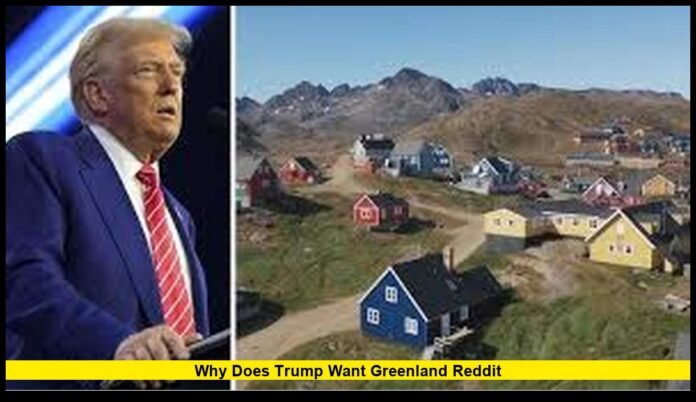

In early 2026, one question dominated global discussion threads and public debates alike: why does Trump want Greenland Reddit became a central search topic as world leaders scrambled to respond to an unprecedented standoff between the United States and its closest allies over the fate of Greenland. What started as a contentious idea reignited by former President Donald Trump has grown into one of the most serious geopolitical crises of the year, involving escalating trade measures, massive public protests, and deep strains in long-standing alliances. This article explains the verified facts unfolding now, why Greenland matters so much, and precisely how this dispute is reshaping international relations.
Greenland’s Global Importance
Greenland is the world’s largest island, a sparsely populated Arctic territory of roughly 57,000 people, and an autonomous constituent of the Kingdom of Denmark. Its location is uniquely strategic — bridging North America and Europe, overlooking key Arctic sea routes, and lying close to both Russia and the North American mainland. For decades, Greenland has drawn interest from global powers due to its military value, because it sits along critical early warning lines and Arctic defense corridors, and because its vast undisturbed land holds major natural resources.
In addition to its strategic position, Greenland is believed to contain wealth in rare earth minerals, critical metals such as lithium, and possibly massive amounts of hydrocarbons beneath its ice and tundra. As Arctic ice melts from climatic warming, these resources are becoming more accessible, and emerging northern shipping routes are increasing the island’s economic and geopolitical value. At present, the United States operates a major military installation in northern Greenland, which plays a role in space surveillance and missile warning systems critical to continental defense.
Trump’s Assertive Push for Control
Since taking office for a second term, Donald Trump renewed his controversial campaign to bring Greenland under U.S. control. The idea is not new — he floated acquiring Greenland in his first presidency — but in early 2026 he escalated his rhetoric dramatically. The former president stated publicly that Greenland must be acquired by the United States for national security reasons and argued that without U.S. sovereignty, adversaries such as Russia or China might attempt to gain influence in the region.
Trump framed Greenland’s strategic Arctic geography as essential to American defense, especially in expanding capabilities tied to missile defense systems and monitoring capabilities. He repeatedly described the island as “vital” for national security and suggested that full control was necessary for long-term U.S. interests. His remarks extended to endorsing strong economic or even military pressure to secure Greenland, insisting that the U.S. would take action “whether they like it or not” if necessary, though he also said diplomatic options remained possible.
At the start of 2026, Trump announced punitive economic tariffs on eight European nations — including Denmark, France, Germany, the United Kingdom, and others — arguing that these allies were undermining U.S. interests by opposing American control over Greenland. The tariffs begin at 10 percent in February and rise to 25 percent in June unless Greenland is transferred to the United States. This extraordinary use of trade policy as leverage against long-term allies marked a dramatic escalation in international tensions.
Strong Pushback from Denmark and Greenland
Leaders in Denmark and Greenland responded firmly and uniformly: Greenland is not for sale under any circumstances.
The prime minister of Greenland publicly declared that the territory would remain part of the Kingdom of Denmark, reaffirming allegiance to Denmark, NATO, and the European security framework. Greenlandic leaders stressed that while greater autonomy and eventual full independence remain long-term aspirations for some residents, there is no intention of becoming part of the United States.
Denmark’s government responded by increasing military cooperation with European partners in the Arctic. Several NATO countries deployed additional forces to Greenland for joint exercises, reaffirming a collective defense posture rather than U.S. unilateral control. These actions reflected deep concern among European allies that unilateral American pressure could destabilize Arctic security arrangements and fracture alliance commitments.
Greenlanders themselves took to the streets in large numbers. Thousands marched in Nuuk, the capital, carrying banners rejecting annexation and demanding respect for democratic self-determination. Demonstrations spread into Denmark, with significant rallies stressing solidarity with Greenlandic autonomy and rejecting claims that the United States should govern the island.
NATO Strains and European Revolt
The United States’ tariff threats and aggressive posturing caused immediate backlash among NATO members and European leaders. Officials described the imposition of punitive tariffs on allied economies as destabilizing and harmful to transatlantic cooperation. Several leaders condemned the approach as inappropriate for dealing with alliance partners and emphasized that collective security should not be leveraged to force territorial concessions.
A number of European capitals held emergency discussions to coordinate responses to the U.S. tariff pressure. At the same time, the idea of strengthening NATO’s Arctic defense presence independent of U.S. demands gained traction. Leaders underscored that safeguarding the Arctic region against actual threats — such as potential Russian military activity — required cooperation rather than coercion.
These tensions exposed fault lines within alliances that had been taken for granted since the end of the Cold War. The notion of using economic pressure to influence territorial arrangements among allies raised deep questions about future collaboration on security matters ranging from missile defense to Arctic environmental monitoring.
Why Trump’s Ambition Resonates Globally
So what drives this fierce push by Trump to obtain Greenland, and why does it stir such widespread debate and concern?
National Security and Defense
Greenland’s location makes it critical for monitoring airspace over the Arctic and early warning systems for missile detection. A U.S. presence there supports defense and surveillance networks, and Trump argued that full control would remove any political constraints on expanding these strategic assets.
Mineral and Economic Interests
Greenland’s potential stores of rare earth minerals and critical metals are viewed as economically significant for future technology industries and national defense supply chains. As global demand for these resources rises, having unfettered access could provide strategic advantage.
Geopolitical Competition
The Arctic is becoming a theater of increasing geopolitical competition. As nations vie for influence, shipping routes, and resources opened up by climate change, controlling Greenland could give the United States enhanced leverage over Arctic affairs and emerging northern transport corridors.
Current State of the Dispute
As of January 2026:
- The United States has imposed tariffs on several European allies tied to their opposition to American control of Greenland.
- Denmark and Greenland firmly reject any transfer of sovereignty and emphasize their alliance commitments.
- Major protests in Greenland and European capitals underscore widespread opposition to annexation.
- European governments have begun coordinating responses to U.S. trade actions and reassured continued collective defense cooperation.
- NATO allies have increased military cooperation in the Arctic independent of U.S. acquisition demands.
This standoff remains fluid, with diplomatic discussions ongoing even as economic and military maneuvers proceed. What is clear is that the Greenland crisis has shifted global conversations about alliance cohesion, Arctic strategy, and how nations resolve disputes over territory and security in the 21st century.
Tell us what you think about Greenland’s future and share your view in the comments below.