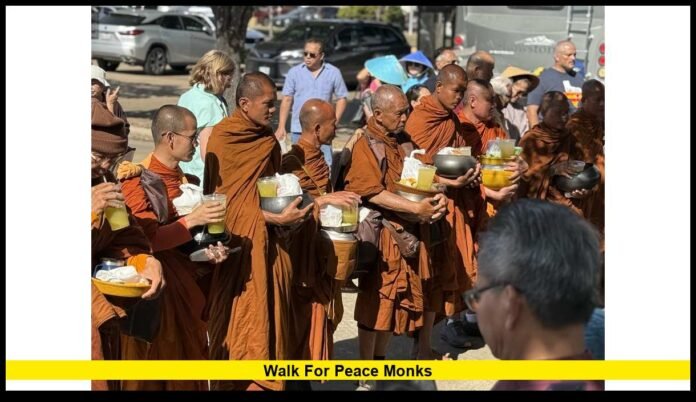

The walk for peace monks are moving steadily across the eastern United States, drawing growing national attention as they continue their long spiritual pilgrimage toward Washington, D.C. As of today, the group of Buddhist monks has already covered well over half of their 2,300-mile route that began in Fort Worth, Texas, in October 2025, carrying a message of peace, mindfulness, and unity to communities along the way.
Their journey is not a protest, campaign, or political march. It is a living spiritual practice carried out step by step on public roads, city sidewalks, and rural highways. With calm expressions and measured movement, the monks demonstrate a form of peaceful presence that has resonated with people across the country.
Origins of the Cross-Country Pilgrimage
The walk began on October 26, 2025, when nearly twenty monks from different Buddhist traditions set out from a meditation center in Texas. Dressed in traditional robes and carrying only basic necessities, they committed to walking the entire distance to the nation’s capital.
The purpose of the journey is grounded in core Buddhist principles:
- Cultivating inner peace through mindfulness
- Encouraging compassion in daily life
- Promoting harmony across cultures and beliefs
- Reminding people that calm awareness can exist even in fast-paced environments
Rather than delivering speeches at every stop, the monks allow their presence to communicate the message. Their silence, discipline, and consistency speak more loudly than slogans.
Daily Life on the Road
Each day follows a structured rhythm built around spiritual practice and physical endurance. The monks typically begin before sunrise with meditation, followed by hours of mindful walking. Their pace is steady, neither rushed nor slow, allowing them to maintain awareness with every step.
A typical day includes:
- Morning chanting and breathing practice
- Several walking segments totaling many miles
- Short rest periods for hydration and medical checks
- Community interactions in the late afternoon
- Evening meditation and reflection
They carry minimal belongings and rely on local supporters for meals and safe places to rest. This simplicity is intentional, reinforcing their focus on presence rather than comfort.
Progress Through the Southern and Southeastern States
Since leaving Texas, the walk for peace monks have passed through Louisiana, Mississippi, Alabama, Georgia, South Carolina, and North Carolina. In each state, their arrival has drawn both quiet observers and large crowds.
In urban areas, they have walked alongside busy traffic, drawing respectful attention from commuters and pedestrians. In rural towns, residents have lined roads in silence or offered food and water as gestures of support.
Notable patterns have emerged along the route:
- Faith leaders from Christian, Jewish, Muslim, and Hindu communities have welcomed the monks.
- Schools have brought students outside to witness the peaceful procession.
- Veterans’ groups and civic organizations have joined short segments of the walk.
These encounters highlight how the monks’ message transcends religious boundaries.
North Carolina استقبال and Public Response
By mid-January 2026, the monks entered North Carolina, where interest intensified. Communities organized small gatherings in parks and public squares, creating spaces for reflection and quiet conversation.
Many attendees described feeling a rare sense of calm simply by standing near the procession. Parents brought children, explaining the meaning of patience and nonviolence through the example unfolding before them.
The monks did not promote any ideology. Their presence encouraged people to slow down, breathe, and reflect, even if only for a few minutes.
The Physical Demands of a 2,300-Mile Walk
Walking such a vast distance places enormous strain on the body. The monks face:
- Long stretches of pavement that stress joints and muscles
- Cold winter mornings and fluctuating temperatures
- Occasional rain, wind, and traffic noise
- Fatigue that accumulates week after week
Medical volunteers and supporters monitor their health. Foot care, hydration, and rest schedules are carefully maintained. Despite these challenges, the group has maintained a consistent pace without major interruption.
Their endurance has become a powerful symbol of commitment, showing how discipline and mental focus can sustain the body over long periods.
A Moment of Hardship and Resilience
During the early stages of the journey, the group faced a serious road incident that resulted in severe injury to one monk. The event brought attention to the risks of walking along major highways, even with safety precautions in place.
The injured monk received immediate medical care and remains part of the spiritual community supporting the pilgrimage. The incident strengthened safety coordination and reinforced the group’s focus on awareness and caution.
Rather than discouraging the journey, the experience deepened the monks’ resolve and reminded supporters of the vulnerability that comes with such an undertaking.
Aloka: The Companion on Four Legs
Among the most recognizable figures of the journey is Aloka, a rescued dog who has become an unofficial ambassador of compassion. Often seen trotting near the monks or resting beside them during breaks, Aloka symbolizes care for all living beings.
The dog recently underwent treatment for a leg injury and is now recovering. While activity is limited during healing, Aloka remains part of the traveling community and continues to appear in updates shared by followers.
For many observers, the presence of the dog reinforces the monks’ teaching that kindness extends beyond human boundaries.
The Role of Silence
One of the most striking aspects of the walk for peace monks is their use of silence. While they do speak when approached, much of their time on the road is spent without conversation.
This silence serves several purposes:
- It deepens concentration and awareness.
- It reduces distraction and mental agitation.
- It allows observers to project their own reflections onto the scene.
- It creates an atmosphere of calm even in busy environments.
In a society filled with constant noise, the quiet movement of the monks offers a rare contrast that many find grounding.
Digital Reach and Nationwide Awareness
Although the journey itself is slow and deliberate, its visibility has spread rapidly through social media. Short videos of the monks walking through city streets, crossing bridges, or receiving community welcomes have circulated widely.
Supporters across the country follow daily updates, route maps, and photographs. Many express that watching the steady progress provides a sense of hope and stability amid fast-changing news cycles.
The online response has helped coordinate local support, with volunteers preparing food, arranging shelter, and managing logistics ahead of the group’s arrival in each area.
Interfaith Connections Along the Route
The pilgrimage has become a meeting point for people of many faiths. In several cities, interfaith gatherings have formed spontaneously as the monks arrived.
These gatherings often include:
- Moments of shared silence
- Readings from different spiritual traditions
- Simple messages about compassion and mutual respect
- Collective prayers for peace
Such encounters demonstrate how a non-confrontational spiritual journey can foster unity without debate or division.
Approaching the Nation’s Capital
The final destination, Washington, D.C., carries symbolic weight. The monks plan to arrive in the coming weeks, completing their months-long walk with a peaceful presence in the heart of the country’s political center.
Their intention in reaching the capital includes:
- Offering meditation for global peace
- Highlighting the universal value of nonviolence
- Encouraging recognition of Vesak, the day honoring the Buddha’s life and awakening
- Creating a space for quiet reflection in a city known for constant activity
No rallies or demonstrations are planned. The focus remains on mindfulness and shared humanity.
Why This Journey Resonates
The impact of the walk for peace monks extends beyond religious circles. People from all backgrounds have found meaning in the simplicity of the act.
Several factors explain this resonance:
- The visible commitment required to walk thousands of miles
- The contrast between calm movement and hectic modern life
- The absence of political messaging or confrontation
- The universal appeal of peace and compassion
In many towns, residents have described feeling a shift in atmosphere as the monks passed through, even if only briefly.
A Timeline of the Journey
| Stage | Region | Period |
|---|---|---|
| Departure | Fort Worth, Texas | Late October 2025 |
| Gulf States | Louisiana, Mississippi, Alabama | November 2025 |
| Deep South | Georgia | December 2025 |
| Carolinas | South and North Carolina | January 2026 |
| Mid-Atlantic | Virginia and Maryland | Late January 2026 |
| Destination | Washington, D.C. | Expected February 2026 |
A Message Carried by Footsteps
The walk for peace monks continue to show that influence does not always require loud voices or large platforms. Sometimes, steady footsteps and calm attention can communicate more than speeches ever could.
Their journey across the United States stands as a reminder that peace is not only an idea but a practice, one that can be expressed through patience, discipline, and compassion in motion.
As they move closer to Washington, D.C., their presence continues to invite people to pause, reflect, and consider how calm awareness might shape everyday life in a divided world.