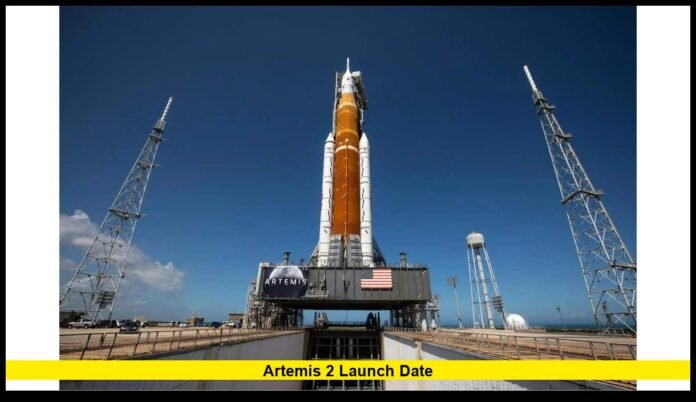

The long-awaited Artemis 2 launch date is now set for September 2025, and the excitement around NASA’s next major milestone is growing every day. This mission will send four astronauts farther from Earth than anyone has traveled in more than half a century, beginning a new era of deep-space exploration and laying the groundwork for humanity’s return to the lunar surface.
America’s Next Great Space Journey
For the first time since Apollo 17 in 1972, astronauts will leave low-Earth orbit and venture toward the Moon. Artemis II is the first crewed mission of NASA’s Artemis program—a series of ambitious missions designed to establish a lasting human presence on and around the Moon before the decade ends.
While Artemis I successfully flew around the Moon without a crew in 2022, Artemis II will be the true test. Over a 10-day journey, the mission will demonstrate that every system—life support, navigation, communication, and reentry—can operate safely with astronauts on board.
The data collected from this flight will pave the way for Artemis III, where astronauts are expected to step onto the lunar surface once again.
Meet the Four Astronauts Making History
NASA carefully selected a crew that reflects both skill and the spirit of exploration. These four astronauts will make history as they journey around the Moon together:
- Reid Wiseman – Commander
A former U.S. Navy test pilot and veteran of the International Space Station, Wiseman brings leadership and hands-on experience to the mission. - Victor Glover – Pilot
A U.S. Navy aviator and former SpaceX Crew-1 astronaut, Glover will become the first Black astronaut to travel to lunar orbit. - Christina Koch – Mission Specialist
Holding the record for the longest single spaceflight by a woman, Koch will be the first woman to orbit the Moon. - Jeremy Hansen – Mission Specialist
Representing the Canadian Space Agency, Hansen will make history as the first non-American astronaut to fly beyond low-Earth orbit.
Their teamwork, diversity, and shared commitment to exploration make them the perfect crew to carry the Artemis program’s hopes into space.
The Rocket and Spacecraft Leading the Way
The mission’s power and precision come from NASA’s Space Launch System (SLS)—a towering, 322-foot-tall rocket capable of producing 8.8 million pounds of thrust. It is currently the most powerful launch vehicle ever built, designed to carry astronauts and heavy cargo into deep space.
Riding atop the SLS will be the Orion spacecraft, built to withstand the challenges of deep-space travel. Orion’s design includes:
- Crew Module with room for four astronauts and advanced control systems.
- European Service Module, built by the European Space Agency, providing propulsion, power, and life support.
- Launch Abort System for safety, ready to pull the capsule away from danger in a fraction of a second.
Every component of Orion and the SLS has been tested to the most demanding standards. Engineers at NASA’s Kennedy Space Center in Florida continue to perform final checks before stacking the rocket for launch.
Inside the Mission Plan
Artemis II won’t land on the Moon—but it will go farther than any crewed spacecraft in modern history. The mission will follow a free-return trajectory, swinging around the Moon and using its gravity to guide Orion back toward Earth.
Key mission objectives include:
- Testing life-support systems in deep-space conditions.
- Validating communication and navigation performance over vast distances.
- Evaluating crew performance during an extended mission.
- Proving reentry and recovery systems can bring astronauts home safely at speeds over 24,000 mph.
During the mission, the crew will travel more than 230,000 miles from Earth and reach about 6,400 miles beyond the far side of the Moon. From that remote vantage point, they’ll see Earth rise over the lunar horizon—an image destined to inspire the world.
Artemis 2 Launch Date and Mission Timeline
As of January 2026, NASA continues to target September 2025 for liftoff from Launch Complex 39B at Kennedy Space Center in Florida. This date aligns with current readiness projections and hardware milestones achieved throughout 2025.
Below is a simplified mission overview:
| Phase | Description | Expected Timing |
|---|---|---|
| Final Integration | Assembly and testing of rocket and spacecraft systems | Early 2025 |
| Crew Training | Flight simulations, survival practice, and system drills | Through Summer 2025 |
| Artemis 2 Launch | Crewed mission to lunar orbit | September 2025 |
| Lunar Flyby | Crew travels around the Moon | Mission Days 4–6 |
| Earth Reentry | Orion reenters atmosphere and splashes down in the Pacific | Mission Day 10 |
NASA emphasizes that while the target date is set, the schedule depends entirely on hardware readiness and safety certification. Every system must meet flight standards before the mission proceeds.
Hardware Progress and Readiness
By early 2026, nearly all major Artemis II hardware components are complete. The SLS core stage has passed its test firings at the Stennis Space Center, while the solid rocket boosters are already being stacked in Florida.
The Orion crew module has completed vibration, acoustic, and thermal vacuum tests, confirming its ability to withstand the extreme forces of launch and deep space. Its European Service Module has finished all power and propulsion verifications.
Integration teams are now performing final “fit checks” between Orion and the SLS. These tests ensure every mechanical and electrical connection functions flawlessly when the spacecraft is fully assembled on the launch pad.
Training for Deep-Space Flight
Artemis II’s astronauts have been training for nearly two years in preparation for this demanding mission. Their schedule includes:
- Flight simulations replicating each mission stage from launch to splashdown.
- Zero-gravity training to practice movement and procedures in microgravity.
- Orion systems training using life-size mockups and high-fidelity simulators.
- Emergency egress and recovery exercises in both water and land environments.
- Team and communication drills with Mission Control in Houston.
This comprehensive training ensures the crew can handle any situation—from routine operations to unexpected challenges—during their ten-day mission.
Why Artemis II Matters for the Future
Artemis II is far more than a test flight—it’s a defining moment in human exploration. It represents the return of people to deep space, proving that long-duration travel beyond Earth’s orbit is not only possible but sustainable.
This mission will validate the systems and strategies required to make the Moon a permanent part of humanity’s future. It also sets the stage for the Artemis III mission, where astronauts are expected to land near the Moon’s south pole—an area rich in ice that could one day support life and fuel production.
Economic and Scientific Benefits
The Artemis program isn’t just about exploration; it’s also driving economic growth and innovation across the United States. NASA’s investments in Artemis II support more than 70,000 jobs nationwide and involve over 1,000 U.S. suppliers from all 50 states.
Technologies developed for deep space—like lightweight materials, advanced sensors, and radiation protection—are already influencing industries such as energy, robotics, and healthcare.
In classrooms across the country, Artemis is sparking renewed interest in science and engineering, inspiring a new generation to pursue careers in space.
A Global Collaboration with American Leadership
While NASA leads the Artemis program, it has become a truly international effort. The European Space Agency built the service module that powers Orion, and the Canadian Space Agency contributed through astronaut Jeremy Hansen’s participation.
Partnerships like these expand scientific capability and demonstrate how space exploration can unite nations toward a common goal—discovering what lies beyond.
The Road Ahead to Artemis III
After Artemis II, NASA plans to build on its success with Artemis III, the first crewed lunar landing of the program. That mission will rely on lessons learned from Artemis II’s flight data and system performance.
The agency also continues to develop the Lunar Gateway, a small space station that will orbit the Moon and serve as a staging point for future missions. This infrastructure will support long-term exploration and scientific research in lunar orbit.
With each mission, NASA is moving closer to creating a sustained presence beyond Earth—a stepping-stone to Mars and deeper into the solar system.
Looking Toward the Launch Pad
As the Artemis 2 launch date draws nearer, teams at Kennedy Space Center are conducting integrated rehearsals, verifying software, and preparing the mobile launcher for rollout. The energy and optimism surrounding this mission echo the pioneering days of Apollo, but with modern technology and a vision for sustainability.
When the countdown reaches zero, and the SLS roars to life, the sight and sound will remind the world of what human ingenuity can achieve. Four astronauts will begin a journey that connects generations—from those who watched Apollo to those who will witness the next giant leap.
NASA’s Artemis II mission marks the beginning of a bold new chapter in exploration. Share your thoughts below and join the conversation as America prepares to return to the Moon.