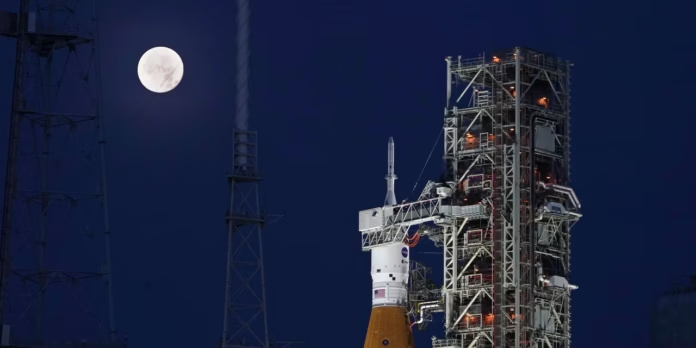

The global space community is focused on a single question: when is the Artemis 2 launch? As of today, NASA has confirmed that the first crewed mission to travel around the Moon in more than half a century is targeted for early February 2026, marking a defining moment in the return of humans to deep space and the beginning of a new era of sustained lunar exploration.
Artemis 2 will be the first time astronauts leave Earth’s orbit since 1972. Four crew members will ride aboard the Orion spacecraft, powered by the massive Space Launch System rocket, on a mission that will carry them farther from Earth than any human has ever traveled. While the flight will not include a landing, it is a critical step toward placing astronauts back on the lunar surface and ultimately preparing for human missions to Mars.
A Mission That Reopens the Deep-Space Frontier
For more than five decades, human spaceflight has remained confined to low Earth orbit, focused on the Space Shuttle and the International Space Station. Artemis 2 changes that trajectory. The mission is designed to demonstrate that modern spacecraft, navigation systems, and life-support technologies can safely carry a crew into deep space and back.
This flight follows the successful uncrewed Artemis 1 mission, which sent Orion around the Moon and returned it to Earth, validating heat shields, propulsion, and reentry systems. Artemis 2 builds directly on that achievement by adding the human element, testing how astronauts and spacecraft perform together in the deep-space environment.
Launch Timing and Window
NASA’s current planning targets an early February 2026 launch window, with the opening opportunity beginning on February 6 and extending for several days. The exact liftoff date will depend on final system readiness, weather conditions at the launch site, and precise orbital alignment with the Moon.
The timing is governed by complex celestial mechanics. The Moon’s position, Earth’s rotation, and the desired free-return trajectory all determine when the spacecraft can depart and still return safely. These windows are narrow, which is why mission planners prepare multiple backup opportunities in case technical or environmental factors require a delay.
The Space Launch System and Orion
At the heart of the mission is the Space Launch System, the most powerful rocket ever built. Standing more than 300 feet tall, it produces millions of pounds of thrust at liftoff, enough to send Orion and its crew on a direct path toward the Moon.
Orion is designed specifically for deep-space travel. It includes advanced life-support systems, radiation shielding, autonomous navigation, and a heat shield capable of withstanding reentry speeds far greater than those experienced by spacecraft returning from low Earth orbit. Artemis 2 will be the first time all of these systems operate together with a human crew on board.
Final Preparations on the Ground
In the months leading up to launch, the fully stacked rocket and spacecraft undergo a meticulous sequence of tests. After being assembled in the Vehicle Assembly Building, the integrated vehicle is transported to the launch pad, where engineers connect it to ground systems and begin final checkouts.
One of the most important milestones is the full countdown rehearsal, in which the rocket is fueled and the launch team practices every step of the timeline, from tanking operations to the final seconds before ignition. This process ensures that hardware, software, and personnel are ready to execute the mission safely and precisely.
The Artemis 2 Crew
The four astronauts selected for Artemis 2 represent a blend of experience, technical expertise, and international partnership. The commander brings years of operational leadership and previous spaceflight experience. The pilot is a highly trained test pilot and engineer, responsible for spacecraft handling and critical systems monitoring. Two mission specialists complete the crew, one of whom will become the first woman to travel beyond low Earth orbit, and another who will mark a historic first for Canada in lunar-distance exploration.
Their training has included spacecraft simulations, survival exercises, and deep-space navigation practice. Together, they will operate Orion, conduct system evaluations, and perform mission tasks that will inform procedures for future lunar landings.
The Journey Around the Moon
After launch, Orion will first enter a high Earth orbit before firing its propulsion system to begin the translunar injection burn. This maneuver will send the spacecraft on a multi-day coast toward the Moon.
As Orion approaches the lunar far side, it will pass thousands of miles above the surface, reaching a distance from Earth greater than any previous crewed mission. The spacecraft will then follow a free-return trajectory that naturally curves back toward Earth, providing an added layer of safety.
Throughout the mission, the crew will test communications systems over vast distances, monitor radiation exposure, and evaluate how the spacecraft performs in the deep-space thermal environment. These data are essential for designing longer missions and ensuring astronaut safety beyond Earth’s protective magnetosphere.
Why Artemis 2 Is a Turning Point
Artemis 2 is more than a single mission; it is a bridge between past and future. The Apollo program proved that humans could reach the Moon. The Artemis program aims to show that they can stay, return regularly, and build the infrastructure needed for long-term exploration.
The success of this mission will directly influence the schedule and design of Artemis 3, which is planned to carry astronauts to the lunar south pole. That region is of particular interest because it may contain water ice, a resource that could support life-support systems and fuel production for future missions.
Preparing for a Sustained Lunar Presence
Beyond individual flights, Artemis is structured to create a sustainable presence around the Moon. This includes plans for a lunar-orbiting outpost, advanced landers, and surface systems that can support extended stays.
Artemis 2 will validate the core transportation system for this architecture. By proving that Orion and the Space Launch System can reliably carry crews to lunar distance, NASA and its partners can proceed with confidence toward building the next elements of the exploration framework.
Engineering Challenges and Safety Culture
Developing a deep-space crew vehicle and heavy-lift rocket has required years of testing and refinement. Engineers have addressed issues related to propulsion, thermal protection, avionics, and ground systems. Each subsystem undergoes rigorous review before being cleared for flight.
Crew safety remains the top priority. Redundant systems, extensive simulations, and step-by-step verification processes are built into every phase of the mission. Artemis 2 will serve as the ultimate validation of these efforts, demonstrating that the integrated system can support human life far from Earth.
Global Impact and Public Interest
The return of humans to lunar distance carries symbolic and practical significance. It represents technological leadership, international cooperation, and a renewed spirit of exploration. For the public, it will be a moment to witness history in real time as a new generation of astronauts follows in the footsteps of the Apollo pioneers.
Educational institutions, research organizations, and industry partners around the world are watching closely, as the technologies and operational lessons from Artemis will influence fields ranging from materials science to robotics and telecommunications.
After the Mission
Once Orion completes its journey, it will reenter Earth’s atmosphere at extreme speed, deploying parachutes for an ocean splashdown. Recovery teams will secure the spacecraft and assist the crew as they return to land.
Post-flight analysis will be extensive. Engineers will study heat-shield performance, structural loads, and system behavior throughout the mission. Astronaut debriefings will provide insights into crew workload, spacecraft ergonomics, and operational procedures, all of which will feed into planning for subsequent missions.
Looking Forward
With final testing underway and the launch window approaching, anticipation continues to build. The mission will answer critical questions about how modern spacecraft and crews perform together in deep space and will set the stage for the next steps in humanity’s return to the Moon.
As preparations continue, the focus remains on precision, safety, and readiness. When the countdown reaches zero and the rocket lifts off, it will signal not just the start of a single flight, but the opening chapter of a long-term human presence beyond Earth.