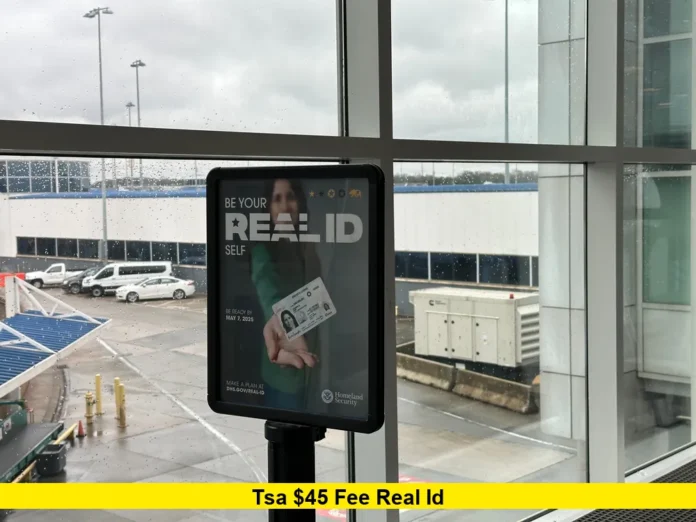

Travel through U.S. airports is entering a new phase of identity enforcement in 2026. Starting February 1, adult passengers who arrive at security checkpoints without a REAL ID–compliant license or another federally accepted form of identification will face a mandatory $45 identity verification charge. The policy, formally tied to the rollout of the tsa $45 fee real id program, marks the first time travelers will be required to pay directly for on-the-spot identity confirmation in order to proceed to screening and board a domestic flight.
The change represents a shift from warning-based compliance to a system that places financial and procedural responsibility on the traveler. It also signals the federal government’s intention to fully standardize identification for aviation security after two decades of gradual implementation under the REAL ID Act.
What the New Rule Means at the Checkpoint
Under the new procedure, every passenger aged 18 or older must present a REAL ID–compliant driver’s license, state ID, passport, or another approved credential to access the security line. Travelers who cannot do so will no longer be automatically routed to free secondary screening. Instead, they will be required to complete a paid identity confirmation process before being allowed to continue.
The $45 charge activates a secure verification system operated by the Transportation Security Administration. This process involves validating personal information through multiple federal and commercial databases and may include additional questioning and screening steps. Only after successful confirmation will a traveler be cleared to proceed.
If identity cannot be confirmed, access to the sterile area of the airport will be denied, and the passenger may be unable to travel on their scheduled flight.
Why the Fee Is Being Implemented Now
The REAL ID Act, passed in 2005, established minimum security standards for state-issued identification used for federal purposes, including boarding commercial aircraft. For years, enforcement deadlines were delayed to allow states to modernize their licensing systems and residents to upgrade their credentials.
By 2025, full REAL ID compliance became the standard for domestic air travel. However, millions of travelers continued to arrive at airports with noncompliant IDs, relying on manual identity checks that required additional staff time and security resources.
The new fee structure shifts the cost of that extra verification away from general security operations and places it directly on those who arrive without acceptable identification. Federal officials have described the policy as a way to reduce checkpoint congestion, streamline screening, and encourage nationwide adoption of standardized IDs.
How Identity Confirmation Works
When a traveler lacks proper identification, TSA officers will offer the option of paid identity confirmation. The process typically includes:
- Collection of full legal name, date of birth, and address
- Verification against secure identity databases
- Possible biometric or document cross-checks
- Additional physical screening before entering the secure area
The procedure can take significantly longer than standard document checks, particularly during peak travel hours. The $45 payment must be completed before the process begins, and proof of payment is required at the checkpoint.
Confirmation is valid for a limited time window. Travelers who fly again outside that window without compliant ID may need to repeat the process and pay the fee again.
Who Must Pay and Who Is Exempt
The rule applies to:
- All domestic air travelers aged 18 and older
- Passengers without REAL ID–compliant licenses or state IDs
- Travelers who do not carry alternative approved credentials
Children under 18 traveling with a properly identified adult generally are not required to present ID and are not subject to the fee.
Passengers who present any of the following avoid the charge entirely:
- REAL ID–compliant driver’s licenses or identification cards
- U.S. passports or passport cards
- Military and Department of Defense IDs
- Permanent resident cards
- Enhanced driver’s licenses issued by select states
- Federally approved digital or mobile identification where accepted
Payment Rules and Limitations
The identity verification charge must be paid electronically. Cash is not accepted. Approved payment methods include major credit and debit cards and certain digital payment platforms.
Travelers who cannot complete payment will not be allowed to begin the verification process and may be denied access to the security checkpoint altogether. Airlines are not required to delay flights or hold boarding for passengers delayed by identity confirmation.
How Airports Are Preparing
Airports across the United States are updating signage, public announcements, and checkpoint layouts to reflect the new policy. Document-check positions are being reinforced with additional staff trained to handle identity verification cases and payment processing.
During major travel periods such as summer holidays and winter breaks, officials expect increased wait times for travelers who arrive without compliant ID. Airlines are advising passengers to arrive earlier than usual and to confirm their identification status before departure.
Impact on Frequent Flyers and Occasional Travelers
For frequent flyers, the message is straightforward: carrying compliant identification is now essential. Even a single instance of paying the $45 fee can outweigh the cost and effort of upgrading to a REAL ID.
Occasional travelers, particularly those who rely on older licenses or have postponed updating their documents, may face unexpected expenses and delays if they arrive unprepared. Travel industry analysts note that the policy could disproportionately affect infrequent flyers, seniors, and residents of states where REAL ID adoption has lagged.
Security and Efficiency Goals
Federal security planners view the policy as a step toward more uniform and efficient screening. By reducing the number of travelers requiring manual identity resolution, TSA aims to:
- Shorten overall checkpoint wait times
- Allocate screening resources more effectively
- Strengthen confidence in the integrity of the identification process
- Reduce administrative costs associated with ad hoc verification
The program also aligns U.S. aviation security with global trends toward standardized identity systems and digital verification.
What Travelers Should Do Before Flying
To avoid delays and additional charges, travelers are advised to:
- Verify that their driver’s license or state ID displays the REAL ID star or symbol
- Carry a passport or passport card if their state ID is not compliant
- Confirm that any digital ID they plan to use is accepted at their departure airport
- Allow extra time at the airport if identity verification may be required
- Ensure access to an accepted electronic payment method
Planning ahead can prevent missed flights, additional screening, and unexpected expenses.
A New Standard for Domestic Air Travel
The introduction of paid identity confirmation marks a turning point in U.S. airport security policy. What began as a long-term effort to modernize identification standards has now reached a stage where compliance is enforced not only by regulation but by direct cost.
As enforcement tightens, the tsa $45 fee real id rule is expected to accelerate nationwide adoption of compliant identification and reshape how travelers prepare for domestic flights.