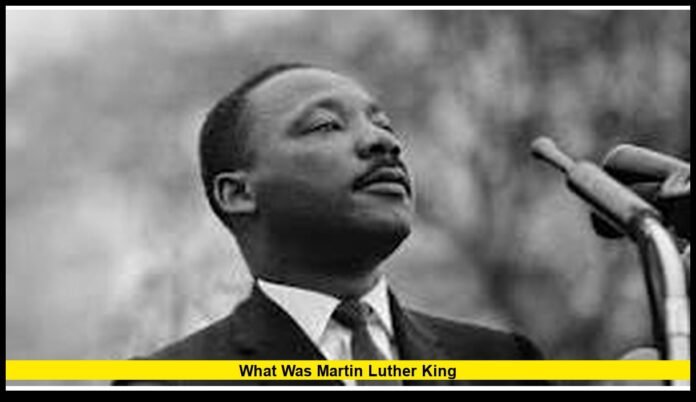

In answering the question what was martin luther king, history points to a Baptist minister who became the central moral voice of the American civil rights movement and a global symbol of nonviolent resistance to injustice.
Martin Luther King Jr. was not only a leader of protests. He was a strategist, a preacher, a Nobel Peace Prize laureate, and a man whose words and actions reshaped U.S. law, culture, and the meaning of equality under the Constitution. His influence continues to define how America understands civil rights, peaceful protest, and social change.
Early Life and Education
Martin Luther King Jr. was born on January 15, 1929, in Atlanta, Georgia. He grew up in a middle-class Black family rooted in the church. His father and grandfather were both Baptist ministers, and the pulpit shaped his worldview from an early age.
King excelled in school and entered college at just 15 years old. He later earned a degree in sociology, followed by theological training that grounded him in Christian ethics and the philosophy of nonviolence. He completed his doctoral studies in systematic theology, becoming one of the most highly educated leaders of the civil rights era.
His academic background gave him the ability to connect moral arguments with constitutional principles, a combination that would define his public life.
Rise as a Civil Rights Leader
King first rose to national prominence in the mid-1950s during the Montgomery Bus Boycott. After Rosa Parks was arrested for refusing to give up her seat on a segregated bus, Black residents of Montgomery, Alabama, organized a mass protest.
King, then a young pastor, was chosen to lead the movement. For more than a year, the Black community refused to ride city buses. The boycott ended with a Supreme Court ruling that segregation on public transportation was unconstitutional.
This victory established King as a national leader and proved that disciplined, nonviolent action could bring real legal change.
Philosophy of Nonviolence
King’s approach was rooted in Christian teachings and inspired by Mahatma Gandhi’s methods in India. He believed that nonviolent resistance could expose the moral weakness of unjust systems while preserving the dignity of both the oppressed and the oppressor.
Nonviolence, for King, was not passive. It involved organized marches, boycotts, sit-ins, and civil disobedience designed to force the nation to confront its own contradictions.
He argued that unjust laws must be challenged openly and peacefully, even if that meant arrest or imprisonment.
Major Campaigns and Achievements
Birmingham Campaign
In 1963, King helped lead demonstrations in Birmingham, Alabama, one of the most segregated cities in the country. Images of peaceful protesters attacked by police dogs and fire hoses shocked the nation.
From a jail cell in Birmingham, King wrote a letter that became one of the most important political essays in American history. He explained why waiting for gradual change was unacceptable and why direct action was necessary to achieve justice.
March on Washington
Later that year, King delivered his most famous speech during the March on Washington for Jobs and Freedom. Speaking before hundreds of thousands of people at the Lincoln Memorial, he articulated a vision of racial equality and unity that resonated around the world.
His words about judging people by the content of their character became one of the most quoted passages in American history.
Civil Rights Act and Voting Rights Act
King’s leadership helped create the political momentum that led to the passage of landmark legislation. The Civil Rights Act outlawed segregation and discrimination in public accommodations and employment. The Voting Rights Act protected the right to vote for millions of Black Americans who had been blocked by discriminatory practices.
These laws transformed the legal landscape of the United States and remain cornerstones of civil rights protections today.
Nobel Peace Prize
In 1964, King became the youngest person at the time to receive the Nobel Peace Prize. The award recognized his commitment to nonviolent struggle and his role in advancing human rights through peaceful means.
He donated the prize money to support the civil rights movement, reinforcing his belief that leadership was a form of service.
Expanding the Struggle
In the final years of his life, King broadened his focus beyond racial segregation. He spoke out against economic inequality and called for fair wages, housing, and employment opportunities for all Americans.
He also publicly opposed the Vietnam War, arguing that violence abroad and injustice at home were connected. This stance cost him political support but reflected his consistent moral philosophy.
Assassination and National Mourning
On April 4, 1968, Martin Luther King Jr. was assassinated in Memphis, Tennessee, where he had gone to support striking sanitation workers. His death sparked grief and unrest across the country.
He was 39 years old.
His assassination marked a turning point in American history, but it did not end the movement he helped build. Instead, it cemented his place as one of the most significant figures in the nation’s story.
Enduring Legacy
Today, King is honored with a national holiday, monuments, and institutions that bear his name. Schools, streets, and public buildings across the United States reflect his lasting influence.
More importantly, his ideas continue to shape debates about justice, equality, and democracy. His speeches are studied in classrooms, his writings are cited in courtrooms, and his philosophy guides activists around the world.
Understanding what was martin luther king means recognizing him as more than a historical figure. He was a moral force who challenged America to live up to its founding ideals and proved that peaceful action could change the course of a nation.
Why His Message Still Matters
King’s vision of a society built on fairness, dignity, and equal opportunity remains unfinished work. Issues of voting access, economic inequality, and racial justice continue to test the nation.
His insistence on nonviolence, dialogue, and moral clarity offers a framework for addressing conflict without losing sight of humanity.
His legacy endures not because of monuments alone, but because his words and actions still speak to the conscience of the country.
What part of Martin Luther King Jr.’s legacy do you find most powerful today? Share your thoughts and stay connected for more historical insights.