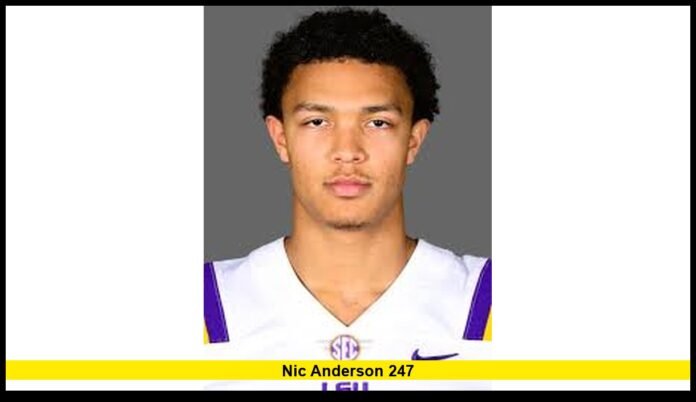

The college football world continues to track nic anderson 247 as one of the most discussed wide receiver stories in the SEC, shaped by early promise, major transfer portal movement, injury battles, and a season that did not unfold as many expected. From his record-setting start at Oklahoma to his highly anticipated arrival at LSU, Anderson’s career has followed a path filled with both excitement and challenges that have kept fans and analysts closely watching every development.
As of today, all confirmed information shows that Anderson remains one of the most physically gifted receivers in the conference, but his 2025 season with LSU has been defined more by limited availability and inconsistent production than by the breakout many predicted. His story highlights the growing complexity of modern college football, where talent, health, system fit, and opportunity must align for success.
From Texas Standout to Oklahoma Star
Nic Anderson emerged as a top prospect out of Katy, Texas, where his size, speed, and body control made him a dominant high school wide receiver. Standing 6-foot-4 with a strong frame and long reach, he quickly drew attention from major college programs and ultimately committed to Oklahoma.
His freshman season in 2023 placed him on the national radar. Anderson became one of the most productive first-year receivers in school history, setting a freshman touchdown record and establishing himself as a red-zone weapon with a rare combination of height and leaping ability. His performances that year positioned him as a future star in the Big 12 and one of the most promising young receivers in the country.
Injuries and a Turning Point
After that explosive freshman campaign, Anderson’s momentum slowed due to injuries that limited his availability and rhythm. While he continued to be viewed as a high-upside player, his on-field opportunities became more sporadic, and consistency became harder to maintain.
Following the 2024 season, Anderson entered the NCAA transfer portal. The decision immediately generated national attention. Programs across the SEC and beyond showed interest, recognizing the potential impact of a receiver with his physical tools and proven scoring ability.
A Major Transfer to LSU
LSU secured Anderson as one of its most notable transfer portal additions for the 2025 season. The move was widely seen as a significant win for the Tigers, who were looking to reload their receiving corps with experienced, high-ceiling talent.
The expectations were clear. Anderson was projected to compete for a starting role, stretch the field, and provide a reliable target in the red zone. His size and previous production suggested he could become a key piece in LSU’s offensive system, especially in an SEC environment that values physical mismatches on the perimeter.
The 2025 Season: Hype vs. Reality
When the 2025 season unfolded, Anderson’s role did not develop as many had forecast. While he appeared in games and contributed in select moments, his overall production remained modest compared to preseason projections.
Statistically, he finished the season with a limited number of receptions, just over one hundred receiving yards, and a small number of touchdowns. These numbers reflected a rotational role rather than that of a primary target. Injuries once again played a part, affecting his ability to gain consistent snaps and fully integrate into the offensive rhythm.
The SEC’s depth at wide receiver, combined with LSU’s competitive roster, meant opportunities had to be earned week by week. Anderson showed flashes of his ability, particularly in contested-catch situations, but sustained momentum proved elusive.
Evaluations and Season Context
Across the college football landscape, analysts assessed the 2025 transfer class with a focus on expectations versus production. In that context, Anderson was often cited as an example of how even highly ranked portal additions can face challenges in translating past success to a new environment.
This evaluation did not diminish his talent, but it underscored the realities of adapting to a different playbook, quarterback chemistry, and game-to-game roles. The transition from being a focal point at one program to competing for targets at another can be complex, especially in a conference as demanding as the SEC.
Health and Development Remain Central
The central theme of Anderson’s career progression continues to be health and continuity. When fully available, his size-speed combination makes him a difficult matchup for defensive backs. Coaches and teammates have consistently pointed to his work ethic and physical tools as reasons for optimism.
Spring practices and offseason conditioning have become crucial phases for him, offering opportunities to regain timing, build chemistry, and carve out a clearer role in the offense. For a player who once set freshman records, the focus now is on translating potential into sustained performance.
What His Journey Says About Modern College Football
Anderson’s story also reflects the broader landscape of college football in the transfer portal era. Movement between programs is more common than ever, and with it comes heightened expectations for immediate impact.
Programs like LSU rely on transfers to fill gaps quickly, while players seek environments that maximize their development and visibility. The process can be rewarding, but it also carries risk, as system fit and health play decisive roles in determining outcomes.
Looking Ahead
As the next season approaches, attention will remain on how Anderson’s role evolves. Whether he emerges as a more consistent contributor or continues in a rotational capacity will depend on offseason progress, competition within the receiver room, and his ability to stay healthy.
What remains clear is that his career is far from defined by a single season. With his physical profile and past production, Anderson still possesses the tools that once made him one of the most talked-about young receivers in college football.
Fans across the SEC and beyond will be watching closely to see how the next chapter of nic anderson 247 unfolds—join the conversation and stay tuned for what comes next.