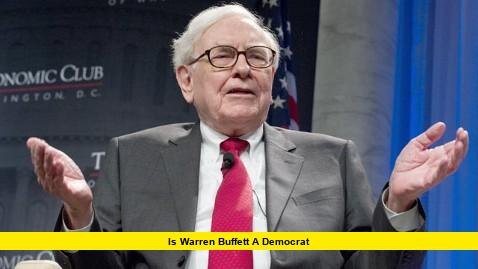

For decades, Warren Buffett has shaped the global financial conversation as the leader of Berkshire Hathaway and as one of the most respected voices in American capitalism. Beyond stock markets and corporate strategy, his opinions on public policy and elections have also drawn sustained attention. A question that continues to appear in political searches and public debate is: is warren buffett a democrat?
Understanding his political identity requires looking at his own words, his voting history, his policy positions, and how he has chosen to participate in the political process over time.
A Personal Philosophy Rooted in Economic Fairness
Buffett has long described his political outlook through the lens of economic balance and social stability rather than strict party loyalty. He often frames issues in practical terms: what policies strengthen the middle class, protect long-term growth, and ensure that prosperity is broadly shared.
On these core principles, his views consistently align with center-left economic thinking. He has argued that a healthy economy depends on a strong middle class, access to opportunity, and a tax system that does not place disproportionate burdens on working families while allowing the wealthiest Americans to pay comparatively little.
This values-based approach places him closer to Democratic economic philosophy than to modern conservative platforms.
Public Identification With Democratic Values
At different points in his public life, Buffett has openly said that he considers himself aligned with the Democratic Party in terms of policy direction. He has emphasized that this alignment is driven not by ideology alone, but by practical outcomes: fiscal responsibility, social mobility, and long-term national stability.
Rather than presenting himself as a partisan figure, he has positioned his political identity as issue-driven. When Democratic candidates and platforms reflected his views on taxation, healthcare access, education, and economic opportunity, he supported them.
Support for Democratic Presidential Candidates
Buffett’s political alignment became especially visible during major election cycles in which economic policy dominated national debate. He publicly supported Democratic presidential nominees, participated in campaign events, and contributed financially as a private citizen.
His backing of Democratic leadership during periods of economic uncertainty reinforced the perception that his political outlook leaned toward the party’s approach to regulation, fiscal policy, and social investment.
While he has never sought political office and does not engage in day-to-day partisan activism, his willingness to stand with Democratic candidates during pivotal elections made his orientation clear to the public.
Voting Behavior and Civic Participation
Although Buffett values privacy in personal matters, he has acknowledged voting for Democratic candidates in presidential elections when their policies aligned with his views. He has consistently framed voting as a civic responsibility rather than a public performance.
In more recent election cycles, he has chosen not to announce his vote or endorse any candidate publicly. This shift reflects a desire to avoid contributing to political polarization and to prevent his name from being used in misleading or unauthorized political messaging.
Importantly, this restraint does not signal a reversal of his beliefs. It reflects a strategic decision to separate personal convictions from public campaigning in an era of intense media amplification.
The Tax Debate That Defined His Political Image
One of the most influential aspects of Buffett’s political voice has been his advocacy for progressive taxation. He has repeatedly pointed out that, through capital gains treatment and other structural features of the tax code, some of the wealthiest Americans can face lower effective tax rates than their employees.
His call for reform helped bring national attention to income inequality and tax fairness. The principle he advanced was simple: those who benefit most from the economic system should contribute proportionately to maintaining it.
This stance mirrors long-standing Democratic policy goals, including:
- A more progressive tax structure
- Closing loopholes that disproportionately benefit high earners
- Using tax policy to support public investment and social mobility
Through these arguments, he became one of the most prominent business leaders publicly aligned with center-left fiscal policy.
Commitment to the Middle Class
Buffett often speaks about the middle class as the foundation of American economic strength. He has warned that long-term growth depends on consumers having stable incomes, access to healthcare, and confidence in their financial future.
These views align with policy priorities commonly emphasized by Democratic leaders, such as:
- Expanding access to affordable healthcare
- Supporting education and workforce development
- Protecting retirement security
- Encouraging wage growth and job stability
His focus on broad-based prosperity, rather than solely on corporate or shareholder gains, reinforces his reputation as a capitalist who supports a socially balanced economic model.
Corporate Neutrality and Political Boundaries
While Buffett holds personal political views, he has drawn a clear line between his role as a private citizen and his responsibilities as a corporate leader. Berkshire Hathaway does not endorse political candidates, fund campaigns as a company, or base investment decisions on party affiliation.
He has repeatedly stated that businesses should not become instruments of partisan politics. This separation protects shareholders, employees, and customers from being associated with any single political ideology and maintains the firm’s reputation for independence and stability.
Why He Avoids Modern Endorsement Culture
In recent years, Buffett has intentionally stepped away from public political endorsements. Several factors have influenced this choice:
- The rise of misinformation and fabricated statements online
- The increasing polarization of political discourse
- A desire to prevent his reputation from being used to sway voters through celebrity influence rather than policy debate
By remaining publicly neutral during recent election cycles, he has sought to preserve the integrity of his voice and reduce the risk of misrepresentation.
How Analysts Describe His Political Position
Political observers and economists often characterize Buffett as a pragmatic centrist with a center-left economic outlook. He supports market capitalism, private enterprise, and entrepreneurship, but also believes in:
- Sensible regulation
- A fair tax system
- Public investment in infrastructure and education
- Social policies that promote long-term economic stability
This blend of free-market confidence and social responsibility places him comfortably within the ideological space traditionally occupied by moderate Democrats.
A Long-Term Perspective on Governance
One defining feature of Buffett’s political thinking is his long-term horizon. Just as he evaluates businesses over decades rather than quarters, he views public policy through its impact on future generations.
He has argued that:
- Sustainable growth requires fiscal discipline and social cohesion
- Inequality, if left unchecked, can undermine economic and political stability
- Government has a role in creating conditions where opportunity is widely accessible
These beliefs echo the policy frameworks of leaders who prioritize inclusive growth and institutional resilience.
What His Stance Means for Public Debate
Because of his credibility in finance and his reputation for plainspoken analysis, Buffett’s political views carry unusual weight. When he speaks about taxation, healthcare costs, or economic inequality, he does so not as an academic theorist but as someone who has spent a lifetime operating within the system he critiques.
This combination of insider experience and reform-oriented thinking has made him a unique figure in American political discourse: a billionaire who supports policies aimed at reducing structural advantage at the very top.
So Where Does He Stand Today?
Looking at his statements, actions, and policy positions over time, the conclusion remains consistent. He has identified with Democratic values, supported Democratic candidates in key elections, and advocated for reforms central to the party’s economic agenda.
At the same time, he avoids rigid labels, declines to engage in modern campaign theatrics, and insists on keeping corporate America separate from partisan politics. His approach reflects independence of thought within a broadly Democratic-aligned framework.
When the question arises again in public discussion — is warren buffett a democrat — the factual record shows that his political philosophy, voting behavior, and policy advocacy place him firmly on the Democratic side of the American political spectrum, even as he maintains a personal style defined by moderation, pragmatism, and long-term perspective.