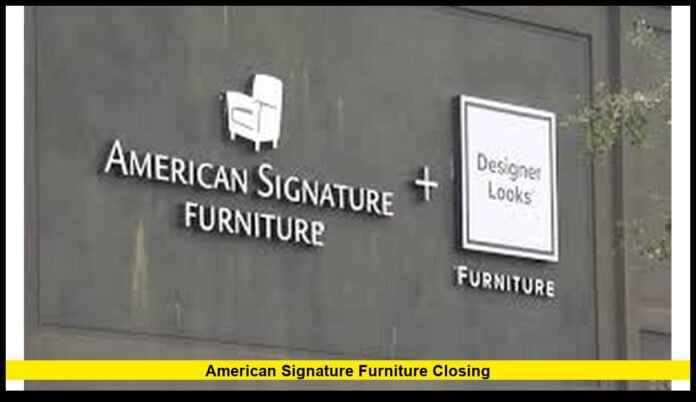

The american signature furniture closing has officially entered its final phase in early 2026, marking the end of one of the most recognized mid-market home furnishings retailers in the United States. After decades of serving American households with living room, bedroom, dining, and mattress collections, the company is now moving through full liquidation following its Chapter 11 bankruptcy filing and the failure to secure a buyer.
What began as a restructuring effort in late 2025 has now turned into a nationwide shutdown. Stores operating under both the American Signature Furniture and Value City Furniture banners are holding going-out-of-business sales as inventory is cleared and operations wind down permanently.
This development represents one of the most significant furniture retail closures in recent years and reflects deeper shifts taking place across the U.S. retail and housing markets.
The Current Status of the American Signature Furniture Closing
As of January 2026, all remaining American Signature and Value City Furniture locations are operating under liquidation status. Storewide clearance sales are underway, offering steep discounts on:
- Sofas and sectionals
- Bedroom sets and mattresses
- Dining tables and chairs
- Home office furniture
- Rugs, lighting, and décor
Discounts in many locations range from 25% to 50% or more, depending on inventory levels and remaining stock. Merchandise is being sold on a first-come, first-served basis, and most locations are advertising final sale policies.
The company originally entered bankruptcy with the goal of reorganizing and selling the business as a going concern. However, after the auction process failed to attract a buyer willing to take over operations, management and the bankruptcy court approved full liquidation.
With that decision, the path toward permanent closure became inevitable.
How the Company Reached This Point
American Signature began as a family-owned business in Ohio in the late 1940s and grew into a multi-state furniture retailer with a strong presence across the Midwest, Mid-Atlantic, and Southern regions.
For years, the company thrived by offering affordable, mid-priced furniture in large showroom-style stores. However, several forces gradually weakened the business:
- Slowing home sales reduced demand for large furniture purchases
- Online furniture retailers gained market share
- Rising logistics, labor, and operating costs squeezed margins
- Consumer spending shifted toward experiences and smaller, faster-delivered items
- Competition intensified from both discount chains and premium brands
By 2025, these pressures became too heavy to overcome. The bankruptcy filing in November was intended to stabilize the business, renegotiate debt, and explore a sale. When no viable buyer emerged, liquidation became the only remaining option.
Store Closures Across the United States
The american signature furniture closing impacts dozens of communities across multiple states. Locations that once served as anchor tenants in shopping centers and malls are now preparing to shut their doors.
Affected regions include:
- Midwest states such as Ohio, Michigan, Indiana, Illinois, and Missouri
- East Coast markets including Pennsylvania, New Jersey, Maryland, and Virginia
- Southern states such as Florida, North Carolina, and South Carolina
In many of these areas, the stores were long-standing fixtures that customers relied on for complete home furnishing solutions. Their departure leaves large retail spaces vacant and creates uncertainty for surrounding businesses that benefited from shared foot traffic.
What Shoppers Should Know
Customers visiting liquidation stores should keep several key points in mind:
Final Sale Policies
Most items are sold as-is, with limited or no return options. Once merchandise leaves the store, it generally cannot be exchanged or refunded.
Gift Cards and Store Credit
Many locations no longer accept gift cards or store credits due to bankruptcy restrictions.
Delivery and Installation
Delivery services may be limited, and previously scheduled orders may face delays or cancellation depending on store closure timing.
Warranty Coverage
Manufacturer warranties may still apply, but store-backed service plans can be affected. Shoppers are encouraged to confirm terms before purchase.
While liquidation offers attractive pricing, it also requires buyers to act quickly and make informed decisions.
What This Means for Employees
The closure affects thousands of jobs in stores, warehouses, corporate offices, and manufacturing facilities. Retail staff, logistics workers, delivery teams, and corporate employees are facing layoffs as operations wind down.
Some job-impact highlights include:
- Store closures nationwide affecting staff at all remaining locations
- The planned shutdown of the corporate headquarters in Columbus, Ohio
- The wind-down or closure of manufacturing and distribution operations tied to the company
- The elimination of long-held positions across sales, management, merchandising, marketing, finance, and supply chain departments
For many workers, this marks the end of long careers with a company that once offered stability and growth. Some employees have served customers for decades, building relationships within their communities and helping families furnish homes across generations.
Short-term liquidation staffing may provide temporary work, but most positions will disappear once stores complete their final sales and close.
Industry Context: Why This Closure Matters
The american signature furniture closing is part of a broader shift reshaping the U.S. furniture and big-box retail landscape.
Several forces are converging:
- E-commerce dominance: More consumers now shop for furniture online, drawn by virtual showrooms, fast shipping, and direct-to-consumer pricing.
- Housing market slowdown: Higher interest rates and fewer home sales reduce demand for full home furnishing purchases.
- Cost inflation: Transportation, warehousing, materials, and labor costs have risen sharply, pressuring traditional store-based business models.
- Changing consumer behavior: Shoppers increasingly favor flexible, modular, and smaller-scale furnishings that suit apartments, remote work, and mobile lifestyles.
Mid-market furniture chains, which rely heavily on large physical showrooms, face particular challenges in adapting to these trends. Without strong digital platforms and lean cost structures, profitability becomes difficult to sustain.
For communities that relied on these stores for furniture needs and local jobs, the closures leave a noticeable gap. Shopping centers and malls may experience reduced traffic, and large retail spaces may remain vacant while landlords search for new tenants.
Community and Economic Impact
Beyond individual shoppers and employees, the american signature furniture closing carries significant implications for local economies and the broader retail landscape in communities across the United States.
One of the most immediate effects is the loss of retail tax revenue for municipal and county governments. Furniture stores typically generate substantial sales tax income, especially during peak shopping seasons. With these stores closing and going-out-of-business sales winding down, local budget projections for 2026 are expected to be negatively impacted. This can affect funding for public services such as parks, libraries, schools, and infrastructure projects that rely on consumer-driven revenue streams.
Closures also lead to reduced foot traffic for nearby restaurants, cafes, salons, and small businesses. Many suburban shopping centers and retail corridors benefited from the presence of large anchor tenants like American Signature Furniture and Value City locations. These stores helped attract consistent customer flow, which in turn supported surrounding businesses. Now, with reduced traffic, some smaller merchants may struggle to maintain sales volume, potentially triggering their own workforce cuts or reduced hours.
Another growing concern is the emergence of vacant commercial properties. Furniture showrooms are typically large spaces, and landlords will now face the challenge of filling these big-box footprints. Repurposing such properties often requires significant renovation investment, new zoning considerations, or reconfiguration for multiple tenants. In many markets, commercial real estate experts anticipate that these spaces may lie empty for months or even years before finding new occupants, potentially dragging down local property values in the interim.
At the employment level, the closures contribute to increased competition for retail and logistics jobs in affected regions. Workers displaced by these shutdowns—including retail associates, delivery drivers, warehouse personnel, and management staff—are now entering already competitive job markets. While some sectors such as e-commerce fulfillment and home delivery services are hiring, many of these roles differ in pay structure, hours, and required skill sets compared with traditional retail positions.
In suburban and mid-sized cities, American Signature and Value City were often among the largest home-furnishings destinations, serving as key shopping hubs for furniture needs. Their absence reshapes local retail patterns and forces consumers to adapt. Many shoppers will shift their purchases online or travel to distant big-box stores and national chains that still operate. This transition may benefit e-commerce platforms and larger competitors, but it also weakens the retail diversity within smaller communities that once counted on mid-market furniture options close to home.
The broader impact reaches beyond retail. Reductions in consumer spending at local levels can ripple through service providers such as movers, interior designers, upholsterers, and small manufacturers who previously relied on referrals or business from furniture buyers.
In some areas, community leaders have begun exploring redevelopment strategies for former store sites, including:
- Converting large showroom spaces into mixed-use developments
- Attracting discount retailers or specialty outlets
- Reimagining properties for recreational or community-oriented use
While such efforts can reinvigorate local districts over time, they require planning, investment, and partnerships between governments, developers, and community stakeholders.
The american signature furniture closing is thus much more than a corporate wind-down. It is reshaping the economic fabric of towns and cities, altering employment landscapes, shifting consumer behavior, and testing the resilience of local retail ecosystems across the country. As communities adapt, the long-term effects will continue to unfold through 2026 and beyond.
Timeline of the Shutdown
The sequence of events leading to the american signature furniture closing unfolded quickly, showing how fast a major retail operation can move from restructuring efforts to complete liquidation when financial pressures and market realities collide.
In late 2025, the company filed for Chapter 11 bankruptcy protection in an effort to stabilize operations, restructure debt, and explore strategic alternatives, including a potential sale of the business as a going concern. Management initially expressed hope that a buyer could step in and preserve at least part of the store network and workforce.
By December 2025, the first signs of contraction became visible. Underperforming locations in several states were closed, inventory levels were reduced, and internal cost-cutting measures intensified. Employees in both stores and corporate offices began receiving notices about potential layoffs as the company prepared for multiple possible outcomes.
In early January 2026, the court-supervised sale process concluded without producing a qualified buyer willing to acquire the business and continue operations. This marked a turning point. With no acquisition agreement in place, the company and its creditors shifted focus from reorganization to asset liquidation.
By mid-January 2026, the bankruptcy court approved a full liquidation plan, authorizing going-out-of-business sales at all remaining American Signature Furniture and Value City Furniture locations. Large-scale clearance events began rolling out nationwide, with discounts increasing as inventory levels dropped and store closing dates approached.
Through winter and into spring 2026, liquidation sales are expected to continue in phases, with merchandise being cleared, store fixtures sold, and distribution operations wound down. As individual locations sell through their remaining stock, they will close permanently, one market at a time.
By the end of 2026, all remaining stores, warehouses, and corporate offices are expected to be fully shuttered, completing the wind-down of a retail chain that operated for nearly eight decades.
This rapid progression—from bankruptcy filing to full shutdown in a matter of weeks—highlights how fragile traditional retail models have become in the face of changing consumer behavior, higher operating costs, and limited investor appetite. It also illustrates how quickly restructuring efforts can give way to liquidation when buyer interest fails to materialize and market conditions leave little room for recovery.
Frequently Asked Questions
Q1: Are all American Signature Furniture and Value City Furniture stores closing?
Yes. All remaining locations are scheduled for permanent closure as part of the liquidation process.
Q2: Can customers still place new orders?
Orders may be accepted only while inventory is available, and fulfillment terms vary by location.
Q3: Will warranties still be valid after the stores close?
Some manufacturer warranties may continue, but store-provided service plans may be limited or discontinued.
The american signature furniture closing marks the end of a long chapter in U.S. retail history. For decades, the brand helped furnish living rooms, bedrooms, and dining spaces across the country. Now, as liquidation sales clear out the last remaining inventory, communities, customers, and employees are witnessing the final transition of a once-dominant furniture chain.
Disclaimer
This article is for informational and news purposes only. All details are based on publicly available information as of the date of publication and may change. The content does not constitute legal, financial, or commercial advice, and readers should verify specific store policies, warranties, and transactions directly with the relevant parties.