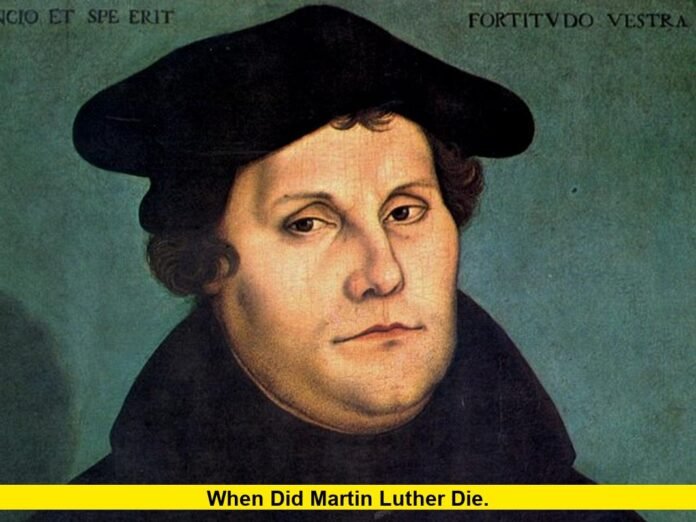

The question when did Martin Luther die continues to attract global interest because it marks the conclusion of a life that reshaped Christianity, politics, education, and cultural identity across continents. Martin Luther died on February 18, 1546, in Eisleben, the German town where his life had begun more than six decades earlier. His death closed a pivotal chapter in European history, but it did not slow the momentum of the movement he helped ignite.
Luther’s passing came at a moment when religious reform was no longer a fringe idea but a permanent force reshaping nations. Understanding the circumstances of his death provides insight into why his legacy remained powerful long after his final breath.
Martin Luther’s Condition in His Final Years
By the mid-1540s, Martin Luther’s health had deteriorated significantly. Years of relentless writing, teaching, preaching, and travel had taken a heavy toll. He suffered from recurring physical ailments that limited his strength but not his determination.
Despite ongoing health struggles, Luther remained deeply engaged in religious and civic matters. He continued advising political leaders, guiding church organization, and responding to theological debates. His mind remained active even as his body weakened.
In early 1546, Luther made a demanding winter journey from Wittenberg to Eisleben to mediate a dispute among regional leaders. The mission reflected his lifelong commitment to resolving conflict and strengthening social order, even when personal health risks were high.
The Final Days in Eisleben
Eisleben holds unique importance in Luther’s story. It was the town of his birth and the place where his life came full circle. During his stay there in February 1546, his condition worsened rapidly.
Witness accounts describe Luther experiencing severe physical distress in the days leading up to his death. Still, he remained mentally alert and engaged in conversation. Those present recalled his calm demeanor and unwavering confidence in his faith.
On the early morning of February 18, 1546, Martin Luther died peacefully at the age of 62. He was surrounded by trusted companions who later recorded his final moments as composed and resolute.
Where Martin Luther Was Buried
After his death, Luther’s body was transported to Wittenberg, the city most closely associated with his work. He was laid to rest inside the Castle Church, a location deeply symbolic of his role in religious reform.
The burial site reflected the significance of his contributions. Wittenberg had been the center of his academic career and the stage for events that challenged religious authority across Europe. His resting place became a focal point for reflection, study, and remembrance.
Religious Europe at the Moment of His Death
To fully grasp the importance of Luther’s death, it is essential to understand the religious environment of Europe in 1546. By that time, the Protestant Reformation had permanently altered the structure of Christianity.
Entire regions had adopted Lutheran beliefs. Churches had been reorganized, religious practices transformed, and political alliances reshaped. Religious identity had become deeply intertwined with governance, law, and education.
Luther’s teachings were no longer dependent on his personal leadership. His ideas had been codified, taught, and defended by institutions that ensured their survival beyond his lifetime.
The Theological Legacy Luther Left Behind
At the heart of Luther’s influence were principles that challenged long-standing traditions. He emphasized salvation through faith alone, the authority of scripture, and direct access to God without institutional intermediaries.
These beliefs altered how individuals understood their relationship with religion. Personal conscience gained importance. Scripture became accessible to everyday people. Worship shifted from ritual to understanding.
By the time of his death, these theological foundations had been firmly established and widely adopted across Protestant communities.
Cultural and Educational Impact
Martin Luther’s influence extended far beyond church walls. His commitment to education reshaped learning across Europe. He advocated for schools that taught reading so people could engage directly with religious texts.
His translation of the Bible into the German language had lasting effects on literacy and communication. It helped standardize the language and made religious ideas accessible to a broader population.
Music, literature, and public discourse were also shaped by his work. Hymns attributed to Luther became part of religious life, reinforcing shared identity and belief.
Immediate Reaction to Luther’s Death
News of Luther’s death spread quickly across Europe. Supporters mourned the loss of a leader who had articulated their deepest convictions. Many viewed his death as the end of an extraordinary era.
At the same time, the Reformation did not falter. Churches continued to grow. Leaders trained under Luther stepped into prominent roles. The movement transitioned from charismatic leadership to institutional strength.
Opponents recognized that Luther’s death did not reverse the changes already underway. The religious transformation he helped initiate had become irreversible.
How Leadership Evolved After 1546
Without Luther’s direct guidance, Protestant leadership became more structured. Theologians and educators refined doctrine, clarified teachings, and established formal systems of governance.
This period saw increased cooperation between church leaders and political authorities. Religious belief became a defining feature of regional identity, shaping laws and social norms.
The absence of Luther encouraged diversification within Protestantism, leading to the emergence of additional reform traditions while preserving core principles he had established.
Why the Date of His Death Remains Important
The question when did Martin Luther die matters because it marks a turning point from individual leadership to enduring influence. His death symbolized the moment when the Reformation no longer depended on one voice.
For historians, February 18, 1546, represents the conclusion of Luther’s personal journey and the beginning of a new phase in religious history. His teachings continued to spread, evolve, and influence societies far beyond Germany.
This date is often referenced in academic study, religious education, and cultural remembrance because it anchors Luther’s life within a clearly defined historical framework.
Separating Facts From Legend
Over time, stories surrounding Luther’s death have been exaggerated or misrepresented. Verified historical records consistently describe a natural death following illness, not a dramatic or suspicious event.
Understanding the factual account preserves historical integrity and prevents distortion of his legacy. Luther’s life was marked by bold action and public confrontation, but his death was calm and grounded in faith.
Enduring Influence in the Modern World
More than four centuries after his death, Martin Luther’s influence remains visible. Protestant denominations trace their roots to the principles he championed. Concepts of religious freedom and individual conscience reflect his ideas.
In the United States, many religious traditions, educational values, and civic principles carry indirect influence from the Reformation. Luther’s emphasis on personal responsibility and moral conviction resonates in modern discourse.
His death in 1546 did not diminish his presence in history. Instead, it solidified his role as a transformative figure whose ideas outlived him.
Why Luther’s Story Continues to Matter
Martin Luther’s life demonstrates how individual conviction can reshape institutions and societies. His death reminds us that ideas, once set in motion, can outlast their originators.
Understanding his final chapter helps contextualize his achievements and highlights the enduring power of belief-driven change.
Which part of Martin Luther’s legacy do you think has had the greatest impact on the modern world? Share your perspective and stay engaged for more historical insights.